
This story was originally published by WOUB and is republished here with permission.
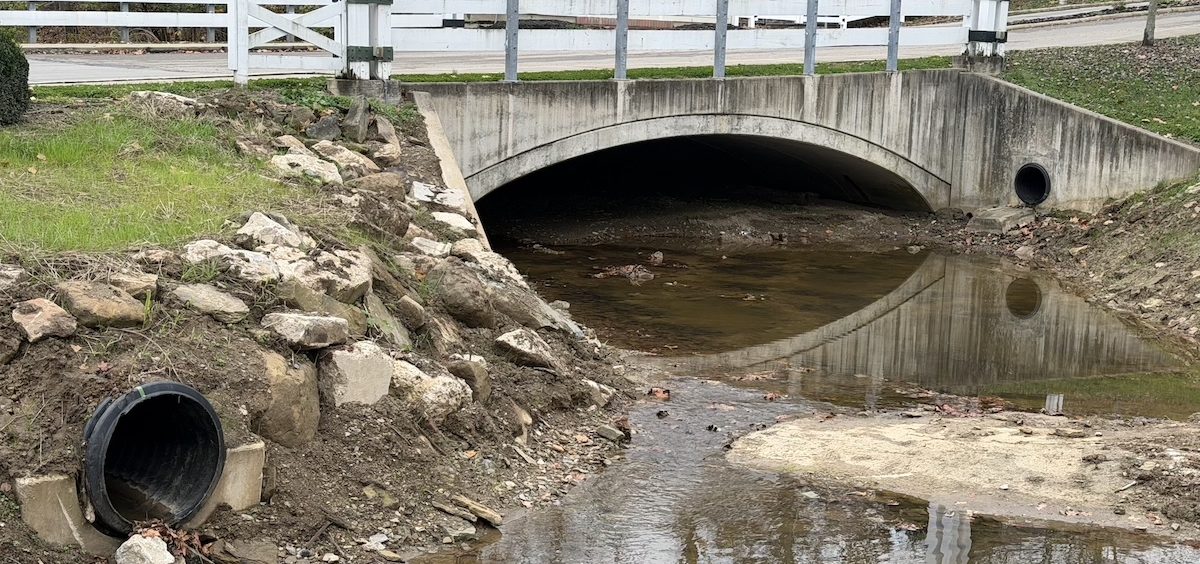
ATHENS, Ohio (WOUB) — During the unusually heavy rains this summer, videos popped up on social media showing water gushing out of storm drains in Athens.
This was presented by frustrated residents as evidence the city is failing to properly maintain the storm drainage system, leading to blocked lines and flooded roads, homes and businesses.
There’s no question water should be flowing into storm drains, not out. But the cause has less to do with blockages than a very old network of pipes that is simply overwhelmed by the increasing intensity of storms.
In other words, the system wasn’t built to handle so much rainfall in such a short period of time.
But upgrading the system with bigger pipes, which would be tremendously expensive and disruptive, probably wouldn’t solve the problem.
This is because all that rainfall has to drain somewhere, usually a creek or river. At some point during these intense storms, those waterways may not be able to absorb the water as fast as it’s being delivered.
The answer, according to experts, is not to move more water faster. Instead, some of that rainfall should be captured in surface or underground reservoirs and slowly released into the storm drain system.
To understand why, a good place to start is with the formation of the Appalachian mountain range and the millions of years of erosion that followed, sculpting the mountains into what we see today.
This left the Ohio side of the Appalachian range with lots and lots of creeks. Some of them may be dry much of the time so people might not even realize how close they are living to one.
But the point is when rainfall blankets the hills that define the topography of southeast Ohio, the water doesn’t have far to go before it reaches a creek.

Much of southeast Ohio is forested, and these forests act like a sponge, soaking up a lot of the rainfall. So, during a typical storm, the creeks may not get much water, or at least not enough to cause a problem.
But lately, the region is seeing more storms that are not typical. Warmer temperatures are sending more moisture in the atmosphere, causing more intense storms that deliver a lot of rainfall in a short period of time.
That was the case this summer.
“We’re seeing conditions that are setting up much more moisture, much, much more intense bursts of rain on repeat where you have a week or more of multiple days of intense rain that saturates the ground and leaves nowhere for that water to go but to overwhelming these (creeks),” said Natalie Kruse Daniels.
She is director of the environmental studies program in the Voinovich School of Leadership and Public Service at Ohio University. Her research is focused in part on developing more resilient infrastructure to address a changing climate, which in southeast Ohio includes more intense rainfall.
Because so many homes and businesses in southeast Ohio are close to creeks, the string of summer storms brought heavy flooding to communities that hadn’t seen anything like this, at least not in recent memory. It was not usual to hear longtime residents say they might have seen a little flooding before, but nothing like this.
The more intense rainfall is also overwhelming storm drain systems. These systems are typically designed for a two to five-year storm. This means they are designed to handle a big storm that comes around once every two years or every five years based on historical data.
“And then if you have a storm event that’s bigger than that, then there’s a period of time where it can’t handle all the water,” said Andy Stone, the service-safety director for Athens. “In recent years, the frequency of those very intense storm events have been getting closer together. … And so that data that we’ve historically used to have those design standards is not as valid anymore.”
Bigger pipes may not solve the problem
All this water rushing into the drainage system can pressurize the pipes, leading to a blowout at an opening down the line as that intense pressure releases, Kruse Daniels said. This is why water ends up gushing out of some storm drains.
One solution is to upsize the drain pipes so they can handle more water. Stone noted the city of Athens has installed larger pipes as it’s torn up and rebuilt some of the bigger streets, including portions of East State, West Union, Richland and Stimson.
But upsizing the network of smaller pipes running through the city’s neighborhoods is not an option, Stone said.
“Number one, it’s not financially doable,” he said. “Number two, the disruption would be massive.”
And bigger pipes may not solve the problem anyway.
“All that’s doing is shedding the water out of our developed area more quickly and getting it downstream more quickly,” Kruse Daniels said. “And so it doesn’t ameliorate the issue. It just sends it downstream.”
Kruse Daniels pointed to South Richland Avenue in Athens. The street is flanked by hills and has a history of flooding during heavy rains. Flooding this summer sent water spilling into Purple Chopstix restaurant, forcing it to close for repairs.
The storm drains along Richland drain into Coates Run, a creek that runs parallel to the street. The steep hill on the west side of Richland also drains into the creek.
“And so let’s say that you magically increase your capacity of the storm drains on South Richland — bigger inlets, bigger pipes, blah, blah, blah. If those are still draining into Coates Run, you’re actually going to exacerbate flash flooding at Purple Chopstix, because now you’re getting the water from South Richland into Coates Run more quickly, right?” Kruse Daniels said. “And so I think that’s the thing, is like once you put something in a pipe, it’s going to go quicker than it will overland.”

The solution to dealing with more intense rainfall is not to try and move more water through the storm drain system but instead to regulate the flow of water into the pipes, according to Kruse Daniels and others who study the issue.
One way to do this is to essentially recreate some of what was lost with the development of modern communities. It used to be that when creeks and rivers overflowed, that water spread into the floodplains, the lower-lying flat ground. Some of that water would soak into the soil, some of it would evaporate and some of it would flow back into the waterways as their levels receded.
Modern developments filled the floodplains with homes and businesses and lots of impervious surfaces, like concrete and asphalt, that allow the surface water to move faster and also prevent it from seeping into the ground. Storm drains and other flood-control measures were meant to divert or capture this runoff and send it back to the creeks and rivers.
Communities turn to nature-based solutions
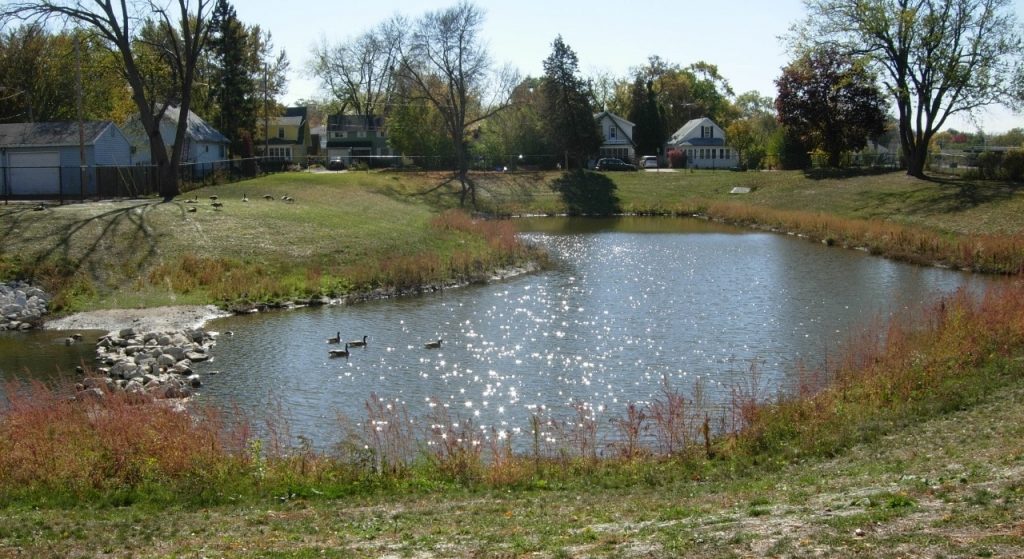
Some communities are now using retention and detention systems to capture some of the surface water and then gradually release it into the storm drain system so it doesn’t become overwhelmed.
Retention involves some kind of surface basin, like a pond, to spread the water out and slow it down. This operates much like a floodplain, with some of the water seeping into the ground, some of it evaporating, and some of it flowing into the storm drain system as the basin overflows.
While retention basins are designed to maintain a certain level of water year round, a detention system is intended to temporarily store water and then drain it out. It could be some kind of surface basin, or it could be an underground container, like a cistern. Water could be released through gravity-fed drain or pumped out.
These systems can be expensive to develop. Also, the best locations for them — places where rainfall naturally accumulates during heavy storms — may be private property, so it could require the cooperation of landowners, and possibly some compensation, to get the systems installed.
“It’s sort of like a tragedy of the commons thing of like, everyone sort of takes the creek and its flood-carrying capacity as a commons, and so my parking lot isn’t the issue or my hillside is not the issue,” Kruse Daniels said. “But actually, your parking lot and this hillside and that parking lot and the highway and all those layered (together) creates an issue, right? It’s a highly altered environment now. And so it does take private actors saying we value the commons to change that.”
Retention and detention are part of the nature-based solutions to flooding promoted by the Appalachian Flood Resilience Coalition.
Communities looking to implement these systems can get funding for the planning phase through the federal government. The Planning Assistance to States program administered through the U.S. Army Corps of Engineers can cover about half to 100 percent of the planning cost, depending on the economic makeup of a community, said Brendan Muckian-Bates, a policy and planning associate with the coalition.
Construction of these systems traditionally has been funded through another federal program, Building Resilient Infrastructure and Communities, which is administered through the Federal Emergency Management Agency, or FEMA.
The program was created during President Donald Trump’s first term and got a significant boost in funding through the Inflation Reduction Act signed by President Joe Biden. The second Trump administration stripped the program’s funding, resulting in lawsuits by several states. A judge ordered the administration to release the funds, nearly $900 million.
The application period to apply for these funds has closed, and it is unclear whether more funds will be added to the program.
Muckian-Bates noted that some communities in Kentucky, including the small city of Radcliff, just west of Lexington, have built or are planning to build retention ponds.
“The biggest cost really associated with them is you’re digging up so much soil and debris and everything,” he said. “Basically when you’re building this you have to find places to dump it. And so that’s really where the biggest cost comes down to is where do we get rid of this excess dirt and everything.”
Who should pay for better flood control?
The city of Athens already requires that developments bigger than 5 acres include a retention system in certain cases.
“Basically the intent is that if you change the nature of the watershed such that water runs off of it faster, you have to capture that water that’s running off of it so that it comes off at the same rate that it did before you changed it,” Stone, the city’s service-safety director, said.
But Athens doesn’t have many developments this big.
Stone said the city might consider adding some kind of retention or detention systems at locations more prone to flash flooding, like Richland. But that’s a potentially yearslong or even decadelong project, he said.
“It’s a heavy lift,” Stone said. “Number one, getting access to the space and the design. And then number two, the cost of building it. And then how do you assign those costs is the thing that we’ll have to grapple with, because if you live on the top of the hill on, you pick a street — Mulligan — why should you pay for the people on Richland Avenue to not get flooded? Or maybe you should, because we collectively should pay for things.”
When the Hocking River was rerouted more than 50 years ago, it was paid for by the federal government, but it’s maintained through a special assessment on the properties that benefited from the project, Stone noted. It’s a special assessment on their property taxes.
“But boy,” he said, “you got to make sure it’s going to work before you go and do that to someone’s property taxes, right?”
In the meantime, the city is dredging sediment that has built up in Coates Run over the years and restricted its capacity. But Stone notes this is only a temporary solution.
With each storm, rainfall stirs up sediment as it rushes down streets and hillsides and carries this into the storm drain system. More intense storms mean more water moving faster and sweeping even more sediment into the system.
Some of this sediment ends up in the creeks and rivers the system drains into. Some of it, combined with leaves and branches and other debris swept off the ground, builds up in the pipes and storm drain entrances, causing blockages.
Stone said the city tries to keep the drains clear, but some residents have voiced their frustrations about clogs.
Athens has 21 employees, including supervisors, to maintain the city’s water and sewer systems and its streets, Stone said. They are spread thin, he said.
“Nobody has their sole job to check storm drains,” he said. “But it kind of falls on all of them — especially if we’re expecting a significant wet period or whatever — to just go around and look at the usual, what we call the usual suspects, the places that historically have gotten clogged.”
But even clear drains can clog quickly in a heavy storm.
The city’s top maintenance priorities are fixing broken water lines and clogged sewer pipes, which are frequent problems given the city’s aging infrastructure, Stone said. This doesn’t leave much time to drive around inspecting storm drains, he said. The city is mostly counting on residents to report clogged drains. But even that is no guarantee the problem will be addressed quickly, Stone acknowledged.
“I’d love to say that we get to everything right away and everybody makes it into the work order system, and we have a great system for prioritizing,” he said. “But the priorities change every day based on the crisis of the moment dealing with old infrastructure. So I would encourage people to continue to follow up on it.”
