
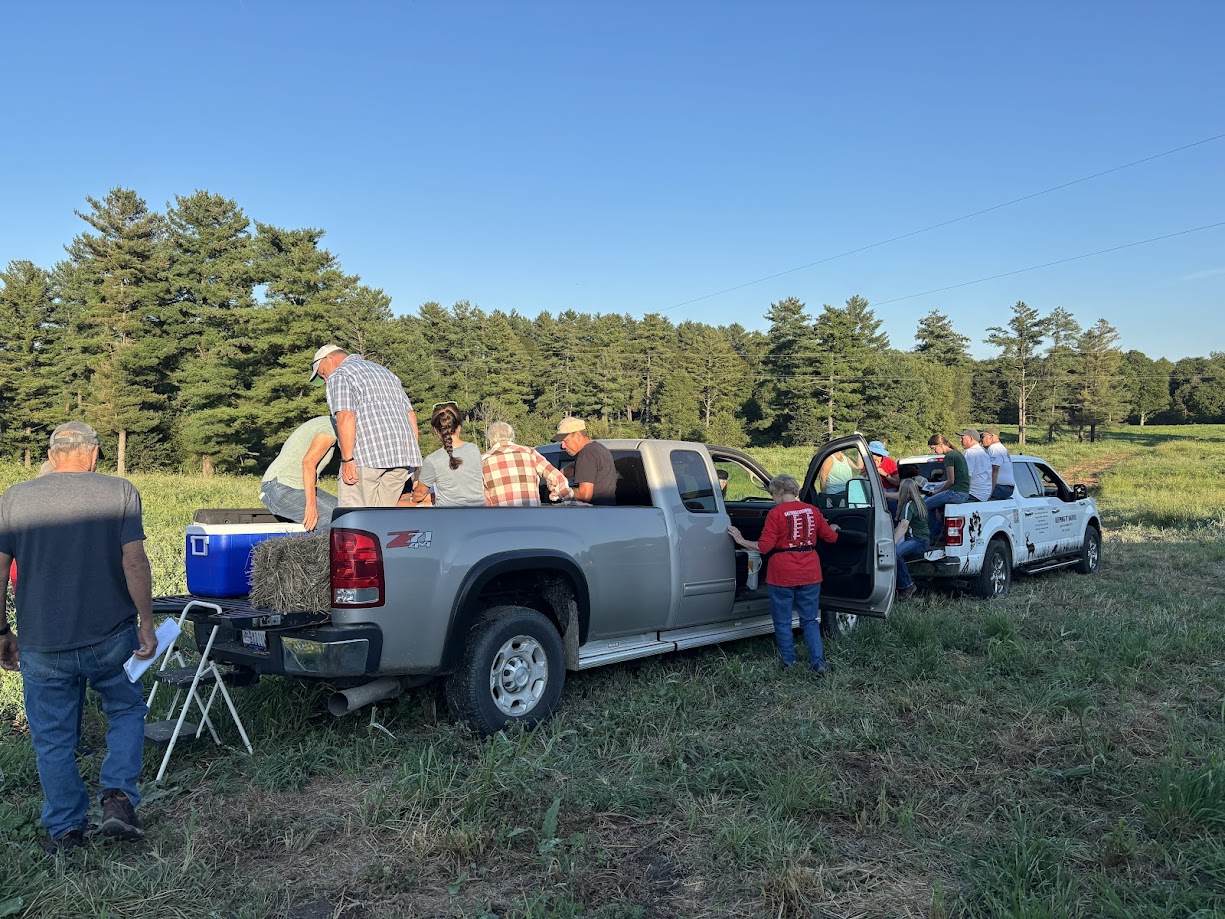
ATHENS COUNTY, Ohio — Farmers from throughout the county convened this month to discuss grazing animals, pasture management, and land stewardship at the most recent Athens Grazing Council meeting.
The council helps livestock farmers share knowledge and was formed “decades ago” through a partnership between the Ohio State University Extension and the Athens Soil and Water Conservation District, according to group organizer Ed Brown, also the agriculture and natural resources educator with OSU Extension.
“The mission of the group is to educate those having grazing animals on best practices and to collaborate with other farmers to share farming practices,” Brown told the Independent.
The group paused during the beginning of the COVID-19 pandemic before restarting last summer.
During the cooler months, the Athens Grazing Council gathers for guest speakers and discussions. In the summer, the council visits local farms for pasture walks and demonstrations, which can draw more than 25 participants.
“We are hoping that farmers can learn from one another, share ideas, and take home some ideas to improve their operations,” Brown said.
The Monday, June 16 meeting, held in The Plains, focused on woody invasive plants and how they impact pastures.
The session offered collaborative problem-solving, what the group was designed to provide: A room full of neighbors willing to share what they have learned. Farmers compared notes about what had worked on their own properties, what had failed and what they planned to try next.
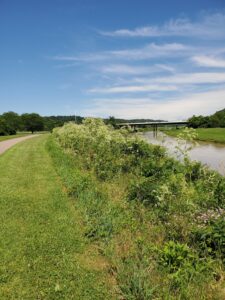
Participants explored the differences between animals that browse and those that primarily graze pasture. Discussions touched on a range of invasive species common in Southeast Ohio, including autumn olive, bush honeysuckle, multiflora rose, Japanese stiltgrass, bittersweet, Japanese knotweed, tree-of-heaven, and poison hemlock.
Guest speaker David Wilkel, of the Ohio Department of Natural Resources Division of Forestry, led the discussion, but the evening was driven by participants’ queries: When should Japanese stiltgrass be sprayed? Would a goat eat it? Rather than using chemicals, can livestock help control invasive plants? And what should replace that stiltgrass on steep slopes once it is gone?
Throughout the two-hour conversation, Wilkel often returned to the same answer: “There’s no silver bullet.”
Questions prompted discussions that blended scientific findings with personal experience, exemplifying the myriad challenges farmers consider while managing productive land with an eye toward long-term stewardship that cares for wildlife habitat and soil health.
The council discussed how invasive plants can alter ecosystems. Wilkel pointed to research suggesting that cardinals feeding heavily on bush honeysuckle berries can appear brighter red than they otherwise would, potentially affecting mate selection and producing less-fit offspring.
Attendees discussed several treatment methods for woody invasive species, including cut-stump and “hack-and-squirt” chemical applications. Conversation also explored non-chemical methods; Wilkel suggested blackhaw viburnum as a native alternative that can compete with Japanese stiltgrass, while also benefiting wildlife.
For bamboo infestations, his advice was simple: “Mow, mow, mow.”
“There are smorgasbords of different ways [to treat woody invasives],” Wilkel said. “Each and every species will respond to certain things differently than other species.”
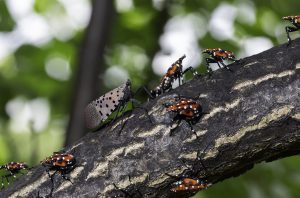
The group had an enthusiastic exchange about emerging biological controls, including a fungus used to target tree-of-heaven, a non-native species that serves as a host plant for the invasive spotted lanternfly.
Wilkel also described a bark-stripping method that he learned from another landowner and tried at home. One treated tree-of-heaven died without resprouting, while another responded by sending up vigorous root shoots — another reminder that invasive species management often involves trial and error.
The group agreed that, in their experience, repeated cutting is most effective in mid-summer. One participant summed up the importance of timing with an old saying: “Cut before June, we’ll be back soon; cut in July, say goodbye.”
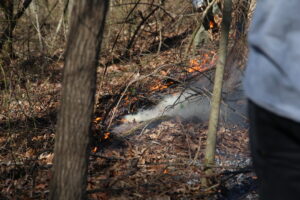
Attendees discussed prescribed fire, which some said had produced positive results in certain settings, but different outcomes in others.
Some questions and comments focused on herbicide concentrations and application methods. One person wanted to know whether pesticides stored in a barn remain effective after years of temperature swings; another participant noted that herbicides can often be diluted to reduce costs and exposure. Another chimed in to remind the group that most herbicide exposure occurs during mixing.
When one farmer mentioned having 50 acres overrun with osage orange trees — a non-invasive native species, but one he finds hard to manage — another participant offered a solution that could ease some of his troubles and feed her animals, too.
“I’ll come get that fruit from you in the spring,” she said.
Many of the land management challenges attendees discussed having experienced in their operations are common among non-farmers, too. Some have made their livestock mobile, for others to employ: Among attendees at the June council meeting was Albany-based butcher and chef Jennie Sartwell, owner of Hayseed Grazing Co., a business that rents grazing goats to others wanting to manage vegetation and reclaim overgrown land. Her mission includes addressing the region’s “ever-expanding habitat of ticks and the illnesses they spread.”
Sartwell told the Independent that she started attending the Athens Grazing Council “to learn from folks that have been at it longer than me.”
“There’s so much to learn and it’s really cool to hear other people’s approaches to invasives, animal health, and such – and pick and choose what to try in your own grazing context,” Sartwell said.
The next Athens Grazing Council is open to the public. For more details, contact Ed Brown at brown.6000@osu.edu, or call the Athens Soil and Water Conservation District at 740-797-9686.
Its next event is 6–8 p.m. Monday, July 13, at the Federal Valley Resource Center, 8225 SR 329, Stewart, and will focus on reducing the impacts of tick-borne diseases in cattle herds. RSVP is required one week in advance; email ruff.72@osu.edu.
Additionally, the Ohio Department of Agriculture will host a free farm pesticide collection event 9 a.m.–3 p.m. Aug. 27 at the Albany Independent Fairgrounds, 5201 Washington Road, Albany.
