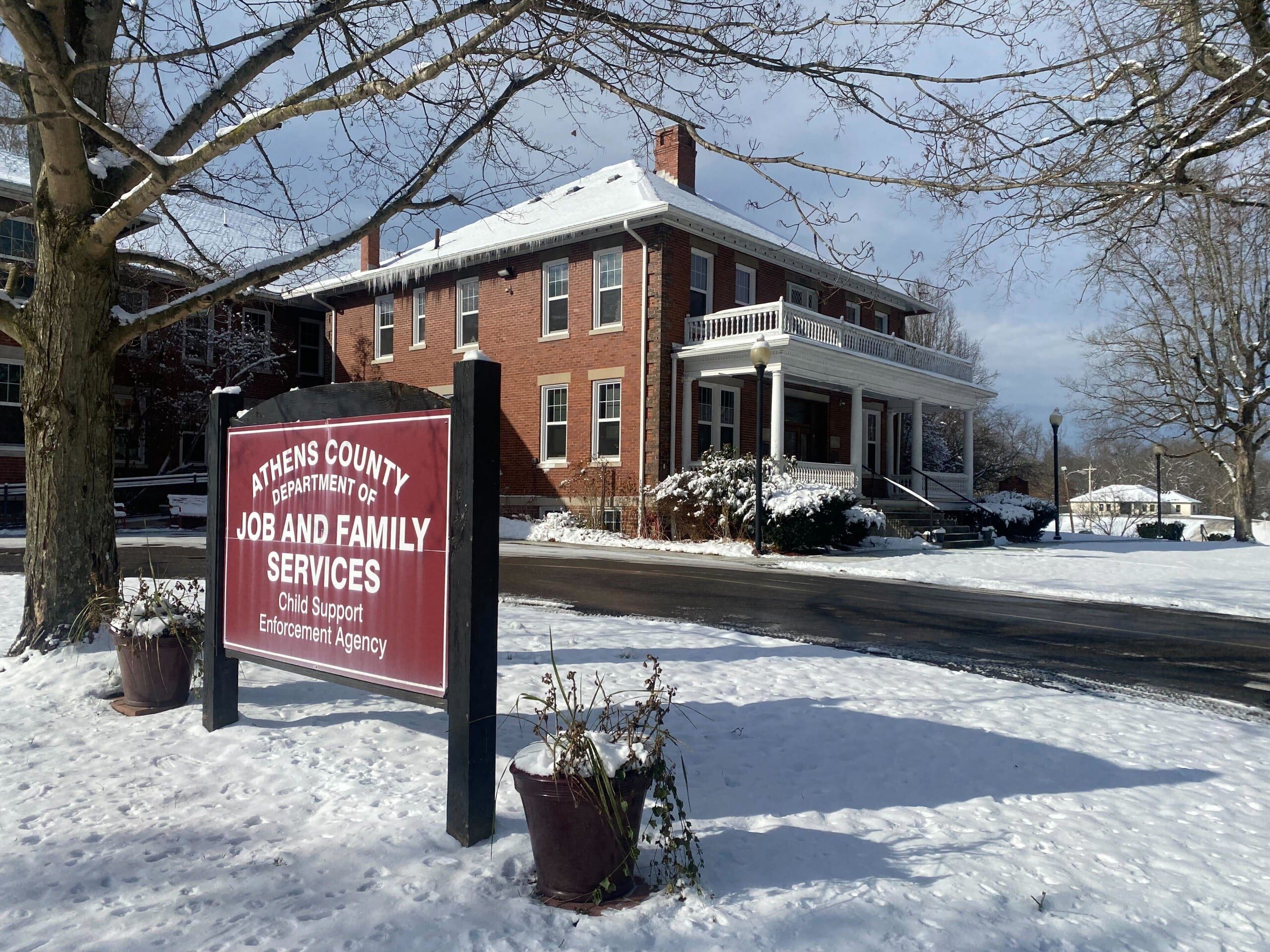
MILLFIELD, Ohio — Athens County Commissioners voted Tuesday to eliminate seven positions at Athens County Job and Family Services, the latest step officials have taken to address the agency’s financial situation.
Any JFS employee whose position is eliminated will be able to move into an open position, Athens County Commissioner Chris Chmiel told the Independent.
Athens County JFS Director Jean Demosky told the Independent in an email that the agency “started carefully monitoring expenditures in 2024 and took significant steps like initiating a hiring freeze among other savings strategies at the start of 2025.”
The situation appears dire: In addition to the temporary 10% pay cut and now, the elimination of seven positions, the agency is considering selling its Nelsonville building that opened only 17 months ago.
“The agency is clearly in a precarious position and there seems to be no quick end in sight,” Communications Workers of America #4320 President Jay Walther said in a Nov. 5 email to Demosky.
However, despite cuts and a general feeling of uncertainty within the agency, Demosky, Walther, and multiple Athens County Commissioners, who supervise the agency, all said they did not know exactly how bad the problem is.
“We still don’t know why — we still don’t know what happened to the money,” a JFS employee, who requested anonymity due to fear of retribution, told the Independent in a Dec. 16 interview. “We don’t know anything. We know absolutely nothing.”
Athens County Commissioner Lenny Eliason told the Independent in a Dec. 17 interview that while the exact scale of the problem remained uncertain, the county and agency received more clarity after a meeting this month with the state that he attended with Demosky.
Among the agency’s financial troubles, it owes about a million dollars to the state due to problems the state identified with the agency’s reporting on reimbursements, Eliason said.
Eliason said the exact amount won’t be clear until January 2026.
“The state’s going to arrange for a long-term repayment plan,” Eliason said. Therefore, he added, there should not be much additional impact on JFS from its current fiscal issues.
Chmiel told the Independent the state also granted the agency more leniency in terms of the overall amount that must be paid.
“It’s starting to not sound as horrible,” Chmiel said. “Since the state’s willing to work with us, and they maybe lightened up on some of the scrutiny and given some relief – it is a lot of money, but since the state’s working with us – it seems like it’s gonna get dealt with over time, instead of, like, a big hit.”
Chmiel said it is not yet clear whether the agency’s financial situation will translate into a hit to the county’s budget.
Demosky did not respond by press time to a question regarding the repayment arrangement with the state or the decision to cut positions.
No matter the cause and scope of the problem, however, JFS employees are taking a hit — and so are agency services.
Impact on employees
Eliason said the staff cuts were needed to “right-size the agency.”
“And clearly they have some positions that they no longer need, so they’re going to get rid of them,” Eliason said.
Chmiel told the Independent he voted to eliminate seven positions at the agency because “everyone would have an opportunity to basically get a different job,” through reassignments to different positions.
That will involve a restructuring of some departments, Chmiel said. Specifically, he said the agency’s child support division will “lose a couple employees.”
In a Nov. 14 email to union employees, Demosky wrote, “Funding for Child Support Enforcement Agencies has been flat for many years. … The amount of funding we receive does not support the number of staff we have. After a peer review of our staffing levels and recommended caseloads, we have determined a reduction of staff is necessary.”
Chmiel told the Independent it remains to be seen what impact the reduction in positions will have on the community.
“Ultimately, it’s like, ‘As these staff changes happen, are we serving the public as good as we can?’ I guess it’ll be the question,” Chmiel said. “You’re changing staff positions, and is it all going to work out, and people are going to be able to get what they need and such?”
Chmiel told the Independent that the JFS employee union’s decision not to continue a reduced work week was the “trigger” for the reduction in staff.
The reduction in hours for all 80+ JFS employees took effect Nov. 2 and was set to last 90 days, per a Memorandum of Agreement. The weekly workweek was reduced from 40 hours to 36, equivalent to a 10% pay cut.
The change also meant reducing the agency’s office hours, and the time it can serve the community. Amid the reduced workweek, the Athens County JFS office at 13183 SR 13 in Millfield is currently open from 7:30 a.m. to 4:30 p.m. Monday through Thursday, and 7:30 a.m. to noon Fridays.
According to the anonymous employee who spoke with the Independent, union members initially agreed to the reduction in hours to help those who weren’t “quite over their probationary period yet,” giving those employees more union rights in the face of possible layoffs. That decision came despite the limited information Demosky had shared about the scale and root causes of the fiscal crisis.
In a Nov. 6 email to Demosky, Walther expressed concern that calculations the agency shared with him weren’t “accurate because there just wasn’t enough detail.”
A day earlier, Walther wrote to Demosky, “Our members can feel that things are bad but the Agency leadership is telling them nothing. … We can’t in good conscious continue doing this not knowing when the shoe will drop.”
That situation did not change meaningfully by the time the union met on Tuesday, Dec. 9, to discuss whether to continue the reduced work week, the anonymous employee said.
“It was just more or less, ‘Do you want to continue doing it?’” the employee said. “[Demosky] says it’s going to help the agency. But we couldn’t even really say that.”
“We didn’t have enough information, and [we were] tired of just giving things away,” they added.
Employees voted “overwhelmingly” not to continue with the reduced workweek, the employee added.
“People are tired of not having money for no fault of their own,” they said.
The 36-hour work week agreement will expire Jan. 31, 2026. After that, the agency may return to its normal operating hours, 8 a.m. to 4:30 p.m. weekdays.
Cuts and pauses
In addition to temporarily cutting hours the agency is available to serve the community through its reduced workweek, the agency has paused programs throughout the year. This included temporarily suspending a non-emergency transportation services contract in September, as well pausing emergency assistance for low-income parents.
“It was a short pause for some program delivery,” Demosky said.
In November, the agency also considered eliminating its Athens County Community Cares Fund, a separate nonprofit that has supposed some agency services. The Athens County Foundation has since stepped in to support the fund, which Demosky said will allow it to continue.
However, Athens County JFS is considering at least one other substantial change: Demosky told the Independent the agency and county are considering selling the Athens County Community Cares Resource Center building in Nelsonville.

Athens County Auditor records show that the Nelsonville building where JFS has operated since July 2024 is currently appraised at about $433,000. Demosky noted in an interview with the Independent “how wonderful that building is.” It is currently being independently appraised, she said.
The resource center, owned by the county, gives Nelsonville residents access to walk-in services. The agency has also offered the space to partners such as Athens County Children Services, COMCorps, and the Survivor Advocacy Outreach Program’s New Leaf Marketplace, which recently moved into the space.
Chmiel told the Independent he would prefer to see the county sell the 510 W. Union St. building in Athens before parting with the Nelsonville property. The county bought the West Union Street property in 2019, and it is currently “sitting there empty, pretty much,” Chmiel told the Independent.
“For me, the first thing would be to sell that building, because there’s less going on there,” Chmiel said.
The county first solicited sealed bids for the West Union Street property in Athens this past spring. That building is appraised at nearly $1.2 million, according to the auditor.
In a January email to Chmiel, Demosky said the county bought the West Union Street property in 2019, for around $1.4 million, and spent an additional $100,000 renovating it. The agency also borrowed $1.5 million through a 10-year bond to add and make changes to the interior.
“We have paid about $170k per year so far to repay the bond. We owe the same annual amount for 5 more years,” Demosky wrote to Chmiel.
Adkins said the building is located within a floodplain, which has made it less desirable for buyers. Demosky told the Independent that despite multiple bids, none have prevailed.
“We had an auction, but no one came to the auction,” she said.
The agency is still working to sell the Union Street building. Demosky said in her January email to Chmiel that selling the West Union Street building would pay back the balance of the bond, replenish JFS cash reserves and reduce county debt.
Meanwhile, the county also has taken steps to prepare for the sale of the Nelsonville building.
SAOP Executive Director Madison Trace told the Independent in a Dec. 9 interview that construction was slated to be complete Dec. 10, and that the new location for New Leaf would open in the following days. It was only on Nov. 17, however, that SAOP received notice from the county that it would not be renewing SAOP’s lease when it ends June 2026.
The notice from the county said the commissioners would be “open to discussing the possibility of a mutually agreed-upon early Termination of the lease.”
Trace told the Independent that SAOP hasn’t had much time to consider future possibilities yet.
“This is all pretty new news to us,” Trace told the Independent.
Frustrations over limited information
Demosky told the Independent in a Nov. 20 interview that she won’t have clear answers on the budget situation until the close of the fiscal year — and that information will be difficult to come by even then, given the different fiscal years the agency contends with at the same time.

Multiple anonymous former JFS employees told the Independent that Demosky struggles to understand agency finances. Her uncertainty about the agency’s current financial status has frustrated employees and, over the preceding months, officials.
“She is the executive director, so I couldn’t understand how you wouldn’t know what was going on, how you couldn’t give all the information,” the anonymous JFS employee said.
Before the agency’s meeting with the state, Chmiel told the Independent in a Dec. 3 interview, “I’m still trying to figure out, ‘OK, well then, where are we at?’ … We know there’s some issues, but what? Where is it? … The answer I keep getting is, ‘We don’t know yet.’”
Retired financial planner Jim Raeder, unaffiliated with JFS, lives in Logan and still provides volunteer financial planning services to area organizations. Raeder told the Independent the agency should have financial forecasting that would allow it to fully understand its situation.
Such forecasts offer “a potential roadmap to the future,” Raeder told the Independent.
Demosky told the Independent that the agency has worked informally with various individuals who offer guidance and recommendations for its finances. “So, we have had help, but there are no fiscal contractors on payroll,” she said in an email.
In a Dec. 3 interview, Chmiel pinned the limited information about the scale of the problem on Demosky.
“Frankly, you know, when you’re the director of an organization, where does the buck stop?” Chmiel said. “And that’s what frustrates me, that even when I ask questions about, ‘Currently, where are we at?’ I don’t get straight answers.”
Despite his frustrations, Chmiel attributed some issues in understanding the budget situation in part to the agency’s “complicated” funding systems. Its work is funded via cost allocation, in which different sets of funds are pooled together for specific services, like child support enforcement, social services. Workers are placed in those cost pools, too.
The state determines how much to allocate in each cost pool using random moment sampling: It randomly selects workers to observe on a quarterly basis and conducts a time study that measures the agency’s programming activity levels. The state then uses that data to determine how much money is allocated to each cost pool, ultimately affecting how much money the agency is able to get reimbursement.
While the picture may now be clearer for the county following the county’s meeting with the state, frustrations for employees remain.
“I don’t know what she and the commissioners have got going on. I just don’t know,” the anonymous JFS employee told the Independent.
Roots of fiscal crisis
The Independent interviewed multiple people with varying levels of insight about the fiscal crisis at JFS. Different sources named different issues that they believe have contributed to the agency’s financial woes — if they had any insight at all.
“I just don’t know that we know what to believe, because there’s just so many stories going around,” the Athens County JFS employee who spoke on condition of anonymity told the Independent.
Chmiel said over the last dozen years, the agency has remained largely stable financially. While the agency’s budget and staffing have fluctuated historically with changes in state and federal policies, he said that is not what is happening now.
“Other things happened here where decisions were made,” he added. “I don’t think there was enough due diligence, frankly. And some of these decisions aren’t turning out that great financially.”
Chmiel said the biggest issue facing the agency has been issues with the random moment sampling that the state uses to determine how much money the agency should receive.
“The state had critiqued how a lot of those things were coded,” Chmiel said.
“The state has agreed to recode things back” in some cases, he said, softening the issues for JFS. However, JFS will still have to pay an amount “in the millions of dollars” back to the state “over a certain amount of time,” he added.
Demosky acknowledged in a Dec. 11 email to the Independent that “a monitoring of our reporting was questioned.”
“While at one point we were required to make a significant number of negative adjustments, a second review resulted in a more favorable outcome for the agency,” Demosky wrote. “We have been working with state fiscal officials to better train our staff and accurately code RMS [random moment sampling] so that the various pools of funding are utilized in the most beneficial way.”
Chmiel said he does not know how the agency got into its current situation but that there should have been more oversight.
“My perspective is still that this should have been more heavily scrutinized earlier on, because it takes a while for millions of dollars to add up,” Chmiel said. “Why wasn’t it more highly scrutinized?”
When asked about contributing factors to the agency’s current financial situation in a Nov. 20 interview, Demosky did not mention issues with the state’s method of determining funding. Instead, she identified previous pay raises for staff and unexpected building expenses as the largest factors.
Demosky said that the agency overspent on repairs to its Nelsonville building in particular. According to records provided by Chmiel, the agency purchased the building in February 2022 for just over $450,000 and has since spent nearly $718,000 on maintenance and renovations.
Commissioner Charlie Adkins said that some of the money that paid for Nelsonville building repairs came out of the wrong line item within the budget. Demosky did not mention these problems in her interview with the Independent.
In a Dec. 11 email Demosky said, “It’s fair enough to say some of Nelsonville building costs were not expensed correctly and the agency will likely have to enter into some kind of a repayment plan.”
Eliason, on the other hand, blamed the situation on instructions and oversight issues from a former agency employee, since terminated. The Independent on Dec. 4 sent a request to JFS for records that would shed light on Eliason’s allegations, though that request was not fulfilled by press time.
“I don’t think it was an issue with oversight from Jean,” Eliason said.
Eliason added that issues with reporting to the state have been corrected.
“Now, they’ve got it sorted out so they’re coding on the correct way for the state to get maximum reimbursement,” Eliason said.
What comes next
Demosky told staff in her Nov. 14 email, “I cannot guarantee there will not be a reduction in workforce in the future.”
Speaking to the Independent the afternoon after the commissioners decision to eliminate positions, the anonymous JFS employee said agency employees are “very worried” about the future, and the possibility of layoffs.
Walther said any cuts affecting JFS employees are cuts to services for the community.
“Our members care deeply about the community and the work they do, and care about the clients, and we know that the agency needs all of them to function at the levels that it is in and our members want to continue doing that, as well as continue staying gainfully employed themselves,” Walther said.
Demosky told the Independent in a Nov. 20 interview, “I will do anything I can to make sure that we don’t have to have any layoffs.”
But the anonymous JFS employee told the Independent in a Dec. 2 interview, “We’re just afraid it’s going to get even worse, because we don’t know what it is to begin with.”