
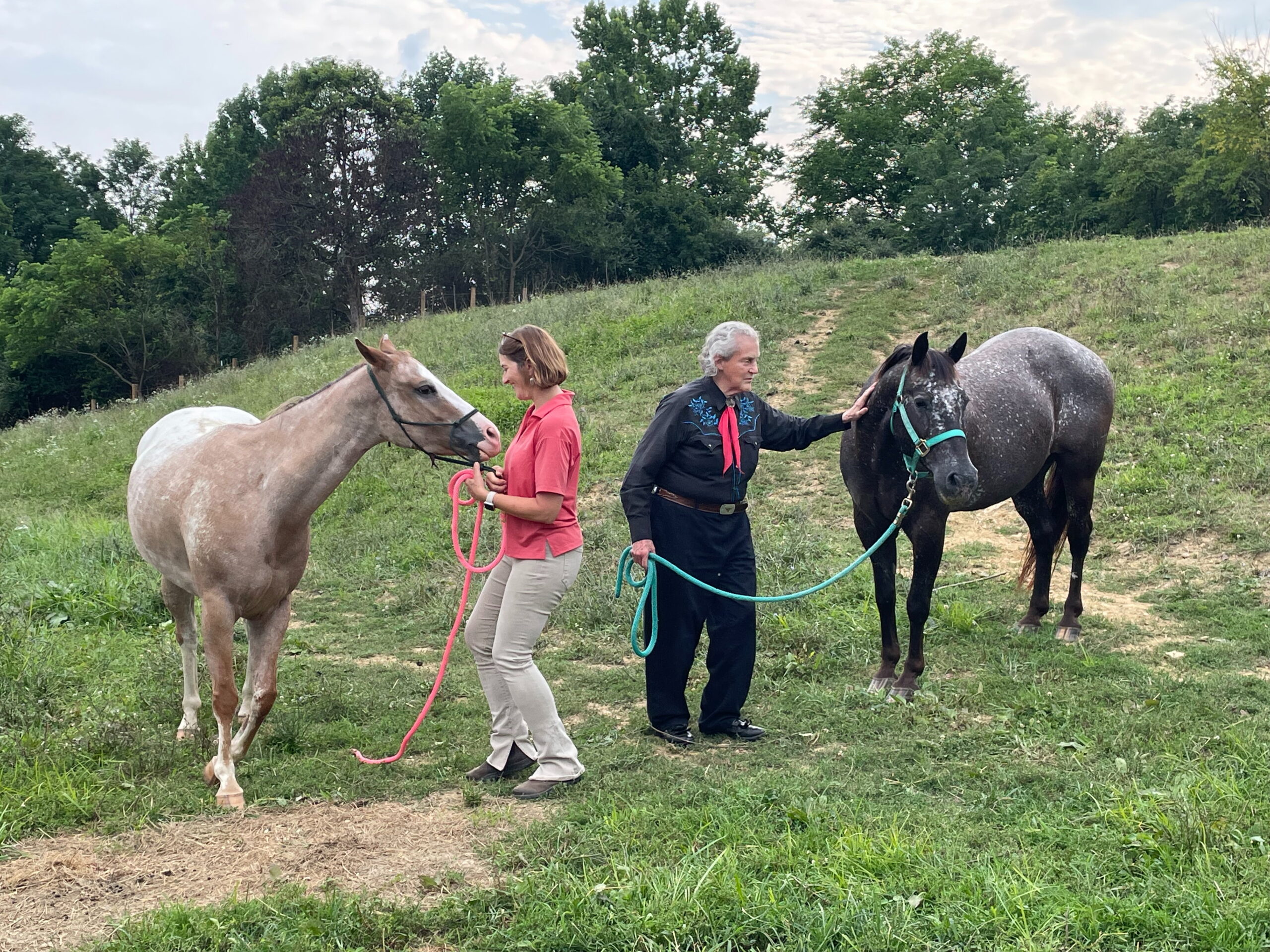
ATHENS, Ohio — In late July, renowned autism activist Temple Grandin visited Pivot Point Pediatric Therapy, a spacious farm-based clinic on North Coolville Ridge Road that treats autistic children and young residents with related communication challenges.
Speech-language pathologist Stephannie Brajot opened the program early in the coronavirus pandemic, when autistic children were cramped indoors with their parents. Pivot Point is one of the few pediatric therapy centers in the region offering a full suite of treatments — intervention programs, occupational therapies and more — for a diverse population that often struggles to find adequate support.
“There are almost no pediatric therapeutic facilities in Southeast Ohio,” Brajot told the Independent.
Brajot noted that many parents struggle to obtain an autism diagnosis for their child, due to a lack of providers in Southeast Ohio, where nearly every county is a federally designated health professional shortage area for primary care and mental health care for low-income populations.
A 2022 community health report from OhioHealth O’Bleness Hospital in Athens listed increasing access to mental health services and addiction care as the top priority for the area.
In a statement to the Independent, a spokesperson for OhioHealth noted that the hospital system does not provide autism diagnoses for children in the area, but that “pediatric providers help coordinate referrals for specialized assessments.”
Parents in Southeast Ohio seeking an autism diagnosis for their child are primarily referred to Nationwide Children’s Hospital in Columbus.
“OhioHealth Pediatrics serves as the child’s medical home before and after diagnosis, helping families coordinate care, connect with appropriate services and support the child’s ongoing health and developmental needs,” the OhioHealth spokesperson said.
Brajot said that while Nationwide Children’s Hospital, and other hospitals in Cleveland and Cincinnati, can provide diagnoses, an extended car ride is potentially challenging for autistic children with behavioral issues.
“These are parents who don’t take their kids anywhere. They can’t take them to McDonald’s, let alone to Cleveland,” Brajot said.
A spokesperson for Nationwide Children’s Hospital told the Independent in an email that a growing demand for diagnoses across the country and a nationwide lack of autism providers creates additional difficulties.
“Access to care can be even more challenging for small and mid-size communities and rural areas,” Nationwide Children’s Hospital said in a statement.
The issue isn’t limited to Southeast Ohio. Last year, an investigation by a Cleveland news station found that some parents waited a year or longer before their child was formally diagnosed. A 2023 study detailed “unacceptably long wait times” and “significant diagnostic delays” nationwide. More than 15% of autism centers surveyed reported wait times exceeding one year.
The long wait times for diagnoses delay care and access to programs for autistic children.
“There are certain parts [of the country] where kids 3 years old are on a two-year waitlist to get a diagnosis,” Grandin told the Independent in a phone interview Saturday, Aug 1. “And so that 3-year-old is vegetating on electronics for two years. That’s totally terrible. You’re losing two years of developmental time.”
Without a clinical or school-provided diagnosis, autistic children are unable to access some key support systems, such as the Autism Scholarship Program.
Offered by the Ohio Department of Education, the program allows eligible children from ages 3 to 22 to attend a “special education program” outside of what is offered by their local school districts. A child diagnosed by the school district must have an individualized education program (IEP); a child privately diagnosed must have an IEP or an autism education plan (AEP) created by their district.
These scholarships can provide up to $34,000 for the families of autistic children.
Brajot said these scholarships can allow children to spend “five to six hours a week” at Pivot Point for speech therapy, interventional services and other related treatments.
“There’s no other therapeutic entity, definitely not schools, that can offer that amount of individualized, tailored therapy to a child,” she said.
Parents describe own experiences
The Independent spoke with several parents who described the challenges of obtaining a diagnosis and accessing quality healthcare for people with developmental disabilities in Southeast Ohio.
Jamie Kish, an Athens County resident and the mother of a 7-year-old autistic son, said she was “very lucky” to obtain a diagnosis for her child at Nationwide Children’s Hospital in just six months. She told the Independent she became increasingly concerned when her 2-year-old child was still not speaking.
After her son completed an early intervention program at age three, she received a service and support administrator through the Athens County Board of Developmental Disabilities to help connect her with resources. But at first, she was unsure where to turn.
“I think there’s a lot of parents who don’t know that those resources exist,” Kish said. Her husband is also autistic, she said.
Kish explained that she and her husband do not have family in the area, so local help is essential.
“We are very much in the trenches on our own a lot of time,” Kish said. “Having some more support for the parents would be incredible.”
Autumn Brown, the founder of Integrate Athens, a division of the Athens County Board of Developmental Disabilities, told the Independent that the board serves 850 people “with any type of intellectual or developmental disability,” including many individuals with autism.
“Integrate Athens focuses on helping people get connected to their community in an inclusive way, whether that is resources or volunteer experiences, as well as employment,” Brown said.
She told the Independent that specialized healthcare is scarce in rural areas, and that some families could benefit from such services during the summers when children are not in school.
A lifelong resident of Meigs County, Melanie Vaninwagen told the Independent that her local school district was unable to address the needs of her 13-year-old autistic son, who has a history of violent emotional outbursts.
As a result, Vaninwagen’s son has not attended school for several years, while her 10-year-old autistic daughter, whom Vaninwagen describes as “more on the Asperger’s side,” is a public school student. (Asperger’s, a former autism diagnosis, is no longer used as a diagnosis.)
Vaninwagen, like Brown, also said that support for parents of autistic children is key, especially on the weekends or after school.
“Everything hits the fan on a Friday night at 6 p.m. — and I spent years completely alone. I had no one to call,” Vaninwagen said. “And I knew how horrible that feeling was. It’s just very isolating.”
To address this need, Vaninwagen helps run an “after-hours crisis prevention program” for children with behavioral challenges at Integrated Services in Middleport. She acknowledges that local school districts in the region “go above and beyond” for autistic students, but describes resources as limited.
“[Schools are] just not equipped to teach nonverbal autistic children who have any kind of behavioral outburst,” she said.
Megan Hendrix, an intervention specialist at Pivot Point and former elementary school teacher who lives in Meigs County with her autistic son, told the Independent about a lack of therapeutic options outside of the school district.
Hendrix said she began the autism assessment process when her son was 15-months-old and nonverbal. The process took more than a year. “It’s very hard to get a diagnosis,” she said. “I had a hard time getting people to believe me with my son.”
In comparison to Meigs County, where Hendrix said there is “nothing” for children on the spectrum, Athens County provides greater assistance.
“I don’t think Athens County is necessarily lacking in services—it’s probably a lack of support for parents, honestly,” Hendrix said.
Acknowledging a lack of services in Meigs County and throughout Southeast Ohio, Bret Malone, superintendent of the Meigs County Board of Developmental Disabilities, said his focus is on trying to expand their assistance to families.
Currently, the Meigs County Board of Developmental Disabilities runs an early intervention program for qualifying children and maintains a lending library where families can access adaptive materials, like communication devices for nonverbal children.
But not all autistic children in Meigs County can automatically obtain services. Malone said there are fewer schools left in the area that can provide proper care for students with disabilities.
The Meigs Local School District, in partnership with the Athens-Meigs Educational Service Center, operates “two specialized autism classroom units” to support students with developmental needs, Shawn Bush, the district’s director of special education, said.
Bush told the Independent that while schools can address the needs of some autistic students, care is not comprehensive.
“The ability to support individuals with autism extends well beyond what a school district can provide,” Bush wrote via email. “Like many rural communities, Meigs County and much of southeastern Ohio do not have the same breadth or concentration of specialized providers and support services that are available in larger metropolitan areas such as Columbus, Cleveland and Cincinnati.”
If parents with children in Athens County public schools are facing long wait times at hospitals and having difficulty obtaining a clinical diagnosis of autism, they can be evaluated by a school psychologist, said Tina McWilliams, director of special services for the Athens City School District. She notes that while these school-based practitioners cannot provide a medical diagnosis, they are able to open up services to students who meet certain diagnostic criteria.
McWilliams describes a team-based approach that evaluates a student for autism and then drafts an individualized plan, which may include occupational therapy, speech-language therapy or other treatments. But these interventions may not be sufficient for autistic children with more severe symptoms.
“School speech therapy is perfect for the kid who can’t say ‘fish.’ But for a child who is nonverbal, it is a drop in the bucket,” speech-language pathologist Brajot said.
Still, McWilliams said that school-based speech-language pathologists–which may, for example, provide direct services for a student once or twice a week depending on the need—also help coordinate care with teachers and other advocates. “I would not say that it is a one-and-done, 20-minute [session] once a week,” she said.
“Our goal is to transfer that education to help that child improve and ultimately use those skills on a daily basis,” McWilliams said.
She said that speech-language pathologists at the school are trained to assist nonverbal children with specific therapies.
McWilliams noted that part of her role is to make sure children in need get connected with services, while families have described difficulty knowing who to ask or where to go. She urges families with children in the school system to get involved in the community.
“Start with the students’ general education teacher, just because that could be the very first person to point them in the right direction,” she said.
