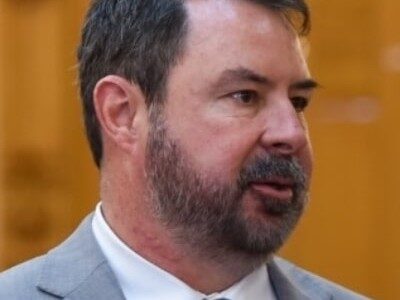
COLUMBUS, Ohio — A complaint submitted to the Ohio Joint Legislative Ethics Committee on Tuesday, Jan. 20, alleges that Sen. Brian Chavez used his position to change oil and gas industry regulations for personal gain.
The complaint was submitted by members of activist group Washington County for Safe Drinking Water. Their complaint says Chavez, who has held office since 2023, has undisclosed ties to five different companies, including DeepRock Disposal Solutions. DeepRock, a fracking waste injection well operator, is at the center of a controversy over the dangers its wells may pose to human health and the environment in Washington County.
The complaint also alleges that Chavez violated Ohio Revised Code section 102.03 through his role shaping a bill introduced in June 2025 that would benefit businesses to which he’s connected. The law prohibits public officials from using the public office for private financial gain and voting on legislation on which they have conflicts of interest.
“Publicly available documents seem to make it clear to us that [Chavez] has a conflict of interest, and we do not think that we are our water is being protected, and we want someone to look into it,” Hillary Royster, spokesperson for Washington County for Safe Drinking Water, told the Independent in an interview.
The Joint Legislative Ethics Committee, a 12-member body with equal Democratic and Republican representation from the Ohio House and Ohio Senate, will choose what to do with the complaint against Chavez. The committee has no obligation to pursue complaints it receives.
Legislative Inspector General Tony Bledsoe, whose office serves as the administrative arm of the committee, told the Independent that at least eight members of the committee must find there is probable cause that a violation has occurred for the matter to become an official complaint before the committee.
Washington County for Safe Drinking Water hopes its findings on Chavez’s financial interests will prompt action from the committee.
“[Washington County for Safe Drinking Water] pretty much put this complaint together on a silver platter, in hopes that the Ethics Committee will take a look at this and see if our complaints are valid,” Royster said.
If the 12-member committee were to find probable cause that a violation occurred and voted to move forward with the complaint, the complaint would then be served on Chavez, who would have an opportunity to file a response.
If, after an investigation by the committee, officials maintain there is probable cause that a violation occurred, the committee could put the matter up for a hearing. Hearings essentially function as trials, with the committee members serving as the jury, Bledsoe said.
The committee could recommend consequences for Chavez if it found through a hearing that a violation had occurred. Such consequences could include a recommendation that the legislature censure the member, a monetary fine, or referral for prosecution, Bledsoe told the Independent.
Due to confidentiality rules, Bledsoe could not comment on anything pertaining to the complaint against Chavez, or on how frequently the committee investigates complaints it receives from third parties.
Personal benefit from legislation
The complaint alleges that Chavez has benefitted improperly from his role as a state senator and his position as chair of the Ohio Senate Energy Committee.
As chair of the energy committee, Chavez “has significant power” over energy-related legislation, the complaint says, including “setting the committee’s agenda, scheduling hearings, and controlling the flow of legislation.”
Chavez used that power, the complaint alleges, to fast-track Senate Bill 219, which would revise laws governing oil and gas wells. SB 219 passed the Ohio Senate Nov. 19, 2025, and has been sent to the Ohio House. It has not yet been referred to a House committee.
The complaint argues several changes the bill would make would benefit Chavez or his family.
“It seems a little self-serving, and we are worried that the injection well companies are being favored and the risk to our water is being ignored,” Royster said. “We really just want our senators and our elected officials to follow the rules and ethics that they swore to.”
SB 219 mandates that the Ohio Division of Oil and Gas Resources Management prioritize plugging abandoned wells nearest to active injection wells. The rule appears to be an acknowledgement by the legislature that there is an ongoing danger that injected fracking waste could migrate underground and erupt to the surface via oil and gas wells.
Contamination of oil and gas wells by underground migration of materials from injection wells — including wells owned by DeepRock — has been an issue in southeast Ohio.
However, the complaint argues that “prioritization of the plugging of orphaned wells in proximity to injection wells is not a solution [to brine migration], instead, it is an effort to sweep the problem under the rug.”
Fracking waste contains highly toxic chemicals such as PFAS and radioactive compounds. Its uncontrolled spread poses a risk to drinking water and the environment, the ODNR has repeatedly found.
SB 219 would also redirect injection well fees from the Oil and Gas Well Fund, which helps finance the Division of Oil and Gas Resources Management. A portion of the fund must be spent on a plugging of old oil and gas wells, per Ohio law.
Instead, fees for a given injection well would flow to the county or counties in which the injection well is located, according to a Senate analysis of the bill.
The result, the complaint says, “will be financially endearing injection well companies with local politicians.” The complaint points to $700,000 that would flow into Washington County should DeepRock’s recently permitted wells become operational.
The bill does not increase fees per barrel of fracking waste injected. Amid inflation, the complaint argues that the unchanged fees make Ohio increasingly attractive for out-of-state companies looking for a place to inject fracking waste. This benefits Chavez’s companies, the complaint argues.
According to the Senate analysis, the bill would prevent the chief of the Ohio Division of Oil and Gas Resources Management from refusing to expedite most drilling permit applications, including for injection wells. That change will speed up approval of drilling permits, favoring industry interests.
Altogether, these changes would mean “the injection well industry will be set to make more money with less oversight,” the complaint says.
Chavez should have recused himself from involvement with the bill due to his “disclosed and undisclosed interests” in such changes, the complaint argues. “Instead, he has co-sponsored the bill, fast-tracked it, and publicly advocated for it,” the complaint says.
Royster told the Independent, “For Senate Bill 219, what we would like to see is less favoritism to the injection well businesses, especially Senator Chavez’s businesses, and more fairness around the whole issue itself — the funds going to places that will actively help with these problems and less that will benefit the Senator and the businesses.”
Although not discussed in the complaint, the bill also includes an additional change that could directly impact DeepRock.
The bill would change Ohio law by requiring that anyone appealing certain decisions from the chief of the Division of Oil and Gas Resources Management operate first within the Ohio Oil and Gas Commission, a body that includes representation for the oil and gas industry. Currently, the senate analysis of the bill says, an appellant has “the choice between appealing to either the Commission or a court.”
The division’s permit approvals for DeepRock’s wells are currently being challenged both before the Ohio Oil and Gas Commission and the Franklin County Court of Common Pleas.
Undisclosed associations
The complaint alleges that Chavez has undisclosed connections to the oil and gas industry that represent conflicts of interest.
“People across Ohio and across the political spectrum agree on one basic principle,” several southeast Ohio environmental organizations wrote in a letter of support for the ethics complaint. “Public officials must follow the law and be honest about their financial interests when making decisions that affect public health, environmental safety, and the future of our communities.”
There are five limited liability companies at issue in the complaint:
- Heinrich Property
- Horizon Partners Investments
- Funds Protection Investment
- Condevco Operating
- DeepRock Disposal Solutions
None of the above were listed on Chavez’s official financial disclosures in 2023 or 2024.
Chavez reported DeepRock Disposal Operating LLC in his financial disclosures. While the company sometimes uses the name DeepRock Disposal Solutions, the latter is a legally distinct entity, the complaint says.
The complaint cites actions taken by the Ohio Department of Taxation as evidence: In 2025, the agency filed separate tax liens against both DeepRock Disposal Solutions and DeepRock Disposal Operating.
Chavez served as CEO of DeepRock Disposal Solutions, the company at the center of the fracking waste injection controversy, according to a January 2023 email between ODNR and DeepRock Disposal Solutions. However, the complaint says Chavez did not report an ownership interest in the company, identifying only that he was an employee of DeepRock Disposal Operating in his disclosures.
The complaint alleges that Chavez’s failure to list his ownership of the company, even if he listed his employment, constitutes an undisclosed conflict.
Furthermore, Chavez said in his financial disclosures that he ended his employment in 2024. However, Chavez was listed as a manager for DeepRock Disposal Solutions in its 2025 annual report filed with the state of West Virginia.
The other four companies are connected to Chavez via his wife, Christyanne Chavez, their family, or Chavez’s connections to DeepRock, the complaint says.
Documents in the complaint do not clearly establish that the Chavezes are currently involved with some of the companies. The documentation listing Christyanne Chavez as a representative of Funds Protection Investment comes from 2017, and documentation connecting the Chavezes to Condevco Operating LLC is also from 2017.
The response to the complaint
John Fortney, the director of communications for the Ohio Senate Majority Caucus, told the Independent in an email that Washington County for Safe Drinking Water “could care less about ethics much less safe drinking water” and that the complaint is “another baseless, desperate, and hollow attack funded by billionaire California special interests with the single goal of killing the oil and gas industry in Ohio.”
The claim that Washington County for Safe Drinking Water is funded by California special interests mirrors previous statements Fortney has made about Buckeye Environmental Network, which signed onto the letter of support for the complaint.
According to information on the nonprofit database Instrumentl, Buckeye Environmental Network, based in Ohio, has accepted funding from organizations based in several states, including California.
Chavez has made statements similar to Fortney’s. In leaked audio of an Aug. 4, 2025, Washington County Republican meeting, he stated that the Buckeye Environmental Network was hosting “fake town halls,” and that Saudi Arabia and China are funding political opposition to natural gas.
The Independent did not identify any evidence that Buckeye Environmental Network is connected to Saudi Arabia or China.
Reporters from the Athens County Independent have attended multiple meetings hosted in Washington County about injection wells and can verify that local residents were present at each.
In response to Fortney’s statement to the Independent, Royster said Washington County for Safe Drinking Water does care about the ethics, pointing to the 51 exhibits submitted as part of the complaint that the group says provides evidence for its concerns.
“We’re asking for the ethics committee to look at this, and if they find wrongdoing, to act on that,” Royster said. “I would say that we are actually trying to involve ourselves in a democratic process.”
Fortney also told the Independent that Washington County for Safe Drinking Water believes that “violent criminals and illegal migrants have more rights than you, the same people who attack federal law enforcement, and the same people who loathe the very laws this country was founded on. They are anarchists at heart, and are ready to surrender your country, state, and your reliable energy that heats your home.”
Royster called Fortney’s response disparaging and “really unfair.”
“We do love this country, and because we love this country, we want to ensure clean water for everyone,” Royster added.
Years of scrutiny on Chavez, DeepRock
Fear for Washington County’s drinking water related to injection wells was a key animating force for Washington County for Safe Drinking Water to file the ethics complaint against Chavez.
“I personally feel that our water, the risk to our water down here, is being minimized by our elected officials,” Royster said. “We really just want to feel like we’re being heard and that they too care about our water.”
Chavez has faced scrutiny for his connections to the injection well industry ever since he was appointed to the Ohio Senate in 2023, in part because of DeepRock’s reputation in the region.
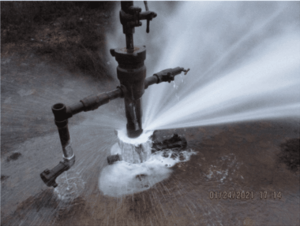
In 2021, brine injected into a DeepRock well migrated underground before erupting to the surface via an abandoned well in Noble County, causing an environmental disaster. Chavez’s company did not have to pay for the clean-up that followed, with the state instead requiring nearly $1.3 million in payment from the oil and gas well operator. DeepRock is currently facing litigation over the issue in the Franklin County Court of Common Pleas.
Since then, the company has faced allegations from regional oil and gas producers that DeepRock injection wells are impacting their operations.
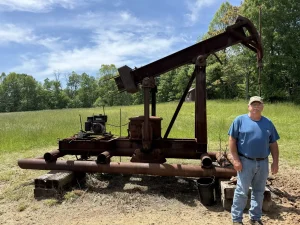
DeepRock has also faced controversy as a result of ODNR’s Division of Oil and Gas Resources Management approving the company’s applications to install injection wells near Marietta under outdated rules. The old rules were replaced in 2022 to better protect the environment and the public after the Ohio Department of Natural Resources found that brine migrated miles underground from a Washington County injection well. DeepRock’s applications were submitted before the permitting process was changed, but were not approved until 2025.
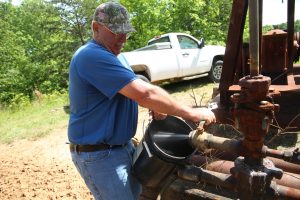
Marietta City Council appealed a decision from ODNR’s Division of Oil and Gas Resources Management granting a DeepRock permit to the Ohio Oil and Gas Commission, which hears cases challenging the division chief’s orders. Buckeye Environmental Network also sued the Division in the Franklin County Court of Common Pleas over its approval of DeepRock permits. The latter case remains pending; the Independent is awaiting additional records on the former.
Local organizers and media outlets have consistently emphasized DeepRock’s connection to Chavez throughout coverage of the controversy. In addition to the Independent’s coverage, reporting from Signal Ohio, Cleveland.com, The Columbus Dispatch has also emphasized the senator’s connections.