COLUMBUS, Ohio — An oil and gas producer will pay more than $1 million to the state for the 2021 cleanup of environmental damages at its Noble County well. To recoup costs, the producer is now weighing a lawsuit against an Ohio senator’s company.
“We’re probably going to pursue it, but we haven’t made a final decision yet,” said Kevin M. Maloney, attorney for Genesis Resources LLC, the oil and gas producer.
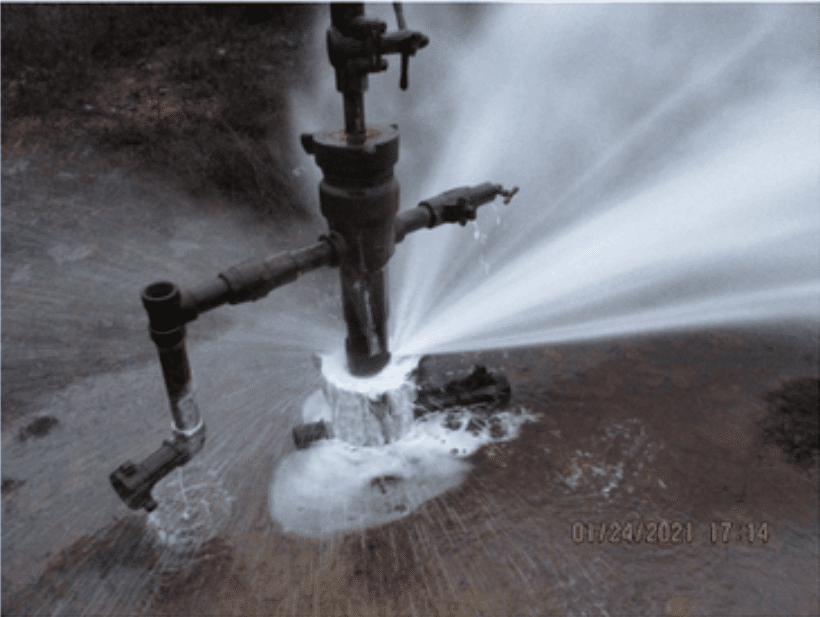
The 2021 incident was caused by the underground migration of ‘brine,’ a hazardous byproduct of fracking. According to ODNR Division of Oil and Gas records, brine traveled underground from injection wells owned by Ohio Senator Brian Chavez’s company, Deeprock Disposal Solutions. Brine then reached the surface via an oil and gas production well owned by Genesis.
Chavez represents Ohio Senate District 30, which includes 10 southeastern and eastern Ohio counties. He did not return a request for comment for this story, though his office confirmed that it received the Independent’s inquiry.
Contractors hired by the state spent several days and the state spent $1.28 million to address the 2021 disaster at Genesis’ well. In the meantime, brine contaminated nearby land and waterways. As Cleveland.com reported, the cleanup involved removing more than 360,000 gallons of water from affected waterways; hundreds of animals died.
Problems at both the Deeprock wells and the Genesis well led to the incident. According to court documents, Genesis had not plugged the well, which had not been active for 10 years. If the well had been plugged, brine could not have erupted to the surface.
Genesis has faced multiple other orders for corrective action due to issues with various wells it owns, as well as numerous orders to plug its wells and address other issues of noncompliance, according to orders by the division chief available online.
In the 2021 incident, however, brine should never have migrated from the Deeprock wells in the first place. The division suspended the Deeprock wells in early 2023 as a result of brine migration issues.
Karina Cheung, an ODNR media spokesperson, told the Independent in an email that the wells remain suspended. Deeprock submitted a plan to address the issues in the suspension order, which is now under review by the ODNR, Chueng said.
Chueng said the issues cited in the suspension order are the only known problems caused by the Deeprock wells. “There has been no known contamination of drinking water attributed to the operation of these injection wells,” Chueng said.
The ODNR did not fulfill a records request pertaining to Deeprock’s wells by press time.
In addition to Deeprock, Chavez owns Reno Oil & Gas, Inc., which manages 450 oil and gas production wells, according to an Ohio Senate press release.
Genesis argues Chavez’s company should pay
Instead of seeking payment from Chavez’s company over the 2021 incident at Genesis’ well, the division ordered Genesis to pay the total clean-up costs the state incurred.
Genesis initially appealed the Division’s order to the Ohio Oil and Gas Commission. Chavez previously sat on the commission, representing the major petroleum industry, alongside three of the commission members who heard the Genesis case.
Genesis contended that Deeprock ultimately caused the 2021 incident and should be held liable for the damages instead of Genesis.
But, as Maloney put it, “The state refused our arguments that Deeprock was the one responsible for this and were hellbent on collecting from my client. They refused to concede on that and go after Deeprock themselves.”
Maloney pointed out that Deeprock’s owner, Chavez, is a state senator, saying, “I’ll just leave it at that.”
An attorney for the ODNR did not respond to requests to comment for this story by press time. Chueng did not address a question regarding whether the ODNR took steps to mitigate real or perceived conflicts of interest in its work with Deeprock.
In May, the commission dismissed Genesis’ appeal of the division’s order that the company pay for the clean-up. The commission found, “Whether any other entity may also have liability for the releases … does not eliminate or mitigate Genesis’ liability as established by the undisputed facts and the law.”
Genesis and its insurance company appealed the commission’s decision to the Franklin County Court of Common Pleas in June.
Genesis and its insurance company never laid out more than cursory arguments in the appeal, and the Franklin County court was not sympathetic. The court denied the company’s motion to temporarily pause the order that Genesis pay the state during the duration of the appeal.
The court found that Genesis and its insurance company “have not established any evidence that their claims will succeed on the merits.” Additionally, the court said, “what is clear is that the public interest in protecting the environment will be harmed if these types of Orders can be avoided and/or delayed.”
The case then settled.
In the settlement agreement, dated Sept. 5, and obtained by the Independent through a records request to the ODNR, Genesis agreed to pay $1.15 million of the nearly $1.28 million the ODNR initially demanded.
“They conceded a little bit on their cleanup demand — reimbursement demand — so we settled with them,” said Maloney.
Maloney said pursuing the case further was a “losing battle.” He referred to the commission’s decision that “the statute clearly provides that the well owner can be responsible for the cleanup, even though they weren’t the cause of the blowout,” he said.
Maloney said his clients will make a final decision on whether to pursue claims against Deeprock within “a couple weeks.”
Chavez injection wells an election issue
Chavez is currently up for re-election, and groups on different sides of the political aisle have drawn attention to issues with his injection wells during the course of his campaign.
The environmental activist group Save Ohio Parks included information on Chavez’s role in the Noble County incident in talking points it distributed to the media in May.
Save Ohio Parks member Roxanne Groff, a former Democratic Athens County commissioner, told the Independent that Chavez’s role in the incident — as well as his extensive interest in oil and gas production — makes her skeptical of Chavez.
“When you go from sitting on the oil and gas commission as an owner of several hundred production wells and an injection well company, then you get appointed [to the state senate], where’s your allegiance?” Groff said. “Your allegiance is not to your constituents out there that could be negatively affected by these operations. Your allegiance is to the oil and gas industry.”
The MOVCAC — a grassroots conservative group which opposes fracking and has multiple chapters across the region, including in Chavez’s district — has also taken issue with Chavez over his injection wells.
The group has discussed the issue at multiple meetings. MOVCAC leader Glenn Newman told the Independent, “It’s as if the state under the DeWine-Husted administration put him in there to maintain southeast Ohio’s contamination.”
Newman said that if he lived in the district, he would not vote for Chavez.
State Rep. Jay Edwards (R-Nelsonville), chair of the Athens County Republican Party, told the Independent he has problems with injection wells, emphasizing the impact of migrating brine on oil and gas producers.
However, he said, “I don’t think there’s a conflict of interest in what [Chavez is] doing. He’s allowed to have outside work, and he comes from the business sector. I think he’s working the district extremely hard. [His ownership of injection wells] may skew his views on some of the state policy. … That’s fine. Everyone’s different.”
Election Day is Nov. 5. Early voting is currently underway.