
Athens County is just the latest community in Southeast Ohio to be shaken up by data center proposals.
Some public officials and residents hope the centers will bring long-awaited economic development — or at least substantial tax revenue. However, researchers at the Georgia Institute of Technology found that data centers can have positive economic impact — but mostly in metropolitan areas. Rural counties see “negligible gains,” they wrote.
Some see data centers as inevitable.
“My personal opinion, it’s technology. We’re not going to stop it,” said Alva Heiss, a Center Township trustee in Morgan County. “I’m a farmer. I don’t like good farm ground being taken for it, but you can’t just hold back.”
But not everyone accepts the developments as a technological necessity. A grassroots organization called Conserve Ohio is gathering petition signatures for a proposed amendment to the state constitution that would ban construction of hyperscale data centers in the state.
Data center opponents worry about the facilities’ impact on local resources like water, or fear rising electricity costs. They’re also concerned about noise pollution and property values for those who live close to a data center.
But in a growing number of communities, a data center could be on the way, whether or not residents are in favor. There are about 200 data centers operating or under way statewide and 14 developments are suspected or publicly announced in Appalachian Ohio.
This month, the Athens County Independent took a look at each of those developments to learn more about what they’ll look like and where they stand today.
Developments in Southeast Ohio
Athens County
In July, a New York-based company asked about land-use regulations applicable to about 300 acres of land along the Athens-Dover township line along U.S. 33. The company, Saadia Holdings LLC, was interested in building a data center on the property.
Public reaction was swift. Residents crowded the July 28 meetings of the Athens County commissioners and the Athens Township trustees, most to speak against data centers.
On Aug. 1, the Athens Township trustees passed a 1-year moratorium on data center development. Athens City Council passed a similar resolution on Aug. 3, followed by a moratorium declared by the Athens County Commissioners on Aug. 4.
Washington County
County and township officials have confirmed a data center is expected to be built in Waterford Township, although no formal project announcement has been made.
Hashworks Powered Land Waterford LLC purchased nearly 500 acres of private property in the area. Community members suspect the company is the data center developer.
Public records from the Southeast Ohio Port Authority suggest the company also signed an option agreement in March to purchase land in the Muskingum River Industrial Park. The park is a few miles from the land purchased by Hashworks.
A port authority document also refers to the developer as HashWorks Industries, a Connecticut-based company that invests in energy and digital computing infrastructure.
On its website, the company states, “HashWorks Powered Land, with its extensive experience and strategic positioning, is well-equipped to capitalize on these unique opportunities.”
Hashworks Powered Land Waterford LLC previously registered a water withdrawal facility a few miles from its land in Waterford. The company reported a surface water withdrawal capacity of 25 million gallons per day.
That’s what it has the potential to withdraw, but isn’t necessarily what a facility might actually use on a daily basis.
The facility is on the banks of the Muskingum River, just over the Washington County border and into Morgan County. It was updated as “inactive” at the end of last month, which means it’s not drawing water at this time.
It’s not yet clear what kind of power source the potential data center would use. However, the Muskingum River Industrial Park, which Hashworks may purchase, is close to three Enbridge natural gas pipelines.
Washington County Commissioners signed a non-disclosure agreement about the development and have revealed few details about it.
The county commissioners have generally expressed support for the development. In a June 25 meeting, the commissioners said they are working to negotiate a deal that will be economically beneficial to the community.
That could include a tax abatement and payment in lieu of taxes, or PILOT.
Athens County Independent graphic by Corinne Colbert.Some residents have urged the commissioners to take steps to prevent the data center. Because the county does not have zoning, a tax agreement is the main tool commissioners have to regulate development.
“Whether we agree to an abatement, a PILOT, or not, I don’t see that there’s any way we can stand in the way of any type of development,” said commissioner Charlie Schilling in a July 9 meeting.
The commissioners’ office confirmed they are still negotiating an abatement agreement.
Morgan County
Cipher Digital, a company that develops and operates hyperscale data centers, announced plans to build a data center in Center Township last month. The company took questions from the public during a June 17 meeting at Morgan High School.
Athens County Independent graphic by Corinne Colbert.Some residents have urged the commissioners to take steps to prevent the data center. Because the county does not have zoning, a tax agreement is the main tool commissioners have to regulate development.
“Whether we agree to an abatement, a PILOT, or not, I don’t see that there’s any way we can stand in the way of any type of development,” said commissioner Charlie Schilling in a July 9 meeting.
The commissioners’ office confirmed they are still negotiating an abatement agreement.
County commissioner Steve Best said the developer has been a “good neighbor” so far, and he hopes the development will be a boost to the community. Cipher has not asked any public officials to sign non-disclosure agreements.
In a statement to the public, the company said it will generate an average of about $7 million in taxes annually.
Best said the project will provide about 50 long-term jobs and about 1,500 construction jobs. He clarified that construction work will be phased over time. The county, which has a population of about 14,000, won’t see an influx of 1,500 people at once.
Ft. Frye Local School District, not Morgan Local Schools, will benefit from the tax revenue, according to Best. Portions of Center Township fall under the Ft. Frye school district in Washington County because of its location on the border of both Morgan and Washington counties.
Morgan County resources with existing tax levies, like emergency services, will still benefit from the development according to Commissioner Best.
Best said the county hasn’t yet determined what kind of tax arrangement to offer the development, but there will not be an abatement.
Center Township Trustee Alva Heiss said he believes a TIF agreement is under discussion.
According to Heiss, Cipher is still working to secure a tenant and will not have additional information about the acreage of the data center until then.
The company hasn’t released full details about power and water use.
In a statement to the community, Cipher said it paid “more than $8 million in financial security and transmission equipment construction costs to the utility,” which suggests it will plug into the grid. Heiss said Cipher plans to build a substation on site.
Commissioner Best said that right now, he has been told Cipher will not withdraw water from the Muskingum River. Instead, it will import water to start using tanker trucks.
However, Best said Cipher could choose to take water from the river in the future, depending on the data center tenant it secures.
The company told commissioners it will use a closed-loop system, which cools and recirculates the same water for servers rather than requiring a constant intake of new water. The technology uses less water than alternatives, but can demand more electricity for cooling.
Jackson County
No developer has come forward announcing a project in Jackson County. But some Scioto Township residents say they’ve received offers to buy their land for a data center project.
Kasey Hall, who said her family was offered millions of dollars for their farmland, quickly organized a group called “No Data Centers in Jackson Ohio.”
The Jackson County Economic Development Partnership often has a role in courting major economic development projects to the county. The organization’s executive director, Sam Brady, said he could not comment on any projects because of client confidentiality.
The township recently formed a zoning commission. Some residents hope that will prevent the development in a largely agricultural area, or keep future data centers out.
Zoning, though, is a lengthy process. And projects could be grandfathered into any new zoning code.
Developments in greater Appalachian Ohio
Lawrence County
Strata Expanse, a Texas-based development firm, is building a 40-acre “AI Center of Excellence” in Hanging Rock, a small village in Lawrence County.
The development will use geothermal energy to cool its computers and will not rely on a local water source. A press release from Strata says it will use hydrogen as its primary source of power but will also use some natural gas.
About 95% of hydrogen is produced from fossil fuels, primarily natural gas, according to the MIT Climate Institute.
The data center will also use some solar power to support its operations.
The development is expected to bring 15-20 long-term jobs to the area.
Monroe County
Mara Holdings Inc. announced plans in June to acquire a 485-megawatt gas plant operation in Monroe County for $1.5 billion. It already owns a nearby data center.
Both sites are located in Hannibal, a census-designated place on the Ohio River.
The gas plant, known as the Long Ridge Energy Terminal, is located on a 1,600-acre site once home to the Ormet aluminum smelter. It employs about 20 people, which Mara said it will retain in the acquisition.
Mara is one of the largest publicly traded bitcoin mining companies in the world. However, the company recently announced a pivot to AI infrastructure investments.
The company plans to increase the site’s capacity to 600 megawatts through grid expansion and by increasing on-site power generation. Mara Holdings is hopeful that expansion can support “up to 600 gross MW of AI and critical IT load.”
Jason Hamman, the economic development director for Monroe County, said Mara previously leased a bitcoin mining facility in the area for several years. He believes this facility is what the company is now describing as a 200 megawatt data center.
He said he’s not aware of any new data center under construction.
Hamman said he believes Mara’s acquisition will be a positive change and could lead to more jobs in the area, but did not have any estimates to provide.
In 2019, DP Facilities announced plans to build a data center in the area. Hamman said this did not come to fruition.
Pike County
A $33.3 billion development in Pike County could include the country’s largest data center.
The federal government says part of the development will be on the U.S. Department of Energy’s Portsmouth Site, once home to the Portsmouth Gaseous Diffusion Plant.
As part of a 2025 federal trade deal, SB Energy, a subsidiary of Japanese investment firm Softbank, announced in March that it would build a 10 gigawatt AI campus near Piketon.
At the groundbreaking, public officials celebrated what they hope will be an economic revival for the area.
“This is a small community … kind of a poor rural area,” said County Commissioner Tony Montgomery. “For a project like this to come back to this site, I mean, this is a game changer for us.”
The project is expected to bring tens of thousands of workers to the area and provide about 2,500 operational jobs.
Plans for the site included a 9.2 gigawatt natural gas plant on the DOE site to power the data center. However, a recent filing with the Ohio Power Siting Board announced the construction of a 2 gigawatt plant on 860 acres adjacent to the plant, rather than on the property itself.
Maps included in a wetland permit for the project also suggest the development may include multiple substations, instead of a single natural gas plant.
Guernsey County
There are no active data center projects in Guernsey County, but one local real estate agent stirred controversy after proposing a project to county commissioners last month.
The real estate agent, Jason Miller, owns 425 acres he may develop. Rich Stokey, chief executive officer of Columbus-based Smart Energy Partners, is advising Miller on the potential project.
Stokey said there are no formal plans at this time and that the meeting was intended to gauge the county commissioners’ interest.
“Some early conversations have occurred around threshold questions such as site characteristics, potential fiber access, natural gas availability, power options and whether a project could theoretically be evaluated in a responsible way,” he wrote in an email. “They are not the same as a development plan.”
There is no zoning in Guernsey County, so county commissioners have no say over what a developer can do on private land.
But they’ve said they won’t be negotiating any tax incentives for data centers in the county.
“If a developer wants a data center in Guernsey County, they’ll have to do it without tax
abatements and through a private land sale.” said commissioner Jack Marlin in a press release.
Ross County
The U.S. Medical Glove Company, the new owner of what was once the Pixelle Speciality Solutions plant in Chillicothe, announced a collaboration with Amphibian Aerospace Industries, U.S. Medical Glove Company, Aligned, and U.S. Box Company earlier this month.
A press release from the Ross County Chamber of Commerce said one partner, Aligned, will invest $1.5 billion to develop a “high-performance computing campus” on the property of the former paper mill. The site will also manufacture medical gloves as previously announced.
Members of Chillicothe City Council stated on social media that they were not aware of the development until it was announced to the public.
Chillicothe City Council member Dan DeMint, Ward-6, wrote in a Facebook post that while he believes the area needs more jobs, he wasn’t sure a data center was the best choice in the long term.
“Now, I’m not necessarily disagreeing that the industrial site could truly be redeveloped into anything other than what it’s zoned for — industrial,” he wrote. “I think the entire plan is ambitious and I love that jobs could be created. But they won’t be from a data center.”
The development plan DeMint refers to also includes bringing aircraft component manufacturing and the production of “modular AI pods” to support artificial intelligence infrastructure, according to the Ross County Chamber of Commerce press release.
Scioto County
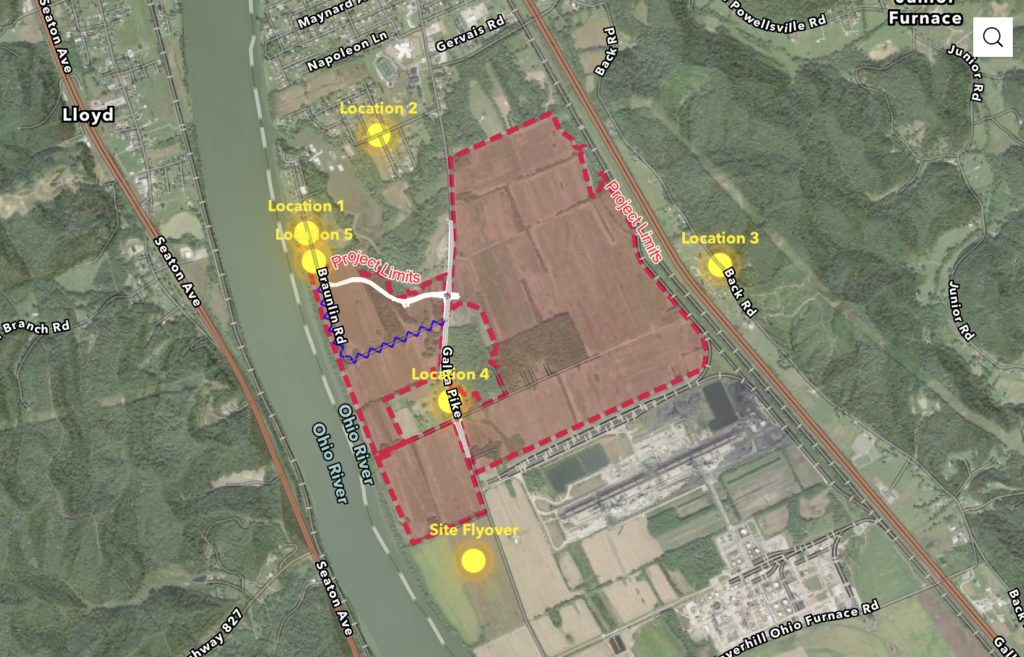
Google plans to build a data center in Franklin Furnace, an unincorporated community in Green Township on the Ohio River.
County commissioners approved a 15-year, 75% tax abatement for the property earlier this year. In addition, they negotiated a $500,000 annual payment-in-lieu of taxes.
While the development was originally reported to be 500,000 square feet, a June EPA filing states the provide a minimum of 1.7 million square feet of data center building space. That’s about 40 acres.
A website created by project developers states that construction will begin this year and is estimated to be completed in 2029. The data center will include an AEP substation.
The website does not clarify the center’s megawatt capacity, nor does it provide information about water use or long term job numbers.
An isolated wetland permit says the project is estimated to provide 200 permanent jobs and up to 500 during the construction phase.
Adams County
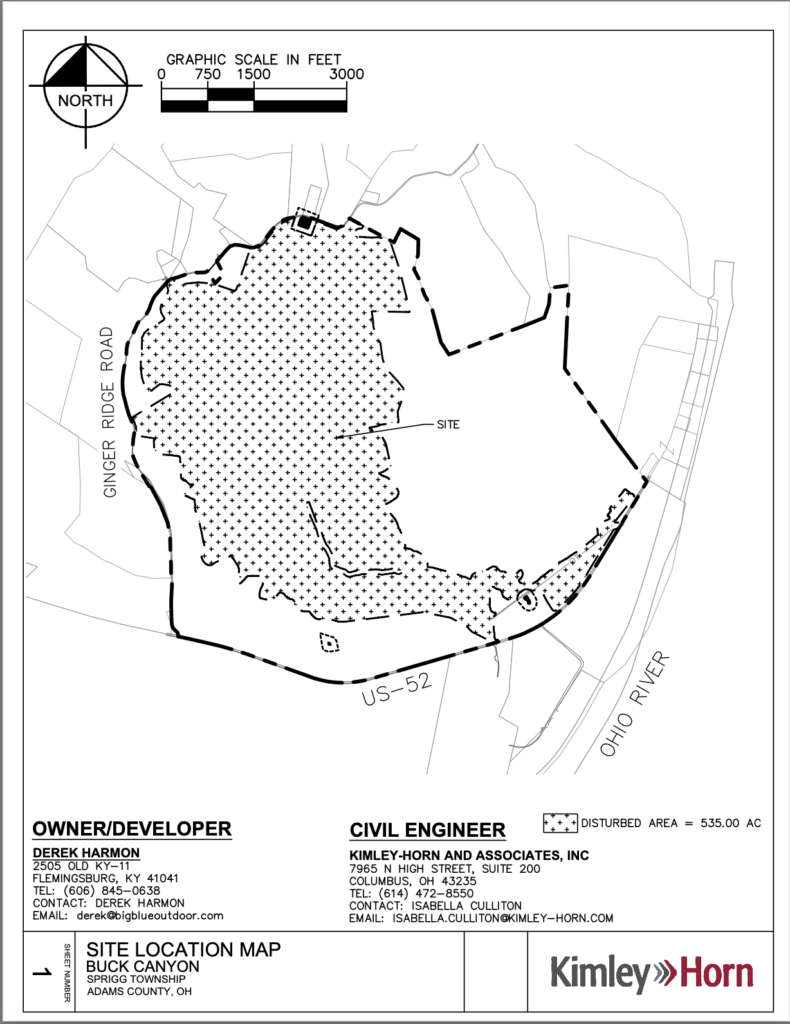
Amazon has expressed interest in developing a data center in Sprigg Township. Emails between county officials and Amazon representatives suggest the development would be located on a former Dayton Power & Light landfill on Ginger Road, and has been under consideration for at least two years.
However, county commissioners say their conversations with Amazon have been preliminary and that no project is finalized.
A county webpage about the development promises at least 500 long-term jobs, though county commissioners said in a meeting last month they have not secured a formal commitment.
An invoice from Argus Growth Consultants for services to county commissioners suggests that they considered a 30-year, 100% tax abatement under a community reinvestment area. No formal tax agreement has been announced by the commissioners or county economic development director.
The 1,016 acre site in Sprigg Township was purchased by Buck Canyon Properties LLC in 2024. Buck Canyon has since filed a wetland permit to construct 12 buildings on the property for “light industrial use.” Another company, 68 Yards LLC, has also filed wetland permit requests for the site.
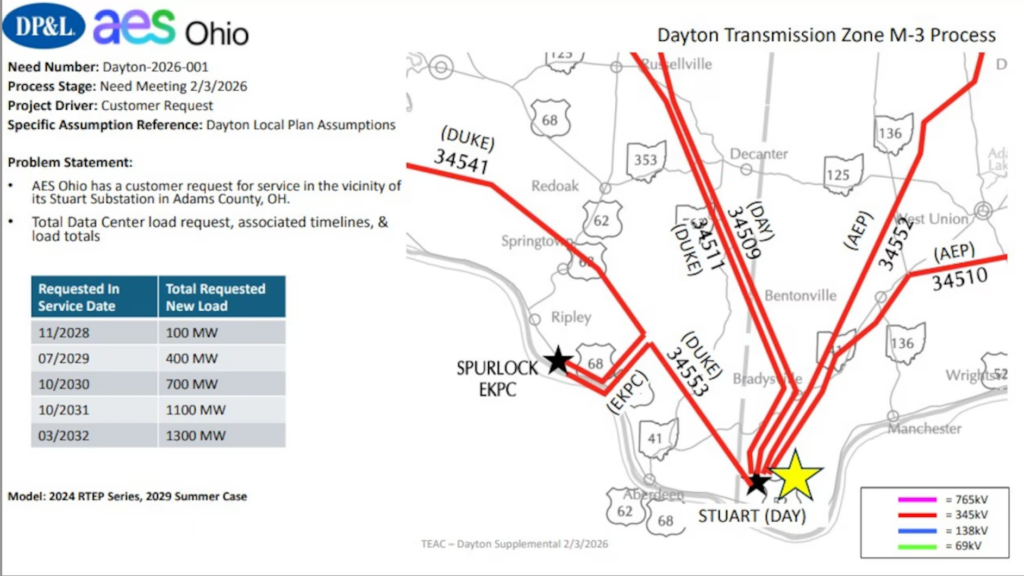
A 2026 regulatory filing from AES Ohio for PJM’s Transmission Expansion Advisory Committee suggests a data center near its Stuart Substation, (in Sprigg Township) could use 1300 megawatts of electricity by 2032.
The Buck Canyon project began in March. A stormwater pollution prevention plan filed with the Ohio EPA for Buck Canyon estimates the project will be completed in 2029.
A series of emails between Amazon representatives and Adams County’s economic development director suggest that the company considered taking water both from the Ohio River and from the Adams County Rural Water District’s wellfield.
In the emails, the general manager of the water district confirmed that the agency will serve Amazon’s water needs for the project, though it’s unclear if a potential data center would still withdraw from the river as well.
Brown County
Mt. Orab, a village in Brown County, is expecting a data center project after an industrial site over 1,000 acres sold last winter. Village public officials signed nondisclosure agreements regarding the development, limiting what’s been revealed publicly.
A purchase agreement for the site confirms that company DB STU LLC purchased the land with the intent to develop a data center. The business license for the company is signed by Toreak Acquisition Corp., a shell company incorporated in Delaware.
According to reporting from HunterBrook and state outlets in Louisiana, two other companies represented by Toreak are affiliated with Meta. Pelican Leap LLC is a subsidiary of the company, and Laidley LLC is an affiliated shell company and real estate developer for Meta.
Coshocton County
Aligned Data Centers, a company that develops and operates data center campuses, is building a 197-acre data center in the Conesville Industrial Park.
Tiffany Swigert, Coshocton County Port Authority executive director, said the data center’s final buildout will have a capacity of 340 megawatts. Swigert said the project is expected to create more than 1,800 jobs during construction. In the long term, Aligned said it will create 149 jobs.
Swigert said Aligned has not been granted any property tax abatements. However, the county did structure a TIF, which will redirect taxes on the property’s improvements to an escrow fund. The fund will be used to repay a state loan that financed the extension of city water services to the entire industrial park. Those municipal services will support the data center, as well as any future developments on the Conesville site.
Swigert estimates that the local school district and vocational school will gain about $2.3 million in new annual tax revenue.
The data center will receive its power from the grid. Swigert emphasized that Aligned will bear the full cost of its electricity use, “ensuring that the campus will not impact electricity rates for local residents and businesses.”
The impact of data centers on electric costs is complicated. Even if data centers pay for their electricity like any other customer doesn’t mean rates won’t go up. Nationally, the addition of more data centers customers may have diluted electricity costs. But what happens state to state depends on local power supply.
Ohio is overseen by grid operator PJM Interconnection, the nation’s largest power grid operator. Right now, demand is outpacing PJM’s supply and infrastructure, driving rate increases for consumers.
A draft air pollution permit issued by the Ohio EPA last fall suggests the data center could also use 41 high-capacity, industrial diesel generators for backup power.
Coshocton’s city water supply will support the data center. The development will use a closed-loop system, which cools and recirculates the same water for servers rather than requiring a constant intake of new water.
Swigert did not clarify what that initial water input volume would be.
When it comes to other water uses, Aligned projects that it will require less than 10,000 gallons per day for all four of its buildings.
The data center is expected to come online sometime this year.
Note: An earlier version of this story stated that Aligned Data Centers was developing a data center in Ross County. The company involved is named Aligned, but is not Aligned Data Centers. We corrected the story at 11:30 a.m. Aug. 12, 2026, and apologize for the error.
