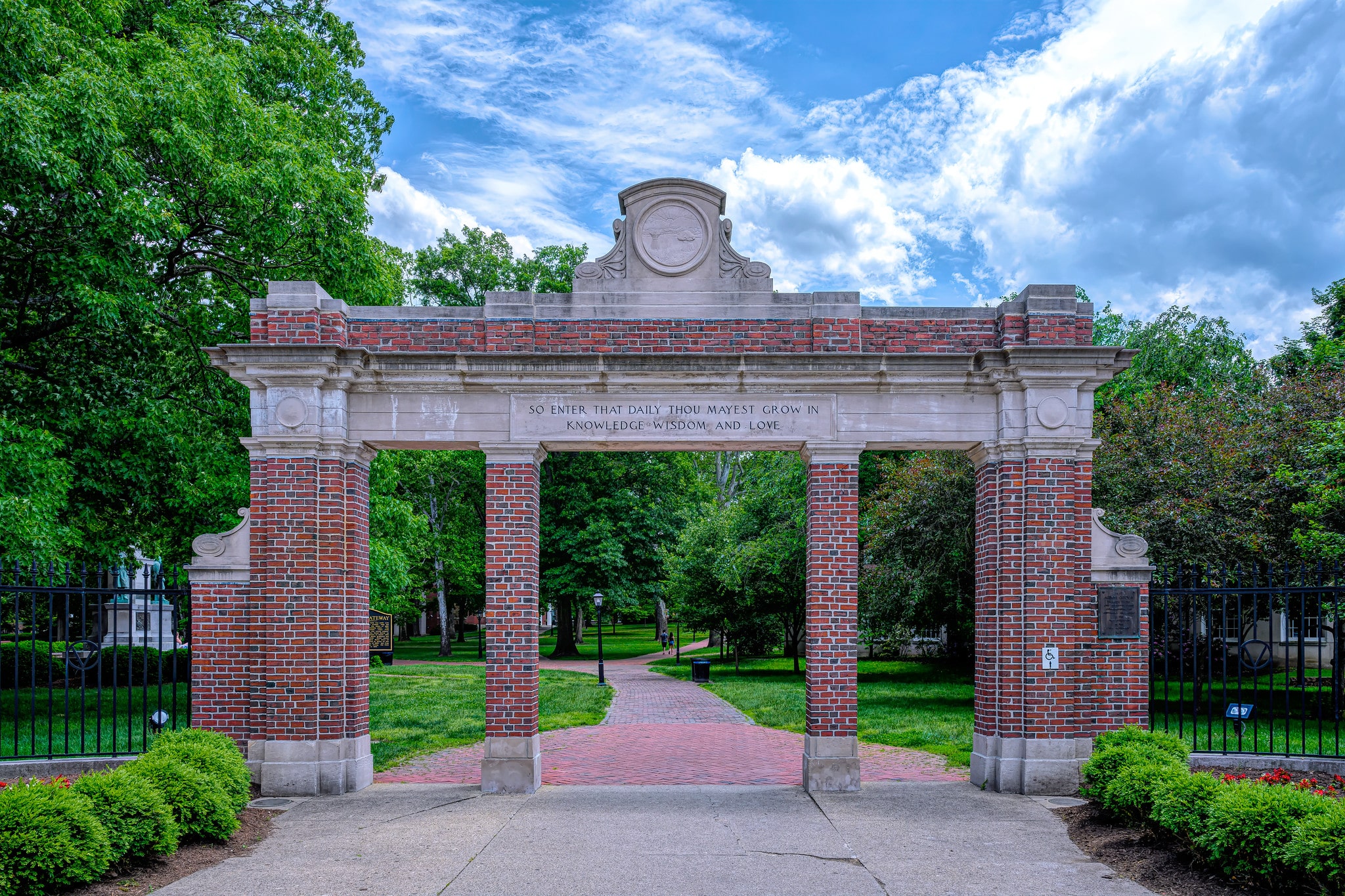
ATHENS, Ohio — As fall semester starts at Ohio University, students will return to a campus stripped not only of its diversity centers and programs – but also of most of the people who made those programs run.
Ohio University eliminated a total of 21 filled and vacant positions when it sunset its Division of Diversity and Inclusion to comply with the Advance Ohio Higher Education Act, or Senate Bill 1, on June 21, OU Senior Director of Communications Dan Pittman told the Independent in an email.

Most employees whose positions were eliminated were unable to continue work at the university in any capacity, according to the Independent’s review of affected employees within the Division of Diversity and Inclusion.
“It was an honor to lead such an amazing group of passionate people,” former Vice President of Diversity & Inclusion Russell Morrow said in an email. “It devastates me that they, many who are OU alumni, will no longer be pursuing that passion at OU after having done so for years, and in some cases, decades.”
Pittman said the communications office does not have information on the exact number of former Division employees who remain employed by OU; the Independent has submitted a public records request to confirm that information.
Micah McCarey, the former director of the OU Pride Center and an at-large Athens City Council member, said he is not “presently aware of any of my colleagues from the Division of Diversity and Inclusion outside of classified staff members who found new employment with the university and are still here.”
OU generally offered standard separation benefits to affected employees.
“In total, all impacted employees were provided an extended period (eight weeks) to consider their options, both within and beyond OHIO, before their positions were eliminated on June 23,” Pittman said. “Additionally, they received a 90-day notice period after June 23, which is part of OHIO’s standard separation benefits; moving forward, they will also remain automatically eligible for interviews for internal positions for which they meet minimum qualifications.”
The university’s approach contrasts with that taken by other institutions in the state. The University of Cincinnati, for example, offered all employees affected by the closure of its identity centers new roles within student affairs, and a representative from The Ohio State University said OSU also worked to reassign affected employees.
McCarey said OU’s decision not to take that approach is “probably the most difficult element to understand in this situation.” He called the approach taken by UC “a far better position to leave employees in.”
McCarey said he is continuing to seek employment at OU and is unaware of what his next steps will look like if he’s unable to find it.
“It’s my personal hope that there will be a professional opportunities for me at Ohio University, and that would best align with my goal to stay in Athens and to maintain my plans to serve as [Athens] City Council president starting in January, all of which would be dependent on me residing in Athens,” McCarey said.
Morrow, meanwhile, is looking for ways to continue serving the Athens community outside his role with OU.
“I am exploring how I can continue to provide value to the community and recently established an LLC as one of my avenues to do so,” Morrow said in an email. “As an alum of Leadership Ohio, I was also recently selected to be a member of the organization’s Civic Salon, where I will represent SE Ohio in statewide conversations, advocacy, and initiatives that promote civic health, social life, and community engagement across the state.”
“As an OU alum and resident of Athens, my love for the university and the community isn’t tied to a position, a paycheck, or even a decision as significant as terminating the Division of D&I,” Morrow said. “Rather, it comes from my experiences and relationships within the community, and from my hopes for what we can do and become, despite current challenges.”
Morrow and McCarey both emphasized that the Athens community has risen to the challenge to support students affected by the closure of OU’s Diversity & Inclusion program.
“There was, and continues to be, so much support, advocacy, and partnership from the community on and off campus,” Morrow said. “We saw it with Black Alumni Weekend in the spring and I think we’ll continue to see it in so many other ways, particularly as students come back to campus.”
The Athens County Foundation launched the Athens County Pride Fund to support the local LGBTQ+ community.
Meanwhile, United Campus Ministry has accepted books and other resources formerly held by OU’s Pride Center. UCM Executive Director Ari Faber said he hopes to see students affected by the closure of OU’s diversity centers use UCM spaces, and that UCM hopes to host LGBTQ+-focused programming over the next year.
However, McCarey said a great deal has still been lost by the closure of OU’s diversity centers.
“There’s so many levels of loss to consider here,” McCarey said.
“It starts with the loss that prospective students feel when they … [see] that we don’t have the same level of formal support that other institutions might have,” McCarey said. “And then there are the students who have actually benefited from our Division of Diversity and Inclusion and its three centers in their time as students and will be returning to see those physical spaces absent and those staff members absent.”
OU has temporarily repurposed the space that formerly housed its Multicultural Center as the “Visible Student Lounge,” according to an update OU President Lori Gonzales shared on June 23, the date the diversity centers officially closed. The space “is reserved for any and all students to gather, to express their unique identities and perspectives, to connect across differences, to practice dialogue and to learn from each other,” the email said.
Meanwhile, the former site of the Women’s Center now hosts an informal student lounge space, and the Pride Center is now “a reservable meeting space for student organizations,” the email said.
“These plans are intended to serve as a temporary response to immediate needs for the 2025-26 academic year as we engage further with our University community to design the best use of these spaces long term,” the email said. “This will also serve as a pilot to help us determine if, and how, students utilize informal student meeting space in Baker.”
McCarey said he was glad to see that the spaces will continue to emphasize student use.
Correction and Note: A previous version of this story did not include McCarey’s first name and title. We regret the error. Also, this story has been updated since original publication to include information on OSU.