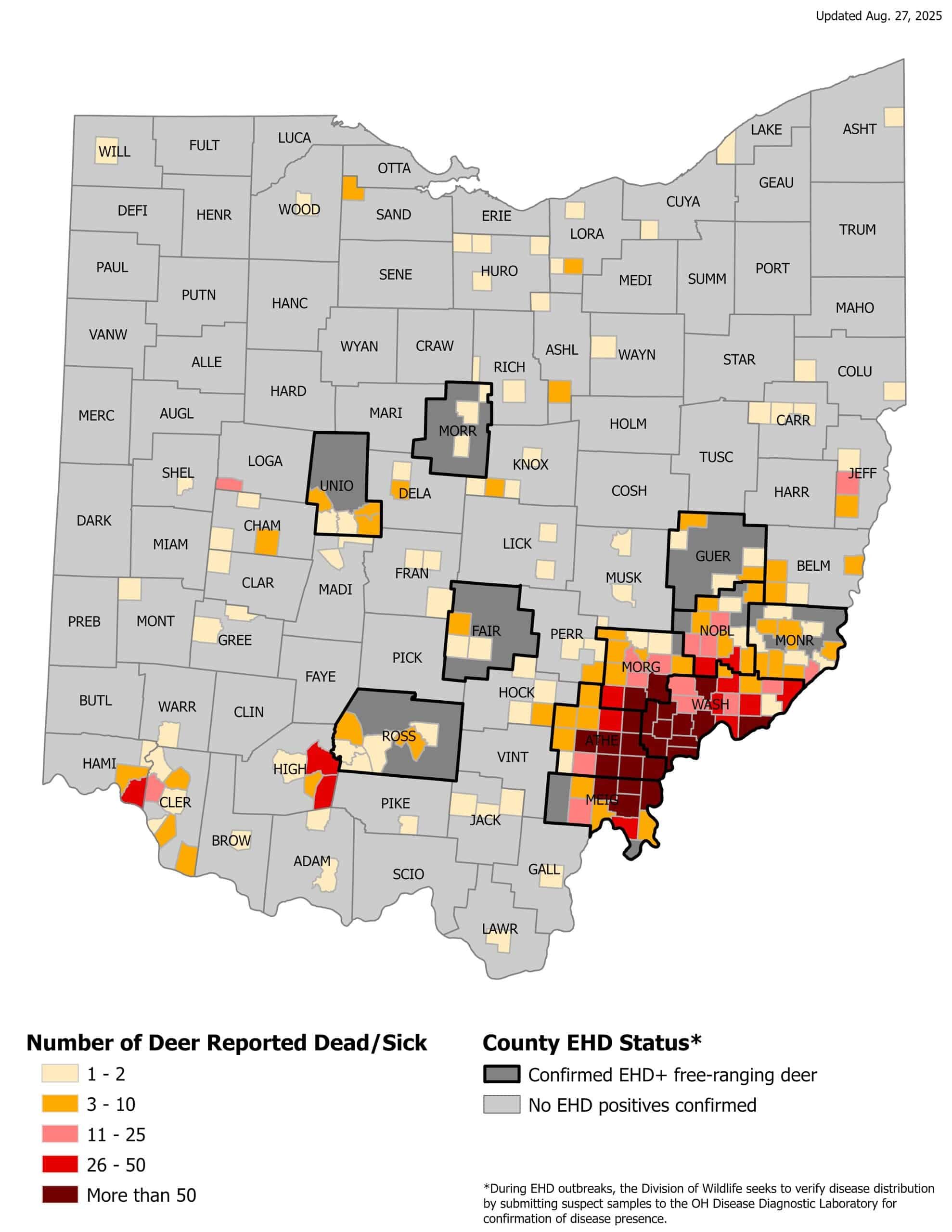

ATHENS COUNTY, Ohio — An outbreak of Epizootic Hemorrhagic Disease is killing deer in southeast Ohio, and Athens County is at the epicenter.
Among the most common deer diseases, Epizootic Hemorrhagic Disease is spread by small biting flies called midges. Deer infected with the disease may lose their fear of people, have visibly swollen facial features and may lose their appetite, according to the National Deer Association. Deer infected with EHD often die near bodies of water, as the disease also causes high fevers and dehydration.
“There’s cases of [EHD] that are documented every year throughout the Midwest,” said Lindsay Rist, a wildlife communications specialist for the Ohio Department of Natural Resources.
The disease’s lethality comes from its impacts on internal organs: fluid fills a deer’s lungs and they experience cardiac hemorrhaging. According to the Cornell Wildlife Health Lab, there is no treatment method for EHD and infected deer typically die within 36 hours.
EHD isn’t transmissible to humans. However, several livestock species, such as sheep, cows and goats, can be infected by the virus.
Public safety
So far, seven Athens County townships have had over 50 reports of dead deer. Every township in Athens and Washington Counties have had dead deer reports submitted to ODNR.
Two dead deer have been reported in the city of Athens, although it is unconfirmed if they died from EHD.
ODNR’s guidance for the public is relatively simple: Don’t touch the deer. If a deer dies on your property and you’d like to remove it, wear gloves.
Dead deer can be disposed of in several ways, according to Rist. Deer carcasses can be put out with regular trash as long as it has been bagged, buried, or dusted with agricultural lime, which dries out the corpse and helps with the smell.
ODNR encourages the public to report sightings of dead deer through the Ohio Wildlife Reporting System. Rist said that every reported sighting provides valuable data for ODNR.
One of the most important recommendations is to avoid eating any deer that appears sick or otherwise behaves abnormally. Rist told the Independent that if a hunter harvests a deer with EHD, it will still count toward their bag limit.
“I think most people who are out hunting are going to be able to observe the deer, or should take the time to observe the deer before they harvest it and know whether it’s expressing any of those symptoms,” Rist said.
Rist said that she hasn’t been involved in conversations about making sure hunters are aware of EHD, but are sure they are happening.
Bow season for white-tailed deer is expected to start on Sept. 27 and last until Feb. 1, 2026. Athens County has a bag limit of three deer for the 2025–2026 hunting season.
Next steps and misconceptions
Rist told the Independent that ODNR typically records a cyclical outbreak of EHD every five years in each of Ohio’s regions. The most recent outbreak of EHD in Athens County took place in 2022, when 169 dead deer were reported to ODNR by October 2022. This year’s outbreak has already surpassed that tally, with over 250 dead deer reported to ODNR as of Aug. 19, 2025.

EHD outbreaks are usually associated with droughts, as deer congregate around fewer water sources. These water sources are the breeding ground for the midges that spread the disease.
“We used to say we were kind of looking for [EHD] in association with drought conditions,” Rist said.
This year’s outbreak deviates from that expectation, as the region has recorded significant rainfall. Athens typically records 40 inches of rainfall annually. As of Aug. 13, the Scalia Laboratory for Atmospheric Analysis at Ohio University had recorded 44 inches of rainfall.

The unusual nature of the outbreak may provide researchers with insight into the spread of EHD and the environmental conditions that bring it about.
“I think [ODNR researchers] are definitely collecting all of that data,” Rist said. “We’ll see how [EHD] progresses this season. But that information is definitely being taken into consideration when looking at future management decisions or what our expectations are for how often to expect to see these kinds of outbreaks.”
According to Rist, ODNR verifies cases of EHD by testing tissue samples from dead deer for the virus. Since ODNR has already confirmed that EHD is spreading in Athens County, officials don’t plan to send more tissue samples for testing.
“We know that [EHD] is here,” Rist said. “So keeping track of the number of dead deer — most likely, the majority of them are going to be associated with the disease, and we’re just trying to track the severity and sort of the spread, the spread of the outbreak for this year.”
An increasing number of dead deer reports have been made to ODNR this month. Rist attributes this growing number to a mixture of public awareness around the spread of the virus and an increasing number of dead deer.
“Once you start a little bit of public outreach, then people are like ‘OK, I saw [a dead deer], now I can report it,’” Rist said. “Our officers, our research techs here, they’ve been getting tons of calls for the last three to four weeks”
Some misinformation has already been spreading about the outbreak. Social media posts in hunting groups have incorrectly referred to the disease as Blue Tongue. Blue Tongue is a hemorrhagic disease, similar to EHD, but no cases of Blue Tongue have been confirmed in Ohio.
“That’s a common misnomer,” Rist said. “Blue Tongue is a completely different disease.”