ATHENS, Ohio — Ohio University faculty and OU have tentatively agreed on a bargaining unit for a proposed faculty union and are moving toward a union election.
“[I’m] very excited, very happy and really looking forward to this election,” said OU faculty member and American Association of University Professors President John O’Keefe.
The development follows an expensive and lengthy legal fight. According to records the Independent obtained from the Ohio Attorney General’s Office, OU spent nearly $125,000 for OU’s labor counsel to contest the faculty union from March through October. A representative of the Ohio Attorney General’s Office confirmed OU paid for its labor counsel directly.
O’Keefe said he was “very frustrated with the long delay before these sit downs happened” and criticized OU for the expenses it has so far incurred fighting the would-be union, United Academics of Ohio University.
“I wish the university had simply just agreed to recognize our union,” O’Keefe said. “That would have saved everyone a lot of money and time and would have avoided a lot of major costs that could have gone to pay for faculty salaries, or other other key aspects of improving the university.”
Asked about its investment in labor counsel for this matter, OU Senior Director of Communications Dan Pittman said in an email, “Ohio University did not voluntarily accept or recognize UAOU as a Bargaining Unit to help ensure that all OHIO employees are provided ample opportunity to engage in the collective bargaining process; instead, UAOU was encouraged to follow the process outlined by ORC and monitored by the State Employment Relations Board.”
A timeline on an OU webpage projects that the union election will take place Feb. 18–March 4, 2025. The election will be conducted by secret ballot. Votes would be tallied by the State Employee Relations Board on March 17, 2025.
The webpage says OU reached a tentative agreement with national union organizers on the proposed bargaining unit in November.
According to a Nov. 25 email from the union’s legal representation, sent to the State Employee Relations Board and obtained through a records request, the tentative agreement is pending “some additional approvals.” The email stated that “the parties will know if there is a full, final agreement” by Jan. 25, 2025.
The composition of the faculty bargaining unit has been disputed by OU and union organizers for months, with OU seeking to exclude faculty in the Heritage College of Osteopathic Medicine and most faculty in the College of Health Science Professions.
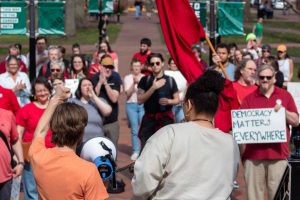
O’Keefe said the tentatively agreed upon bargaining unit does exclude HCOM and many CHSP faculty, but includes more CHSP faculty units than the bargaining unit OU had initially proposed.
Despite frustrations over the delay, O’Keefe said he was “really happy” to find that when OU did sit down with the union, “there was a lot of common ground, and a lot of agreement.”
He also said he was “happy that a lot of people are included in the non-clinical bargaining unit.”
Andrea Bender, a CHSP faculty member who would be excluded from the tentative bargaining unit, said, “It’s kind of hard to swallow. You know, during finals week, when you’re rushing around, you’re putting in extra hours trying to finish up the semester and do all the teaching things — it’s a little disheartening.”
“We have faculty who are instructor level only that don’t make the big salaries that maybe they could make in the private sector,” Bender said. “I think that it was disappointing to hear that certain disciplines, certain programs, would be excluded from a bargaining unit. … We’re not in it for the money, per se, but there is a level where the work that we do, we want to be respected and valued for the time and effort we put into our responsibilities as educators.”
OU has argued that clinical faculty units “operate distinctly from the rest of the general academic community at the University.” However, Bender said that argument shows that OU’s administration doesn’t “really know what we do on an everyday basis.”
O’Keefe said OU agreed that excluded faculty in HCOM and CHSP could hold a separate union election for a parallel bargaining unit without having to formally file for such an election.
The Independent did not receive a requested copy of the tentative bargaining unit by press time. OU did not directly address questions related to the tentative bargaining unit for UAOU or the possible parallel bargaining unit.
Bender said the idea of a separate bargaining unit offers “a little bit of hope it’s not a closed door.”
Despite the tentative agreement on the bargaining unit, this isn’t the end of the road for negotiations with OU.
In addition to the roughly $125,000 OU had already spent on its labor counsel over UAOU, O’Keefe said he is “concerned also about further expenses.”
“Universities often embark on a strategy of delay,” O’Keefe said. “We’ve seen attempts at other universities to also delay out contract negotiations and run up enormous, enormous legal fees in doing so, and I hope that the university works to move swiftly when we proceed into negotiations.”
Pittman said OU remains “committed to sharing information as it becomes available to help ensure that: 1) all faculty have a voice in the process and the outcome and 2) the University community has a broad understanding of the issues and impacts this process may have.”
According to records obtained from OU, the university has a $100,000 budget for work with the labor counsel assigned to this matter in fiscal year 2025, which started in July. By the end of October, OU had already blown through more than two-thirds of that budget, according to the records from the Ohio Attorney General’s Office.