
ATHENS, Ohio — Athens city officials made the case for a proposed income tax increase at a town hall Tuesday night, emphasizing the need for more general operating funds to avoid cuts to city services.
The 0.2% levy increase on income tax will appear on the May 5 primary election ballot as Issue 1 for Athens city voters. If passed, Athens would collect a total of 2.15% of income from employees who work within the city. This would raise an estimated $1.9 million in additional funds for the city in tax year 2027.
The city previously sought an income tax increase of 0.3% in 2025, which voters shot down by a wide margin.
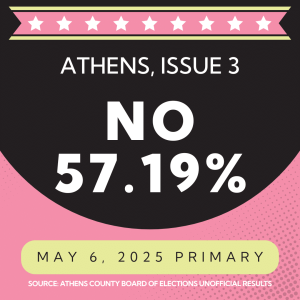
Athens Mayor Steve Patterson said at the March 31 town hall that the 2025 vote was why the city decided to seek a lower increase this year.
“We listened to the electorate that said ‘No,’” Patterson said. “We heard that this was too much at one time.”
Meanwhile, Auditor Kathy Hecht said of trying to pursue an income tax increase again, “We needed it the first time. We can’t just not keep running.”
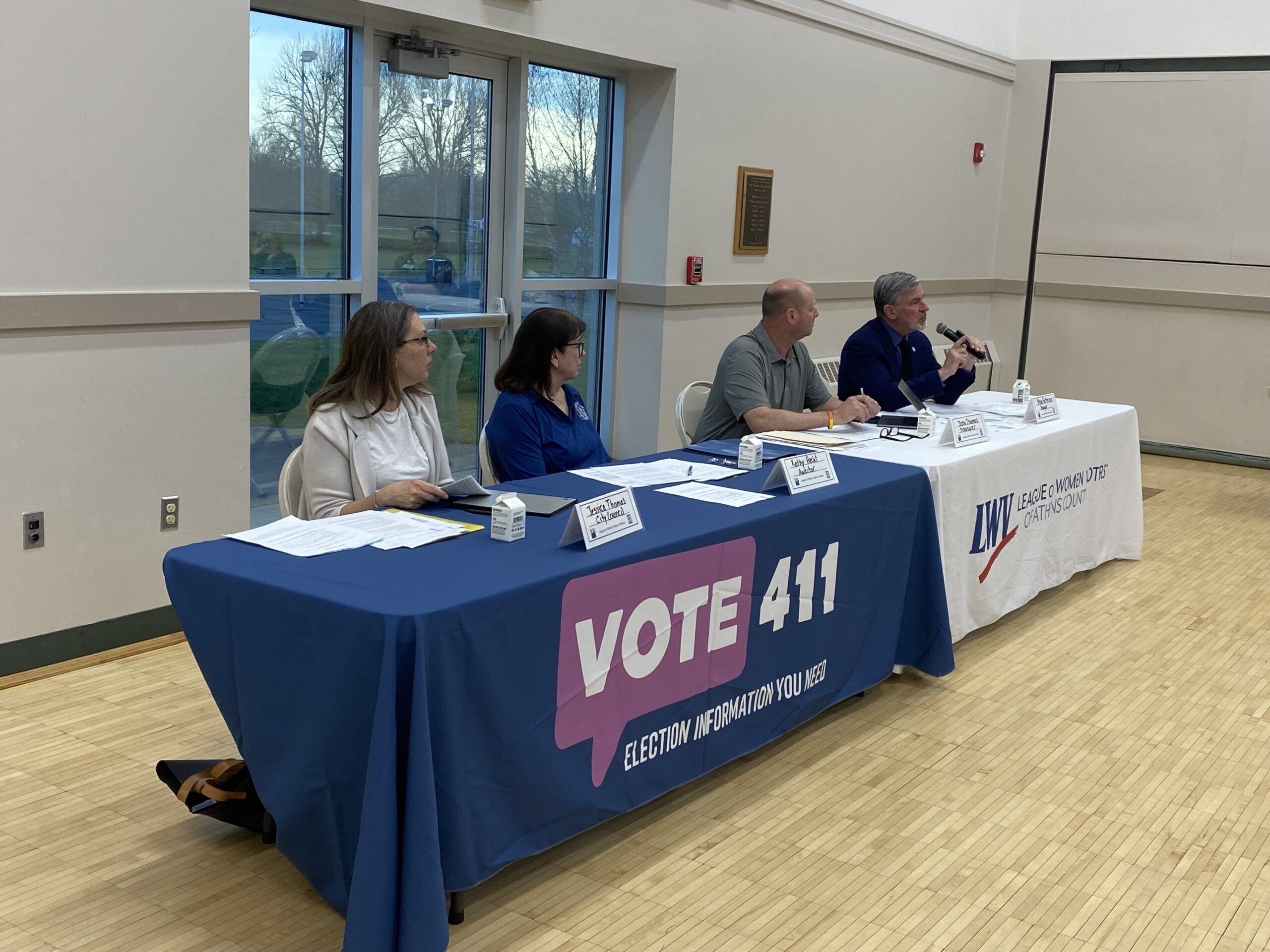
The March 31 townhall was hosted by the League of Women Voters of Athens County.
Where would the income tax go?
City Treasurer Josh Thomas shared an information packet at the town hall that breaks down how income tax would be divided out within the city, and shows the dollar impact of the increase by income bracket.
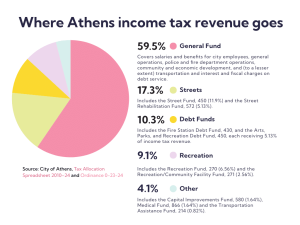
The tax increase would largely support the city’s general fund.
According to the city’s 2024 financial audit, the largest chunk of general operating expenses supported governmental operations that year, followed by expenses for the police department and the fire department. Smaller amounts funded transportation and community and economic development programs.
Josh Thomas said 70% of general operating expenses are on payroll costs for employees.
Just over a quarter of the income tax increase would go toward other city funds, including the Street Fund (15.5%), Recreation Fund (7%), Capital Improvements Fund (2%), Medical Fund (2%), and Transportation Assist Fund (1%).
Currently, 1.6% of income taxed by the city supports those funds in the same proportion, with the largest share going to the general fund. The remaining 0.35% of taxed income supports specific projects at fixed amounts, which would be unaffected by the income tax increase. Those taxes were previously approved by voters and are time-limited, with a 0.1% tax for street improvements set to expire in 2030, a 0.1% tax that funded the city swimming pool to expire in 2035, and a 0.1% tax that supported the new fire station to expire in 2042.
Why city officials say they need an income tax increase
Patterson said during the town hall that income tax is the main source of revenue for the city, and that it receives minimal funding through sales taxes and property taxes. In 2024, according to the city’s financial audit from the Ohio Auditor of State, over half of the city’s general operating revenue came from income taxes.
But, with the current tax, Patterson said the city has been struggling to make ends meet due to increased costs for materials, healthcare, and payroll. General fund expenditures have consistently outpaced revenue over the past 15 years, according to information from the Ohio Auditor of State.
Patterson said the city has taken several steps recently to address financial strain by reducing costs, including a soft hiring freeze and an early retirement incentive for city employees. He added that the city will “continue to look at some other healthcare reforms” to reduce costs for the city.
The current soft hiring freeze is causing greater strain on city employees, Patterson said. He added that ultimately, without more general operating revenue for the city, city services will begin to suffer.
“I would contend that people in the city of Athens by and large, except for those that I’ve heard differently from, that they’re pleased, by and large, with the way things have been going in the city of Athens,” Patterson said. “They’re pleased with the operations we’re seeing, with street repairs, with water lines, sewer lines, storm drains, with the workforce that we have.”
Josh Thomas said at the forum, “Our goal is not to try to expand anything, try to do anything extra. We want to maintain the services that you folks have come to enjoy and maintain the town that you want to live in. That is the ultimate goal.”
If the levy does not pass, Patterson said the city would likely have fewer employees on street crews and the city may not be able to maintain its current pace of street paving.
Patterson said the city may also employ fewer police officers and firefighters.
“It’s going to be stretching them further in terms of their own capacity,” Patterson said. “So that’s the level of service where we’re going to, over time, start to see some effects. We don’t want that to happen.”
Additionally, Patterson said there would likely be an impact on city parks and maintenance of aging infrastructure.
He emphasized, however, that potholes would continue to be filled and police and fire departments would remain responsive even if the levy doesn’t pass.
Other voter questions
In addition to questions about what the income tax levy would fund, and the consequences for the city should the levy fail, voters asked questions regarding the city’s healthcare expenditures, wages for city employees and impact on city residents, among others.
Comparison to similar municipalities
Athens City Council member Jessica Thomas responded to a voter question on how the city’s income tax compares to similar municipalities.
“Generally we are right in the middle. We’re actually a little at the lower end,” she said.
She referenced income tax rates in Ohio towns including Akron, Bowling Green, Kent, Lancaster, Logan, Marietta, Oxford, and Zanesville, which she said had income tax rates ranging from 1.85% in Marietta to 2.3% in Lancaster.
City employee healthcare
Several voter questions focused on the healthcare package for city employees. Josh Thomas said about 100 city employees are eligible for healthcare benefits. He said the city spent $5.7 million on medical costs in 2025, up from $4.9 million in 2024.
Josh Thomas said employees typically pay premiums anywhere between $90 and $150 per month, which support the city’s medical fund. Deductibles are $300 per family, with everything above that covered.
“It’s an excellent plan,” he said.
Asked whether the city would consider shifting more costs onto employees, Josh Thomas said, “We have to have those conversations.” He said that will likely be true even if the income tax levy passes.
“We’re looking at cost savings programs that we can do to try to reduce those numbers, but a lot of these things that happen to try to reduce those would require union negotiations,” Josh Thomas said.
The city’s union and non-union employees receive the same medical benefits, multiple city officials confirmed. Patterson said it’s important for the city to maintain a competitive healthcare package to avoid losing employees to other municipalities.
He said the training the city provides to police and fire department employees is costly, making retention all the more important.
“They’re of value. They’re valuable to me. I think they’re valuable to all of you,” Patterson said. “They know that they’re of value in other communities that might be offering higher wages or greater benefits, and that, like I said, that’s truly a challenge.”
Impact on residents, businesses
One voter asked why those earning income within the city should be required to support both their own rising costs and rising costs for the city. Patterson said the answer is “simple governance.”
“The general revenue that pays for employees, to include the benefits that, in some cases, keep them working for the city of Athens, comes from income tax,” Patterson said.
Another voter said that it is easier for the city to pay its employees more than private businesses, and asked why taxpayers should pay more “so city workers can stay ahead.”
Patterson said pay for city employees “needs to be commensurate with what service is being delivered to our citizenry.” He said the comparison to private businesses is “not a true apples to apples kind of a question.”
Wages for city employees
One voter asked about wages for lifeguards, among the city’s lowest-paid employees, and if the city would better compensate them if the levy passes. None of the city officials on the panel answered the question with a straightforward yes or no.
Currently, lifeguards are paid $12 per hour, Josh Thomas confirmed.
Katherine Ann Jordan later clarified to the Independent that Athens Arts, Parks and Recreation pays lifeguards “anywhere from $12-15.50 an hour depending on their status as a new or returning employee.” Pay is also based on their role designation, which varies from regular lifeguard/pool attendant, head lifeguard/pool attendant, and lead lifeguard/pool attendant, Jordan said.
City Auditor Kathy Hecht said that raising wages for the lowest-paid city employees would mean reevaluating wages for all employees.
“You start raising all the pay levels up, and then that costs the city more money,” Hecht said.
Last year’s income tax levy failure
Another voter asked why city officials felt the last income tax levy failed in 2025.
“We were asking for a 0.3% income tax increase, and I believe a lot of people were angry with the property tax jump [in Athens County]. And, I believe a lot of people were angry with the property tax jump,” Patterson said. He added that the city had no control over property tax increases.
Josh Thomas said the city didn’t come to voters early enough to explain why the city needed an income tax increase, and that, this time around, the city is trying to better inform voters.
Voter information
Early voting for the May 5, primary election begins Tuesday, April 7.
Some polling locations in Athens County have changed. Information on polling locations is available via the Athens County Board of Elections. To vote by mail, voters must submit an official absentee ballot request.
Editor’s note: This story was updated at 2 p.m. Thursday, April 2 to clarify lifeguard pay rates, and to make a correction: based on Ordinance 0-75-25, passed in August 2025, the Street Fund was increased to 15.5% and the Recreation Fund decreased to 7%.
