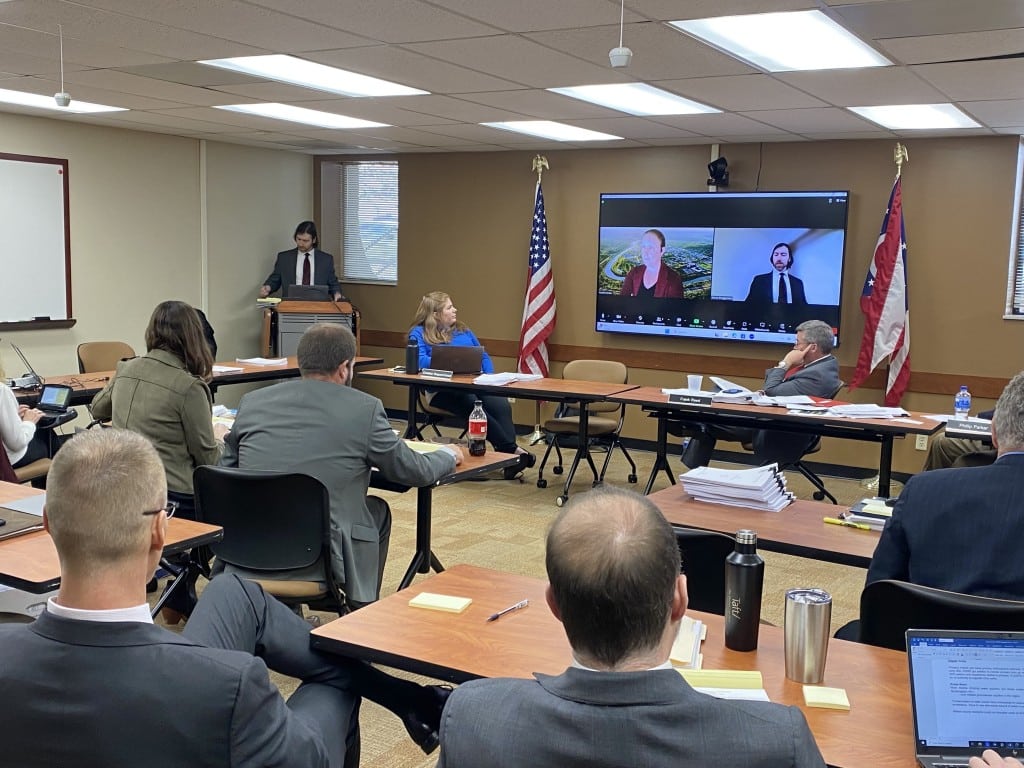
COLUMBUS, Ohio — The Ohio Oil and Gas Commission heard two days of testimony last week as it considers whether to reverse the state’s suspension of three fracking waste injection wells in eastern Athens County. The state says the suspension is necessary to protect drinking water.
The Ohio Department of Natural Resources Division of Oil and Gas Resources Management initially suspended the three wells, operated by K&H Partners, in May. The three class II wells are used to contain toxic wastewater from oil and gas production thousands of feet underground, isolating it from groundwater. The wastewater is commonly known as brine.
However, the division found that fluid injected into the wells had spread at least 1.5 miles underground, reaching oil and gas production wells in Athens and Washington counties.
The underground spread of fracking waste threatens drinking water and therefore human health and the environment, the division has said. The division has estimated that at least 20 water wells within a half-mile radius of the K&H wells could be affected, though it has not yet seen direct evidence of drinking water contamination.
The division’s expert witness on groundwater, Ohio University Professor Natalie Kruse Daniels, testified at the hearing that many people in eastern Athens County rely exclusively on private groundwater wells for drinking water. If groundwater were impacted, it may be difficult for residents to notice, she said.
If an impact does occur, Kruse Daniels said it would impact the community’s drinking water “in perpetuity,” and many residents may not be able to shoulder the cost of accessing clean drinking water.
“There is a risk to the residents of the community, and they deserve to be heard,” Kruse Daniels said.
“This is not a witch hunt”
K&H had and continues to have the option to create a plan that would bring its wells up to the division’s standards. At the hearing last week, Mike Stahl, director of water operations at Tallgrass Energy, parent company to K&H, said the only way the company believes it could meet the division’s standards would be to drill the wells substantially deeper, into a lower geologic formation.
Stahl estimated that this would cost $4 million, and said at the hearing it is not economically feasible. In court documents, the company valued its operation in Torch at $43 million. Tallgrass Energy is owned by the trillion-dollar hedge fund Blackstone, Inc., which claims to be the “world’s largest alternative asset manager.”
Instead of working with the division on a plan to address its concerns, K&H quickly appealed the state’s suspension order, both to the quasi-judicial Ohio Oil and Gas Commission, created to hear these types of cases, and the Franklin County Court of Common Pleas. The Franklin County case was later dismissed for lack of jurisdiction.
Following state, court and commission orders, the company has ceased and resumed injection into its wells twice throughout the unfolding legal process. The wells have now operated continuously since an October order from the Oil and Gas Commission allowed it to resume injection while the commission considers its appeal.
The commission decision came despite warnings from the state that any resumption of injection operations could create “calamity” in Athens County. K&H has argued the division did not have sufficient evidence to suspend its injection wells.
At the hearing last week, the company suggested the division was motivated to issue the suspension in order “to show [the U.S. Environmental Protection Agency] they’re doing something” as a result of a petition filed with the U.S. EPA last year by environmental groups, including groups in Athens County.
The petition challenges Ohio’s ability to regulate underground injection in its borders and initiated a legal process that has prompted U.S. EPA investigators to visit Ohio injection wells since last year, ODNR administrator Andrew Adgate said at the appeal hearing.
“This is not a witch hunt,” ODNR attorney Kara Herrnstein said in her opening statement at the hearing. She added that in the ODNR’s view, hundreds of injection wells “operate safely.”
Arguing the science
Much of the testimony at the hearing centered on debates around the scientific evidence presented by the division and K&H.
Stahl and a former consultant for K&H, Tom Tomastik — with whom the company contracted in 2020 to investigate reports that K&H wells were contaminating the nearby production wells — both emphasized differences in chemical testing at the allegedly impacted production wells as compared to the K&H wells.
The division argued, however, that it is impossible to use the chemical testing referenced by K&H to refute that the fluid appearing in production wells came from the K&H wells. The division’s expert witness in geochemistry, Michael Dolan, testified that “there are too many variables in the subsurface that can alter the chemical composition” of injected waste as it travels underground.
The division, for its part, emphasized that K&H’s wells are injecting into the Ohio Shale, a formation into which the division of oil and gas no longer authorizes new permits for injection. This brings Ohio regulations in line with other states. Adgate testified that injection into shale “is just not something that happens elsewhere.”
In 2019, the division found evidence that brine was migrating through fractures in the Ohio Shale from injection wells in Washington County, affecting many nearby production wells. Before that incident, “the Division did not contemplate that injected fluid could migrate in the manner described in that report,” according to its final suspension order of the K&H wells in June.
However, since 2019, the division has observed multiple instances of brine traveling along a similar directional trend, Adgate testified — in Noble County and, now, in Athens County.
Additionally, observations from the plugging of one of the allegedly impacted production wells appeared to demonstrate that brine was flowing into the well via the Ohio Shale, according to a division witness who oversaw the plugging operation.
Another division witness argued brine could be reaching the wells via the geology beneath the Ohio Shale. However, regardless of whether the fluid is traveling through one layer or the other, the division does believe such migration is occurring, Adgate said.
Also in supporting its case, the division pointed to pressure readings at the allegedly affected production wells, which appeared to show higher pressure when K&H was injecting, and lower pressure when K&H’s wells were suspended.
K&H attorneys said the commission should not take evidence collected after the division issued its suspension order into consideration. K&H attorney Chad Ziepfel said the division’s approach amounted to “shoot first and ask questions later.”
The company also argued the division’s science was sloppy, saying that the division did not conduct a sufficient number of pressure readings to draw any conclusions from the data.
“Even that post-order evidence … none of it adds up either,” Ziepfel said. “The pressure readings they give us are virtually useless.”
He added, “No expert witnesses will be able to say with any scientific certainty that the brine water in the production wells came from the K&H wells. … They saw brine water in the production wells and they simply speculated and guessed that it came from the K&H wells. That speculation is not a scientific conclusion.”
In her closing statement, Herrnstein said ODNR was and is convinced that its suspension order is lawful and reasonable. She pointed out that under state law, K&H must prove its wells are not impacting drinking water — rather than the division proving that they are.
“They can’t definitively say, ‘It’s not us,’” Herrnstein said.
She added that the only plans K&H has offered to address the alleged brine migration are “essentially using Ohio’s freshwater resources as a giant science experiment.”
“How long do we need to let Ohio’s water be threatened before ODNR is allowed to act?” she asked.
What’s next?
The Ohio Oil and Gas Commission, which will decide on K&H’s appeal, comprises five members appointed by the Ohio governor.
Under state statute, one member must represent a major petroleum company, one an independent petroleum producer, and one the public. One member must have expertise in geology, and one in oil and gas law. No more than three members may belong to the same political party.
Only three commission members considered K&H’s appeal at the hearing. One member did not participate in the hearing because his term on the commission was about to end. Another member, Brian Chavez, resigned from the commission immediately before the hearing, because he was tapped to fill the Ohio Senate seat vacated by now-retired senator Frank Hoagland.
Chavez, who represented major petroleum on the commission, now represents Ohio Senate District 30, including Athens County.
This left on the commission Frank Reed, the commission’s oil and gas law expert; Phillip Parker, the commission member tasked with representing the public; and Christine Shepard-Desai, the commission’s representative for independent petroleum.
In his law practice, Reed advises clients on environmental compliance and defends companies against “environmental enforcement” by the U.S. EPA and Ohio. He is a member of the Franklin County Republican Party Central Committee, according to his LinkedIn profile.
Parker is a business consultant who led the Dayton Area Chamber of Commerce for 26 years.
Shepard-Desai is legal counsel for Pin Oak Energy Partners, a small but aggressive Akron-based oil and gas company that operates both conventional wells and fracking wells.
K&H and the ODNR must file post-hearing briefs by Jan. 8, 2024. Reed, Parker and Shepard-Desai will decide the fate of the state’s suspension order.
Parties may appeal the commission’s decision to the Franklin County Court of Common Pleas.