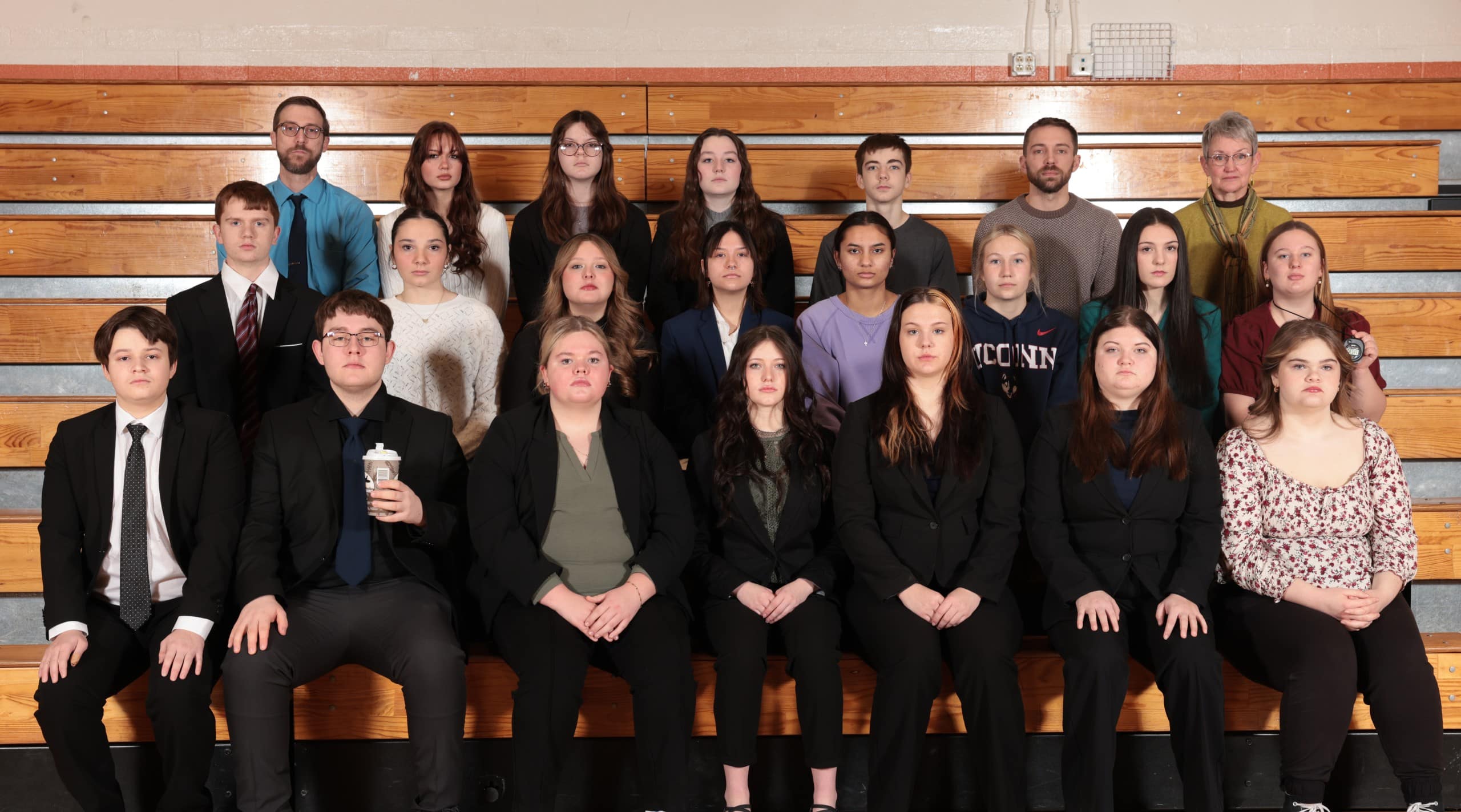

NELSONVILLE, Ohio –– When English teacher Casey Cox returned to Nelsonville-York High School after two days on jury duty in Athens County last year, he started talking to his students about the experience.
“I had such a fun time on jury duty, not only witnessing court procedures but taking part in them, that I decided it was time to try and start a mock trial club at our school,” Cox told the Independent.
His wife, a former mock trial club adviser, had previously encouraged him to start a team at NYHS –– but he first had to gauge student interest, which he did in fall 2025.
Recruited primarily by word of mouth, about 30 students showed up at the inaugural meeting, he said.
Most “didn’t know what they were getting into,” Cox said.
In mock trial, a team is composed of “prosecution” and “defense,” each with two attorneys and at least two witnesses. Each team has a timekeeper, who tracks parts of the competition for scoring, and a bailiff, who assumes the role and responsibilities a bailiff normally has in court, like swearing in the witnesses.
There proved enough interest to form two different teams, with 21 students representing grades 9-12. The teams competed for the first time Jan. 30, in mock trials at Hocking County and Washington County courthouses.
Nelsonville-York won one of its four trials, and two students were individually awarded for their competition performances.


Cox served as team adviser alongside teachers Suzanne Angle and Josh Bartlett; Timothy Warren, Assistant Prosecutor to Athens County, served as legal adviser.
“We all knew that we were going into this competition against well-established programs who have been doing mock trials for years, and we knew that it was highly likely that we would make plenty of rookie mistakes,” Cox said.
But students dove “headlong into this challenging case,” he said, “and learned a lot about themselves and case law in the process.”
How they did it
Each year, teams competing in the Ohio Center for Law-Related Education’s state mock trial competition are given identical information about a fictional case. The file includes a judge’s opinion, a summary of the prosecution’s and defense’s arguments, witness statements for six different witnesses, exhibits and an example of relevant case law.
The students then learn how to craft their arguments. During a competition, attorneys give opening statements, question their witnesses and question the other side’s witnesses, and give closing statements.
Practice began in October 2025 during 30-minute “flex” periods in the school day, when students choose activities relevant to their interests.
“From October to December, we met a few days a week, and in January, we met every day of the week –– when it wasn’t snowing,” Cox said.
They first spent a day going through this year’s case, and then watched video of the state finals from last year to better understand the responsibilities of each role on the day of the competition. The team then completed a survey in which each participant chose the roles they were most interested in, Cox said.
“Most students got their preferred roles, but there were some students who were gently pushed into a bigger role if they felt they had the skills to perform well,” he said.
Mya Schultz, a junior at NYHS, told the Independent she has dreamed of becoming a lawyer. In the fall, she joined the mock trial team.
On Friday, Jan. 30, she was named “Outstanding Attorney” for her trial performance.
“I never saw it as an option. I didn’t really know how to get involved or what paths there were,” Schultz said.
Since the competition, Schultz has researched pre-law majors and searched for classes she may be able to take to get college credit toward her future degree.
For her work in a separate trial at this year’s competition, junior Catalina Dixon was named Outstanding Witness.
Lessons learned
This year’s fictional prompt examined privacy, consent, and technology in a case about genetic genealogy evidence. The case combined forensic science, emerging technology and Fourth Amendment questions.
Cox said competition day was stressful and challenging, but that the students who participated had a positive experience overall, gaining public speaking skills and courtroom experience.
“Throughout our trial, even when we were a little confused on what objections to make, or trying to come up with new questions to ask our witnesses on the spot, we always looked like we knew what we were doing if we spoke with confidence,” Shulutz said.
Cox said the students’ “bravery and willingness to engage” in a new experience was a confidence-builder for the advisers, who were also new to mock trials.
Neither team advanced to the next round of the competition, but Cox said the teams were successful in winning one trial and multiple individual awards in their first year.
“We had an eclectic team of students who have bonded over the last three months, and the day of the competition strengthened those bonds even further,” Cox said. “I see students talking in the hallways who never interacted with each other before mock trial, and it’s so encouraging to see how this club has positively impacted our student body.”
He said a favorite but unexpected part of the process was the atmosphere of team camaraderie that mock trial fostered among students.
“They strengthened existing friendships, forged new friendships with students from other schools, and in the process, learned more about themselves and who they can aspire to be,” Cox said.
“We had so many students tell us that they already can’t wait for next year.”
Disclosure: Athens County Independent Creative Director Jen Bartlett is married to Josh Bartlett.