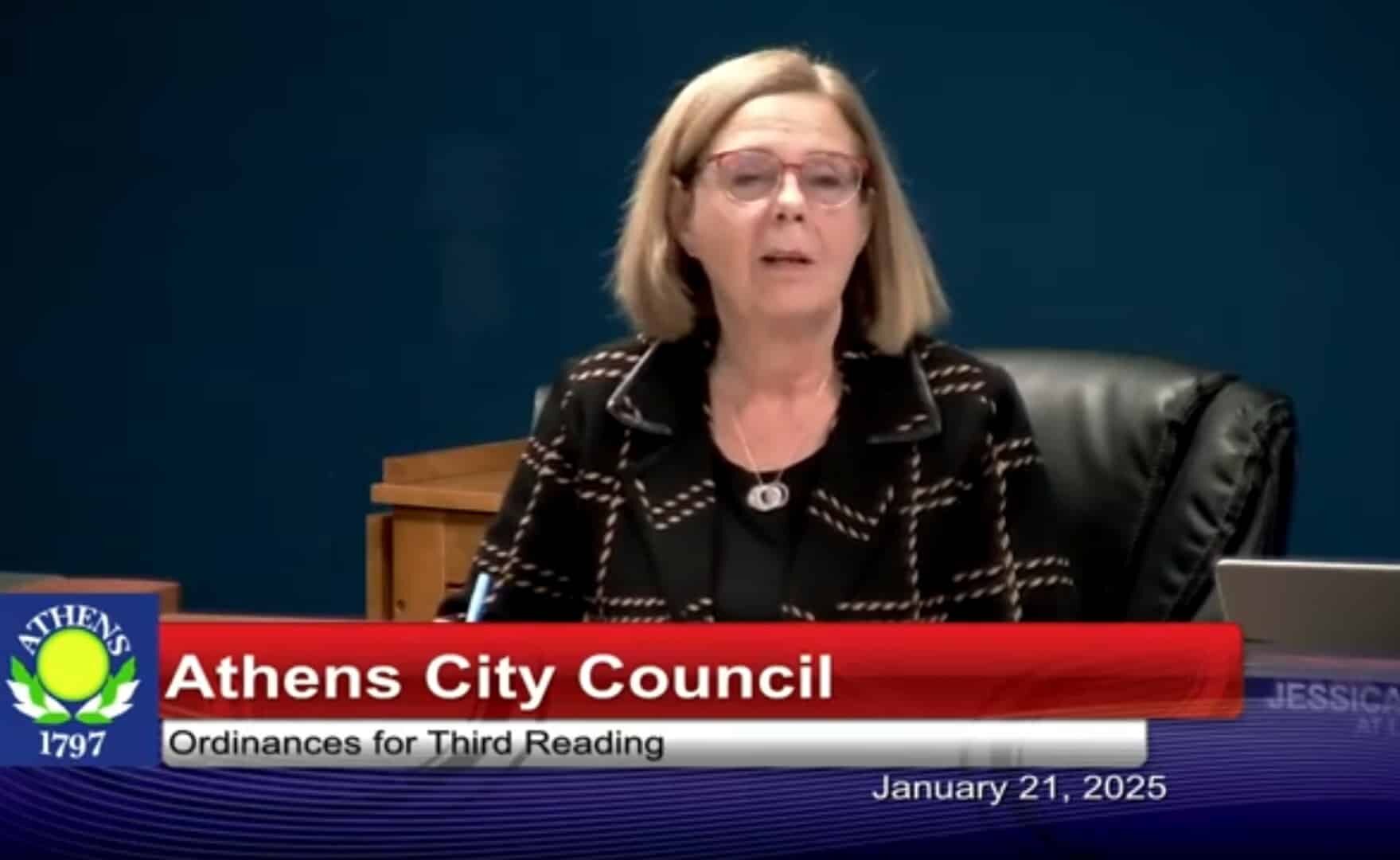

ATHENS, Ohio — Residents of Athens’ south side neighborhoods returned to Athens City Council Tuesday night to voice strong opposition to a proposed 50-unit affordable housing project on Pomeroy Road.
Spire Development applied to the city planning commission in November 2024 for a zoning change from single-family R-1 to multi-family R-3 residential for its proposed Pomeroy Landing project.
At its regular meeting Tuesday night, council heard first reading of an ordinance approving the zoning request, as well as a second to rezone five adjacent parcels from R-1 to small business (B-1). The ordinance was amended to remove the section involving the five parcels.
Councilor Alan Swank, 4th Ward, said the question of rezoning the five parcels needs to go before the Planning and Development Committee. If the request is approved, Swank said, the proposal would come back to council and be reintroduced as its own ordinance. Swank emphasized that the split would not delay the project.
Swank said after the meeting that the third reading of the ordinance is slated for Feb. 18. A public hearing on the project will be held Feb. 3.
The project would build a three-story building on just over 8 acres directly across the road from the south entry-exit of Coventry Lane. The parcel has a slope behind it and a stream nearby; nearby businesses on Pomeroy Road are often affected by heavy rain runoff from the direction of Coventry Lane.
Several property owners in the area, both homeowners and business owners, spoke against the project at council’s Dec. 9 meeting.

One of the concerns raised in December was about the increased risk of flooding on Pomeroy Road. On Tuesday night, Spire’s vice president of development, Sean McMickle, said the public’s project concerns have been taken “very seriously.” He noted that as a result of an engineering study of flooding impacts on nearby businesses such as Floor and Moore, the project would build a stormwater runoff system with an underground detention basin to mitigate the project’s impact on flooding.
Its creation “will actually improve storm water runoff on site,” McMickle offered.
Another concern — traffic — was raised again Tuesday night. Pomeroy Road resident Sharon Walker said speeding vehicles on Pomeroy Road cause accidents, including one in which a car careened onto the property of a local veterinary office. She called the road “extremely dangerous” because of speeding and the curvature of the road near the proposed project.
“Every time I pull into my driveway after work, I have to watch in my rearview mirror for cars coming up behind me to make sure they’re not going to run into the back of me,” Walker said.
She added that the veterinary clinic had one of its clients rear-ended as the vehicle was turning left into the clinic.
“They’ve also had to rebuild their fence four or five times and a shed on their property was recently destroyed last year by a car running off the road there,” she said.
McMickle also said that Spire engaged a traffic engineer to look at peak-hour traffic impacts from adding 50 housing units. The study found that the project would add 25 trips during work hours and 23 trips from 4–6 p.m. He said that was a nominal impact, equal to less than 2% of the traffic at the Pomeroy Road/Richland Avenue intersection.
“So in actuality, it’s a low volume of traffic that this type of development would produce,” he said.
Councilor Beth Clodfelter, At-Large, said she had also heard of traffic concerns in the Pomeroy-Richland Avenue area and asked if traffic-calming measures could be used. Mayor Steve Patterson responded that Pomeroy Road has a speed limit of 45 mph near the top of its hill and 35 mph near the project area. The speed limit could be reduced to 25 mph, he said, and that law enforcement could be stationed on the road at different times as well.
Speed bumps are not a possibility “given the sheeting of water across that surface,” Patterson added.

In a similar vein, Coventry Lane resident Adam Lewis said that parking would be a problem, because the project allots 55 spaces for 50 units. Many units will have two or more people living in them, he said, and they may look to Coventry Lane for overflow parking. That would pose a risk to children who often walk on Coventry Road, he said.
Patterson said after the meeting that drivers without permits are not allowed to park on a street for more than 24 hours. And even if they receive a permit, they are supposed to move after no more than three days.
Coventry Lane resident Aaron Leatherwood noted that the eight acres that would be used for the project were once part of a much larger farm that extended all the way to Pleasant Hill. The farm has been repeatedly subdivided into smaller parcels through the years; the project site is the last of those parcels to be developed –– and there is a reason for that, Leatherwood said.
“The fact that it’s a really bad development site — it’s not an accident because it’s the last little piece of land that nobody wanted,” Leatherwood said. He added, “The question is, ‘How desperate are we, and how much danger and risk are we willing to take on as a city to make this happen?’”
Before the city increases south side density, Leatherwood said, it should focus on building a south side community – “a real sense of place on the south side.” Otherwise, high density merely contributes to the “ghetto-ization” of the South Y area, he said.
Leatherwood and Lewis questioned Spire’s motives with the project. Developers of similar projects benefit from an exception allowing them to pay about 10 cents on the dollar on property taxes, Leatherwood said. For example, he said, the Kershaw Greene housing project just outside Athens on SR 682 pays property taxes on an assessed value of just under $13,000 per apartment. That is about 5% of the cost to construct those apartments, he added.
Lewis said council members should not allow themselves to be fooled.
“The reason that [McMickle] is interested in this project is because his company stands to make millions of dollars in tax incentives,” Lewis said. “That’s why he’s here; that’s why he’s been present at every single meeting; and that’s why he continues to come and you continue to give him time to speak, because he represents a huge financial benefit to his company and not the city of Athens.”
Lewis also mentioned Kershaw Greene, comparing its high density to Sandstone Family Apartments in The Plains and its less-dense approach. Kershaw Greene received more than 300 police calls in a 12-month period, while Sandstone had less than 50, according to Lewis.
“Which do you think we want to mimic and copy, from that example?” he posed.
Speaking in support of the project, Andrew Guidarelli, who said he represents a group interested in issues such as affordable housing, expressed appreciation for the city’s affordable housing projects. The city has a homelessness problem and affordable housing can help alleviate the situation, he said.
Stimson, Richland, Strouds Run bridge projects advance
Three bridge projects moved forward on first readings.
One ordinance authorizes spending up to $5.3 million for engineering services to rehabilitate the Stimson Avenue bridge. The funds will come from three sources: nearly $4.5 million from Small Cities ODOT Fund 589, T.C. 500; $830,000 from Street Rehabilitation Fund 572, T.C. 500; and $250,000 from Street Rehabilitation Fund 572. T.C. 500.
Spjeldnes, who chairs Council’s Transportation Committee, said the project will involve full bridge rehabilitation by removing and replacing the deck and parapets; repairing and rehabbing beams and abutments; replacing the lighting; and building a shared-use path on the south side of the bridge. Signals will regulate traffic and a crash barrier will be in place, Patterson said.
Councilor Michael Wood, Third Ward, said he wants the city to ensure plans are in place to avoid long, drawn-out delays in traffic flow as occurred with last year’s work on West Union Street and earlier work on Stimson Avenue.
Patterson said the project’s traffic flow plan should alleviate such concerns, and that he attended a “productive” meeting with Stimson business owners who appeared satisfied with the plan.
Swank said he wants to ensure traffic flow is maintained so that motorists who live on the far East side of Athens won’t cut through narrow roads on the near east side to get there. Appropriate signs for traffic will be needed, he added.
Another ordinance authorizes the service-safety director to enter into contracts for design, maintenance and additions related to the Richland Avenue bridge over the Hocking River, as well as the Strouds Run Road bridge over US 33. The project entails $240,000 from the unappropriated reserve going to Street Fund 220, T.C. 500; and an authorization to spend up to $262,000 from that street fund on the project.
Spjeldnes said that although the Strouds Run bridge is outside the city limits, it is an entry to the city. The bridge often has graffiti; Spjeldnes said a fence and barrier should be added to prevent graffiti as well as potential falls from the bridge. The Richland bridge needs similar work including coating on parapets. The Strouds Run bridge would include a City of Athens sign.
Swank suggested adding three to five artistic items related to the city of Athens to the Strouds Run bridge to greet motorists driving south on U.S. 33. Clodfelter agreed. Councilor Jeff Risner, 2nd Ward, said the city’s Municipal Arts Commission could be asked to coordinate the art work, perhaps using high school students.
Council also heard first reading of two first ordinances related to community recreational amenities. One involves an expenditure of $300,000 from APR Income Tax Fund 273, T.C. 500, to build a new restroom facility at the West State Street ball parks. Patterson said the facility will be in addition to the existing restrooms and concession stand. Council members described the existing restrooms as “gross” and not presenting a positive image for the city.
The other amenity ordinance would expand the city’s tennis and pickleball courts at a cost of $350,000. Most of the funds will come from APR Income Tax Fund 273, with $50,000 from ARPA Fund 286.
Another ordinance on first reading authorizes online auction of surplus municipal property, such as chairs and tables. It authorizes entering into an agreement with an online auction service to conduct the bids and awards.
Law director’s report
Only one council item Monday involved a third ordinance reading, which was approved. The ordinance increases the assistant law director’s pay grade to 11, an hourly compensation increase from $39.37 to $42.94. The current prosecutor position was set at pay grade 10, an hourly increase from $36.85 to $39.39.
City Law Director Lisa Eliason said she has hired a second prosecutor who will join the city ranks on Feb. 10. The position has been unfilled since October, despite active recruiting efforts.
Eliason also gave council her 2024 Annual Report. The law department prosecutes misdemeanor offenses both in the city of Athens and in unincorporated areas of the county through a contract with Athens County Commissioners. That amount from the county totaled $80,580 last year. The city’s budget for the Office of the Law Director and city prosecutors was just over $730,000.
Eliason and her staff prosecuted 1,748 cases last year, with one jury trial and two cases involved in appeals. In all, the municipal court handled just over 8,000 cases, including 1,454 criminal, 6,281 traffic and 271 OVI.
Of the 1,748 cases involving prosecutions, 800 occurred in the city, including Ohio University properties, while 948 occurred outside the city. Over 275 are still open and will be prosecuted this year.
Last year, 684 defendants entered diversion for driving under suspension, substance abuse, and offenses involving alcohol. Of the 8,006 total cases, 78% waived court appearance (paid the ticket), pled at arraignment, entered diversion, or were prosecuted by another jurisdiction such as the city of Nelsonville.
Sign hearing: no sign of objection
The council held a public hearing before its regular meeting to accept public comments on an ordinance to change the city code by increasing the size of political signs from 350 to 432 square inches.
A related ordinance had its first reading. Eliason said the city cannot regulate content of signs because of First Amendment protections, but can regulate sign size. Swank said the size increase places the city in the position of authorizing sign size as they are actually constructed, 432 inches.
Athens City Council’s next regular meeting will be at 7 p.m. on Tuesday, Jan. 21, in Athens City Hall, Council Chambers, third floor, 8 E. Washington St. Meetings are also available online. Regular sessions are on the first and third Mondays of the month; committee meetings are on the second and fourth Mondays.