ATHENS, Ohio — While Ohio University’s Pride, Multicultural and Women’s centers no longer exist, their legacies live on within the university and Athens communities.
The university closed those programs earlier this year to comply with Senate Bill 1, the Advance Ohio Higher Education Act.
As the act moved through the Ohio Legislature, University Archivist and Records Manager Bill Kimok spoke with the directors of each center to ensure their books, papers and other materials were preserved in the Robert E. and Jean R. Mahn Center for Archives and Special Collections.
“Even though it was a hectic ending, it was an organized way to do all of this,” Kimok told the Independent.
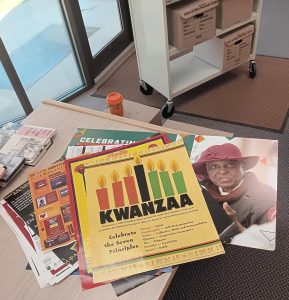
A large variety of materials including books, posters, newspaper clippings, and pamphlets were gathered from the centers.
Some of the archives were also sent to other organizations around Athens. For example, Kimok contacted Trevellya Ford-Ahmed with the Mount Zion Black Cultural Center about the more than 15 boxes of books and other items collected from the Multicultural Center.
The books, posters, flags and more will be displayed in the Mount Zion Black Cultural Center, expected to open in October 2026.
Materials from the Pride Center — including its wardrobe for transgender students — went to the United Campus Ministry.
“We saved everything we could,” Kimok said.
Mahn Center student employee Olivia Ondrik was part of the team that went into the centers to collect everything after the closures.
“It was an interesting experience having to take everything out,” Ondrik said. “There were things going on with the transfer of space while we were there — which is really upsetting.”
Digital archives
Physical materials weren’t the only items to be saved. Digital Archivist Aurora Charlow was tasked with collecting and preserving a wide range of digital content from the centers.
As digital archivist, Charlow oversees the acquisition, arrangement and access of digital records, which encompasses old ways of filing information, like converting floppy disks to modern hard drives.
Charlow said a vast majority of the digital records, like email accounts, OneDrive and SharePoint information, were transferred to OU’s Division of Student Affairs. However, Charlow was able to preserve a variety of other digital materials. For example, Charlow downloaded Canva graphics, newsletters and more to be saved before each center’s social media accounts were deleted.
“It was really a matter of prioritizing the stuff that was going to be left out of the official records transfer and the stuff that the directors felt comfortable sharing and wanted saved,” she said.
The university could not extract files from approximately 60 floppy disks from the Pride Center. Using money left over in the Pride Foundation account, which is managed through OU, Charlow contracted with a vendor to retrieve the files.
Charlow was surprised by the volume of student work recovered from the centers, particularly on their social media accounts.
“I am very glad to be able to have copies of it because it’s a massive amount of work,” she said. “It’s a really strong representation of the kind of really great work that students are capable of doing.”
Charlow anticipates that the centers’ digital archives will be available on a new platform by the end of next summer.
The archives’ impact
Efforts to retain and preserve the centers’ documents and artifacts is important to maintain their history and stories, Kimok said.
“I like to say, ‘rescue things,’ because if we hadn’t, then people in the future wouldn’t have this material to know that we were once making progress,” he said.
The materials will comprise a new collection at the Mahn Center called Memories of the Ohio University Student Centers.
The Mahn Center launched a survey for students, staff, alumni and community members to share their experiences at the centers. Kimok said there haven’t been many reactions yet, and most responses have been more angry about the centers’ closing.
“I understand that emotion, but I was hoping we get more, ‘This is what it meant to me, this is how I experienced,this is how I think I’ll experience it from here on,’” Kimok said. “I don’t think we’ve had a lot of that.”
The archives have also been used in classes that the Mahn Center offers to professors to bring their students. The classes allow students to explore the archives and reflect on them.
“We get things out and let the students go around the room and identify things and talk about what it means to them,” he said.

Despite the rapid changes at OU, Kimok still hopes that the preserved materials will inform current and future students.
“This all grew organically, and so what we all wonder is — can it ever be put back together again?” Kimok said. “Probably not in the same way, no matter what happens politically — it’s all going to hopefully develop, but develop differently.”