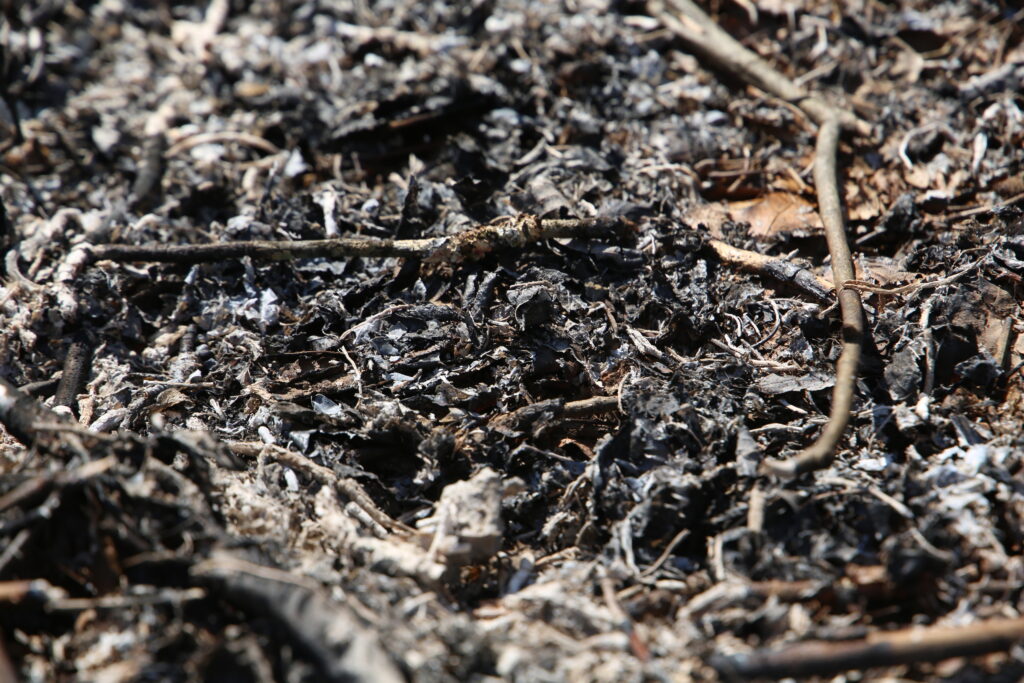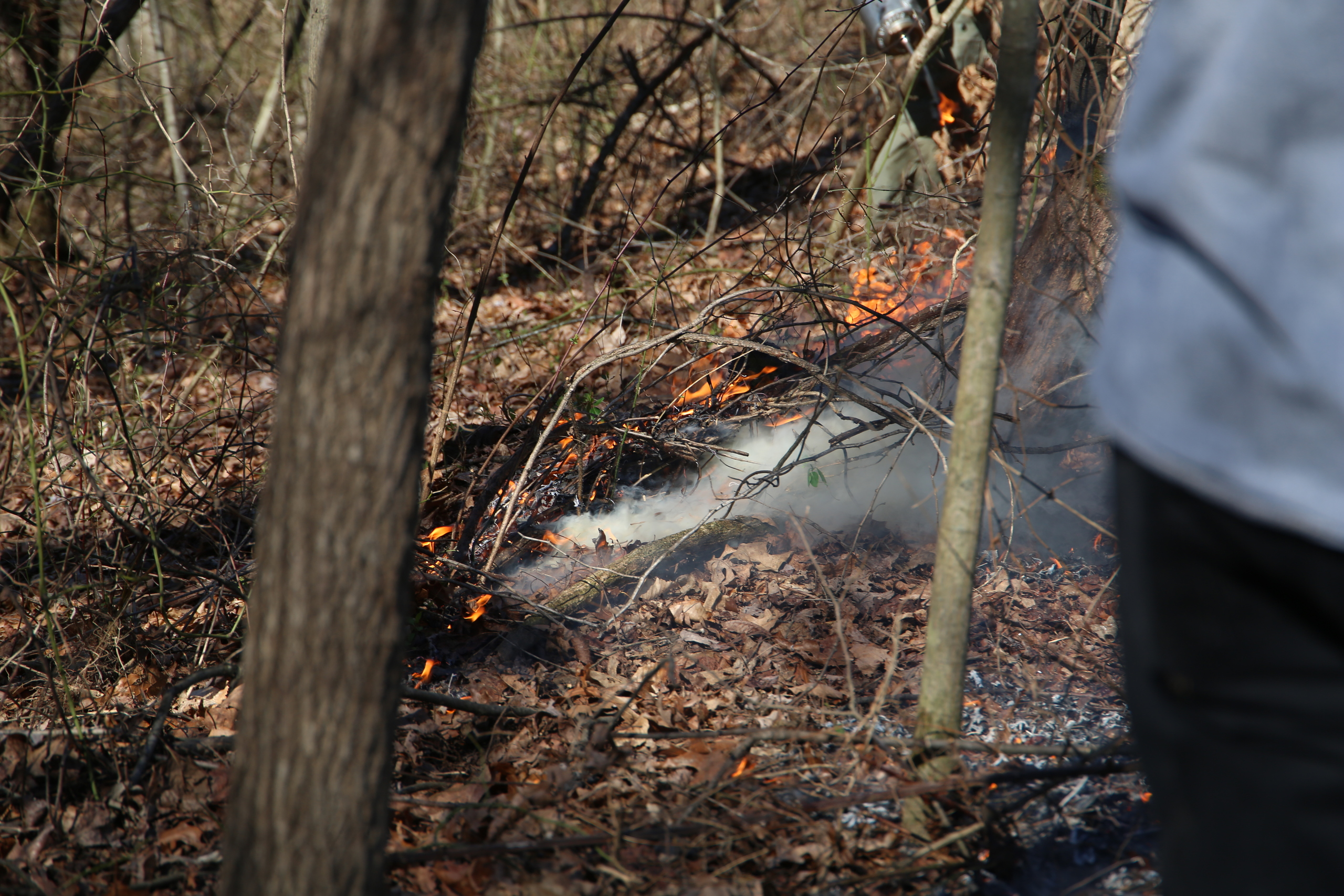
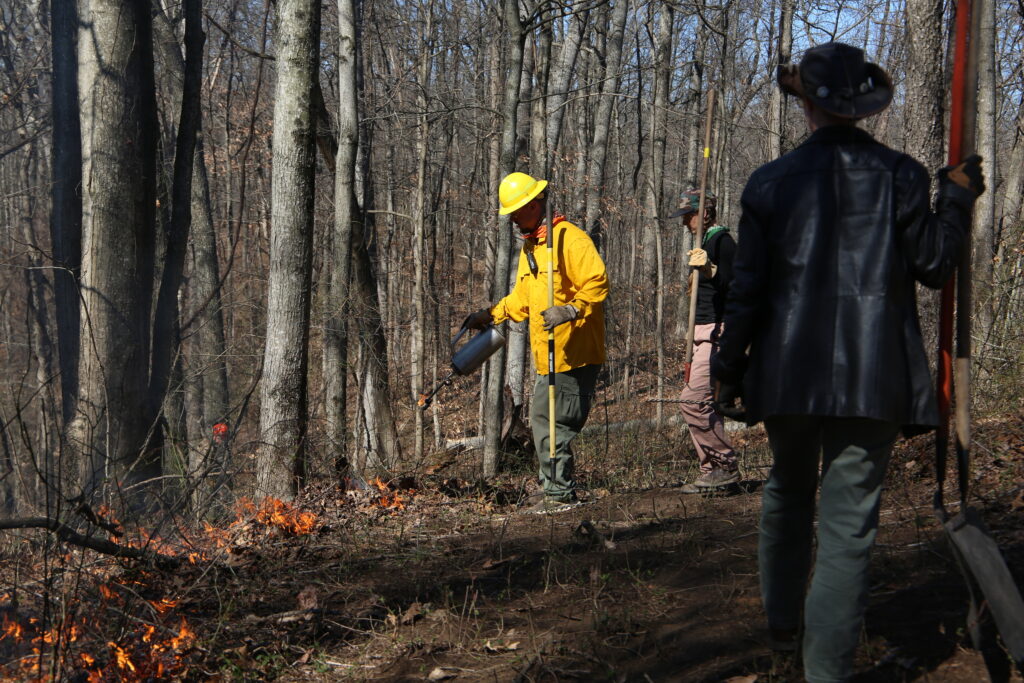
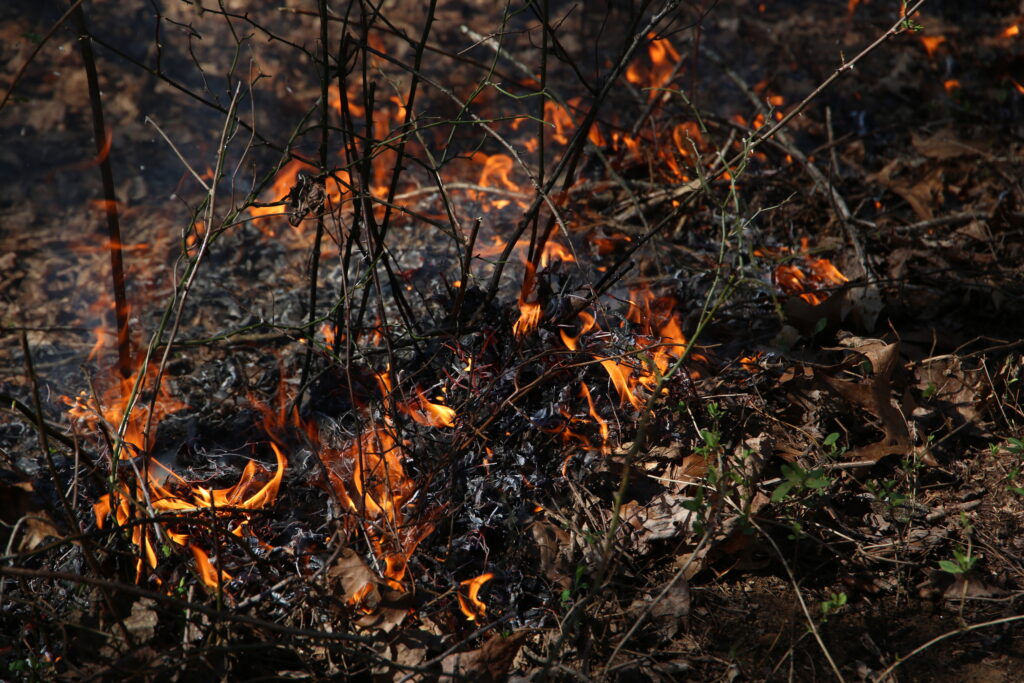
MILLFIELD, Ohio — Clad in high-visibility clothing, Badger Johnson scatters a flaming mixture of gasoline and diesel on the ground around him to ignite the forest underbrush.
Johnson isn’t an arsonist. He is a certified prescribed burn manager, working to clear out invasive plants and enhance the forest ecosystem at Solid Ground Farm.
With Weston Lombard, executive director of Rising Appalachia and co-owner of Solid Ground Farm, Johnson organized a series of burns to help native pollinators and increase the harvest from trees that drop a lot of seeds all at once, including oaks, chestnuts, and hickories.
“I’ve been working in that forest for a period of some years with a number of different mentees and apprentices learning with me and doing work for Rising Appalachia,” Johnson said.
Johnson and Solid Ground Farm had previously burned a former horse pasture to push back the expansion of the forest. They then planted several species intended to attract local pollinators, in hopes that they would benefit Solid Ground Farm’s orchard.
Earlier this month, the group hosted its second burn in the forest and invited the Independent to attend.
“We’re burning primarily to favor masting trees like oaks and hickories. They’re very fire-adapted, and we’re hoping that the burn both increases accessibility and makes harvesting easier,” Lombard said. “We also hope it decreases pest prevalence. There’s acorn weevils, and each nut gets a different little grub. This is a traditional practice for managing those populations.”
Prescribed burning aligns with Solid Ground Farm’s ethos of organic farming, which includes avoiding the use of pesticides and herbicides, Lombard said. Various plants and animals in Ohio have evolved to take advantage of wildfires to beat their competition, and Indigenous tribes used prescribed burning for land management, according to Ohio State University professor Roger Williams.
“I think people fail to realize that Indigenous tribes and so forth also did a lot in shaping the ecosystems around here with the use of fire,” Williams told the Independent. “They would use fire to clear out the underbrush. It made hunting easier. They would use fire to create better forage for animals to eat that they would then hunt.”
The effectiveness of prescribed burning to control invasive species depends highly on which species land managers want to eradicate, Williams said. His previously published research shows that after a wildfire in Shawnee State Forest, Paulownia tomentosa — an invasive tree species also known as the empress tree, or foxglove tree — outcompeted native oaks, maples, and poplars..
“You have to be careful, because those species are adapted to fire,” Williams said. “So while in one sense, you might think, fire kills — and it does, but it might actually promote some of those invasives to become more prolific.”
Prescribed burning isn’t a permanent land management solution; underbrush eventually regrows and plants will continue to compete for light and water. Solid Ground Farms plans to track plant growth, species populations and more as part of their efforts, Lombard said.
“We’ll likely burn the prairie every couple of years, and, in the forest, we might do low intensity burns every three years,” Lombard said. “We really don’t know yet, we’re still learning.”
Planning a prescribed burn
To conduct a prescribed burn in Ohio, burn managers must complete several steps. The first to find someone who has completed the Ohio Certified Prescribed Fire Manager program run by the Ohio Division of Forestry.
The next step, Johnson said, is visiting the proposed burn site to perform an inspection. Inspections can include taking notes about the geography, speaking with neighbors, and meeting with local fire officials.
“You have to go to the site and make sure you’ve clearly identified the objectives of the burn, because how you burn will probably look a little different depending on what your desired end state is,” Johnson said.
After inspection, burn managers develop a burn plan that considers weather conditions, wind patterns, air moisture levels, among other factors, Johnson said.
“I have to look at what the wind direction is, and then in looking at the location of the area I’m going to burn, I really have to pay attention to highways, residential areas, schools, hospitals, those kinds of things, to see if they could be impacted by smoke,” Williams said.
Prescribed burns in Ohio happen only in the spring and fall, when the state’s seasonal burn ban is in effect. Ohio requires that water trucks or other firefighting equipment be on site during a burn.
The burn plan is intended to keep controlled fires from turning into wildfires. A wildfire in Athens County last week burned two acres when a local resident violated the state’s burn ban.
The completed burn plan is submitted to the Ohio Division of Forestry, which determines if the burn can happen. Burn plans are also submitted to the Ohio Environmental Protection Agency, because the amount of smoke generated by a prescribed burn can trigger regulations under the Clean Air Act.
Once the state approves the plan, the burn manager waits for the right weather conditions to assemble a burn crew, usually comprising local firefighters, naturalists, property owners and others. The burn crew typically wears high visibility clothing made from natural fibers and carry tools such as rakes, shovels and leaf blowers.
A few crew members carry drip torches, which contain a mixture of gasoline and diesel fuel. The drip torch is lit at one end. With a tip of the container, the mixture spills out, and is ignited by the fire.
Prescribed burns are highly effective at reducing the severity of wildfires, and the practice has been endorsed by numerous scientists and the U.S. Forest Service. However, their future use is uncertain due to climate change.
Scientific studies have presented findings that suggest that the eastern United States is getting wetter, resulting in more plant matter that leads to worse wildfires when a dry spell hits. When moisture levels are too high, prescribed burn fires won’t catch — and dense underbrush will continue to collect.
“When [wildfires] do occur, they are tending to get larger and that certainly is a concern,” Williams said.