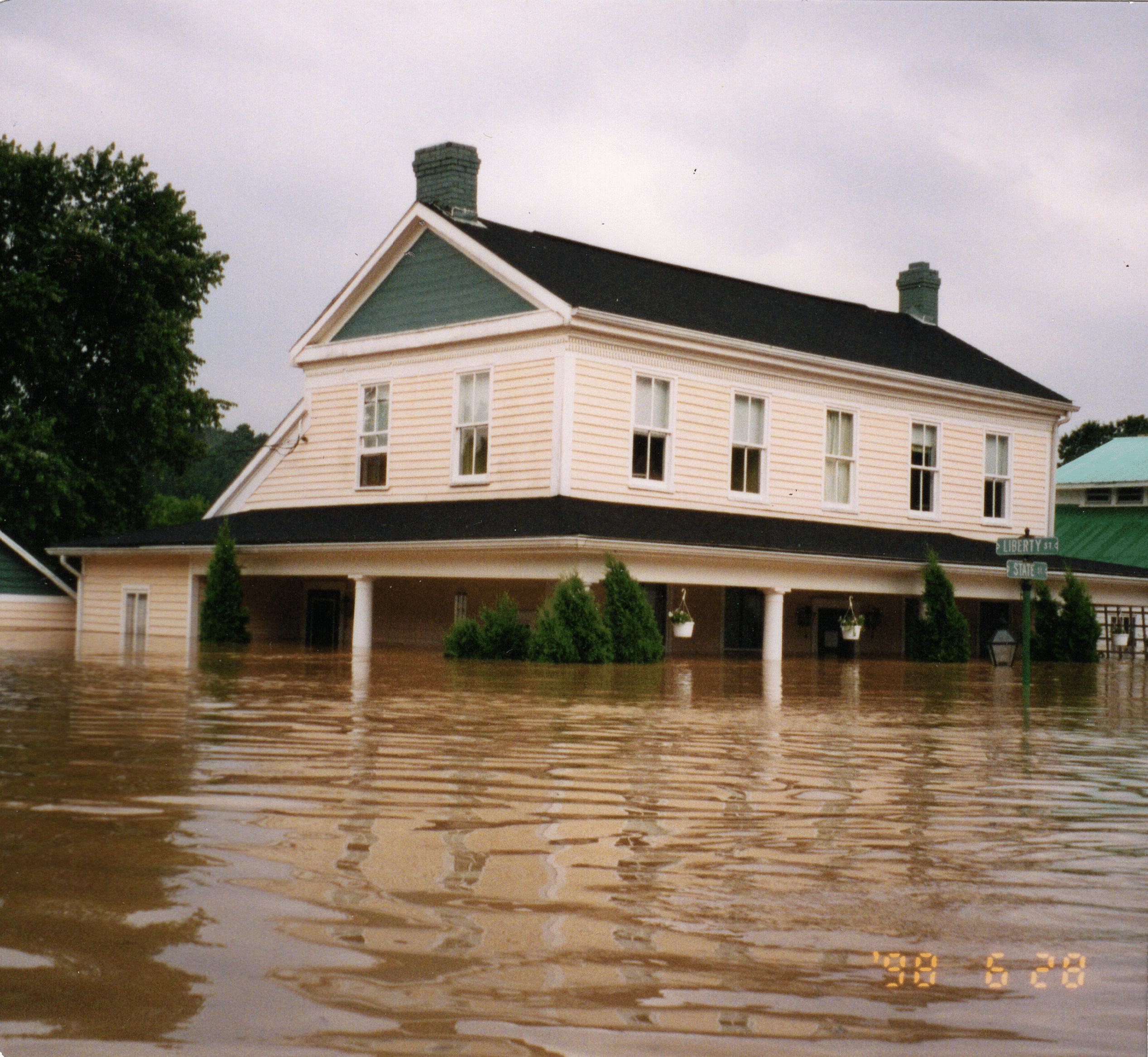

AMESVILLE, Ohio — It’s been 25 years since Amesville was deluged by a once-in-500 years flood — an event that left residents with indelible memories.
Over a four-day period, over 10 inches of rain fell over eastern and southeastern Ohio, causing historic flooding. More than 10 people died and another 9,000 were forced to evacuate.
The four straight days of downpour sent streams and rivers over their banks. Nearly two dozen counties across the state were declared federal disaster areas. The Ohio Emergency Management Agency estimated that the storms and flooding cost the state over $170 million.
The flooding also had a massive effect on public infrastructure in Ohio. More than 100 roads were closed, including I-70 and I-77. More than 24,000 residents lost electricity and almost 6,000 were left without phone service. At one point, five public water systems were out of service and another 24 experienced contamination issues. Damage to public infrastructure was estimated at over $36 million.
Communities across eastern and southeastern Ohio experienced record-breaking floods. The hardest-hit in southeast Ohio was Amesville, which was filled with water for nearly three days.
“I’ve never seen rain like that”
Amesville had experienced a record-breaking flood in March 1997.
“They say, ‘Well, once every 100 years you’ll get this much of a flood. Once every 500 years you’ll get this much of a flood,’” said village resident and former Federal Hocking Superintendent George Wood. “Well, we got both of them within 18 months.”
June 1998 had already been rainy — it was the second-wettest June in Ohio since 1883, according to the Ohio Department of Natural Resources.
“So the ground was already wet, and (the rain) just came in overnight and filled the place with water,” Wood recalled.
The first of a series of storms hit on June 26, 1998, and continued until June 30. Athens County received between 3 and 7 inches of rain; some areas in Washington, Morgan, Noble and Guernsey counties saw as much as 10 inches of rain.
“I’ve never seen rain like that before,” said former resident Julie Stout.
At peak flood stage, Federal Creek was carrying nearly 32,000 cubic feet of water per second, according to the U.S. Geological Survey. (For comparison, the USGS reported stream flow on the Hocking River at Athens at 222 cubic feet per second on July 12, 2023.)
“I stepped outside and it looked like something that you would whitewater raft on going down the road and the sidewalk,” Amesville resident Jayne Darling said.
Wood and the late Allen Kasler tried to retrieve equipment from the fire department in the center of town. “By the time we were done, the floodwaters started coming up and we barely got across the road to go up the hill,” Wood said. “We almost got swept away by the water.”
Many Amesville residents evacuated before facing serious danger, but others had to be rescued from the fast-rising flood.
“There was an elderly couple that lived in a trailer down closer to the river, and it (the water) was over the top of the trailer,” Stout said. “Now luckily I think the children came and got them out, and there was no loss of life, but it definitely could’ve been in that situation.”
Members of the Amesville Volunteer Fire Department were the heroes of the day, Darling said. “It just started bubbling where the water was coming in,” Darling said. “And my German Shepherd wouldn’t get out of the chair, so one of the firemen carried her out. The fire department was wonderful.”
Recovering from the flood
When residents were able to re-enter their homes after two or three days, they found that the worst was yet to come.
“It was pretty devastating,” Darling said.
Led by then-Mayor Frank Hare, the village pulled together to begin the cleanup. The dishwashers at Amesville Elementary ran nonstop to clean and disinfect residents’ dishes. The fire department went door to door, hosing away inches of sticky mud. Teams of volunteers helped residents remove ruined possessions to be hauled away.
“The mayor, Frank Hare, at the time, was just terrific. He was everywhere all the time. I don’t know we would’ve done it without Frank,” Wood said.
Hare was pastor of the village’s Presbyterian church, which became a home base for many displaced residents. Julie Stout, who had previously been hired as a parish worker through the Presbyterian church, organized volunteers to sort and distribute the aid — including preparing three meals a day for a month.
The National Guard arrived to help with recovery, as did officials from the Federal Emergency Management Agency. And some of the volunteers had familiar faces.
“Ted Strickland showed up — he was our congressman at the time — he just showed up out of nowhere and started hauling stuff out of houses,” Wood recalled.
Stout, who had previously worked in an AIDS support group in Los Angeles, said her similar role in the AIDS epidemic influenced how she reacted to the flood.
“That’s part of how I got involved in Amesville is because of my experience dealing with friends with AIDs,” Stout said. “(It’s) that sense of like it’s not affecting me, but what can I do.”
One of the ways Stout helped Amesville residents was by selling T-shirts designed by a local artist. One showed a caricature of volunteer firefighter Loder Lampela (recognizable by his bushy mustache) on a surfboard in his turnout gear. Another was a parody of Grant Wood’s famous “American Gothic” painting, featuring the iconic farmer and his daughter submerged in water.
“We started selling the shirts at farmer’s markets and places like that, and they raked in a good bit of money actually,” Stout said. “So we had all of this money and we bought drywall … So we just provided free drywall for anybody, and they were able to start repairing their houses before FEMA kicked in.”
All the support, however, couldn’t change the devastation of seeing precious and irreplaceable possessions turn into trash.
“I watched the backhoe take away my piano and my leather furniture that I had gotten when I was stationed in Italy in the service,” Darling said.
Changing the face of Amesville
With cleanup well under way, Hare convened a series of town meetings to discuss the village’s future. Those meetings prompted the village to apply for federal flood mitigation funds, with local matching funds provided by Buckeye Hills Regional Council.
The project’s aim was to prevent a similar disaster in the future by purchasing and demolishing homes that had experienced major flooding even before 1998. Other homes were elevated above the 1998 flood line.
The $1.37 million project began in 1999, coordinated by then-Amesville resident Corinne Colbert. (Disclosure: Colbert is co-founder and editor of the Athens County Independent.) She obtained appraisals of homes in the project to determine their fair market value. Buyout offers were based on that figure … minus any FEMA assistance that was not used to repair the home or buy flood insurance.
That deduction caught some homeowners by surprise, Colbert said. “I kind of blame FEMA for that, because I don’t think that is communicated very well.”
Colbert noted the lack of options available to replace the structures in the floodplain.
“One of the deals in the flood mitigation project is that you can’t build anything permanent with walls (in the floodplain),” Colbert said. “You can build a picnic shelter, that’s it.”
The project removed the more than 20 structures in the floodplain. It wasn’t without its costs; many of those whose houses were demolished had lived in the village for years and now had to move away. The village budget took a hit with the loss of property taxes from those homes.
But it also meant that future floods would not have such a great impact, and created what is now Gifford Park.
“I mean, this has been turned into a beautiful park where we have public events once every month,” Wood said.
Through a tragic natural disaster that took many Amesville residents out of their homes, the 1998 flood highlighted what makes Amesville great: resilience and community.
Stout still has friends in Amesville among those she worked with 25 years ago.
“Even though I moved away 12 years ago I’m still very connected and very involved with Amesville and the people in Amesville,” Stout said. “Because once they accept you, that’s it — you’re there for life, they look after you.”
Wood said, “Yeah, it was a flood, yeah, it was awful, but the town is really resilient, and that’s the lesson for us. And sometimes when we have disagreements, I think maybe we need another flood; it teaches us how to get along.”