ATHENS, Ohio — The State of Ohio Controlling Board last week approved the transfer of just over 27 acres at The Ridges from Ohio University to developers, an important milestone in long-term plans to transform the site of the former Athens Lunatic Asylum.
If all goes according to plan, the 27 acres will eventually host hundreds of housing units along with commercial space, according to a presentation developers made to a June 17 meeting of the Athens Affordable Housing Commission.

OU estimated in a June 18 press release that “space for approximately 750 dwellings and housing for nearly 1,700 to 2,000 people is anticipated to be developed at The Ridges over the next several years.”
According to an explanation the Ohio Department of Administrative Services, on behalf of OU, submitted in its request for the transfer approval, developers will pay over a half million dollars for the property, about $330,000 under the appraised value.
“Ohio University has determined that based on the magnitude of deferred maintenance and projected costs to cure the dilapidated buildings into a habitable state, estimated over $100 million, the negotiated purchase price is acceptable,” the ODAS explanation says.
Plans for The Ridges have been in the works for years.
Now that the state has given its approval, construction could begin in 2026, with the whole process likely to take 10–15 years, developer Joe Recchie of Praxia Partners said at the June 17 meeting.
Meanwhile, the Athens Conservancy is working with Ohio University to place much of the property, still owned by the university, under a conservation easement to protect the natural areas at The Ridges from future development.
Development plans
According to the June 17 presentation, the housing units will include new buildings constructed along existing roadways and renovations on many existing buildings, with an eye toward preserving their historic exteriors. Housing units will vary widely.
“We’re trying to do … everything from permanent supportive housing for a special needs population to potentially luxury housing, and including folks that have not been included, like the artists’ live-work units, thinking that that has a regional economic development generation while delivering for the community in a way that uplifts it,” Recchie said during the June 17 presentation.
According to Recchie’s presentation, 265 of the new housing units will be located in renovated buildings on the historic campus. Three buildings are planned for senior housing, three for creative/artisan live-work space, three for affordable housing for OU graduate students, and seven for market rate housing.
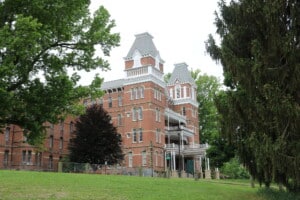
Many buildings on The Ridges historic campus are in disrepair. Renovations to make dilapidated buildings habitable will cost an estimated $100 million. Source: Ohio University photographs submitted to the State of Ohio Controlling Board.
Six buildings are planned for commercial use. The remaining 15 buildings on the campus are slated to remain occupied and owned by OU.
“OHIO has led numerous improvement and renovation efforts since The Ridges was transferred to the University by the state in the early 1990s; more than $30 million has been invested since 2015 to provide numerous opportunities for the historic space to be utilized for a variety of purposes by the University, including classrooms, research labs, cultural facilities and more,” OU said in its press release on the state approval.
Recchie said OU-occupied properties “are used by the university, but would be available for development in the future.” Some require three-year notice by developers in order for the developers to use the sites. Others would only become available to developers if the university identifies a replacement site.
Solveig Spjeldnes, Athens City Council member and chair of the Affordable Housing Commission, told the Independent that senior housing, in particular, is a “very bit unmet need” that the development at The Ridges will address.
She said development at The Ridges will include services intended for seniors, including trails friendly to those with less mobility, and activity and exercise rooms.
“We’re talking about so many people who retire from Ohio University have no place to go, and they want to downsize or whatever, and there’s no place,” Spjeldnes said. “One of the aspects of The Ridges entire plan is to have some really good, affordable places – and I don’t mean low low income necessarily, but places where seniors can live, both in the historical buildings, as well as in town houses and whatnot.”
The town houses will be among the new construction initiatives at The Ridges, which will make up the remainder of the nearly 750 housing units the site will host, according to Recchie’s presentation.
Multifamily housing units will be built at the current site of the Dairy Lane Park and near Campus Heights off Carriage Hill Drive. New townhomes will also be constructed, under the current plans, near the Campus Heights apartments, with other townhomes and lofts slated for construction at the current site of the Richland Avenue Park, along South Ridge Drive, and along Dairy Lane.
While new construction is occurring in parks and previously undeveloped areas, Athens Conservancy Board Member Brian Blair told the Independent that development “along existing streets and some areas that are already more impacted” will have less effect on adjacent natural areas at The Ridges.
“There’s a compromise involved in looking at community growth needs and the desire to protect the natural area,” Blair said.
Next steps for development
According to OU’s June 18 press release, the state approval “paves the way for an official property closing to occur later this year following the final review and approval of the formal land transfer agreement by the Ohio Governor’s Office, which is anticipated to be submitted this fall.”
Recchie said at the June 17 meeting that the developer won’t be able to start construction until the city rezones The Ridges.
“Once the property is transferred –– or even now, before the transfer, but with the approval of the controlling board and subject to the support of the University –– we could come in, start the zoning application process,” Recchie said at the meeting.
City Planner Meghan Jennings told the Independent in an email, “There has not been any official work on rezoning The Ridges.” Jennings said the city planner’s office has “talked casually” with Recchie and a representative of OU “about the need to rezone.”
“I will work with David Riggs, Director of Code, to determine the best route forward with rezoning The Ridges to allow for their now State-approved redevelopment plans,” Jennings said in the email. “We will then consult with OU and Praxia Partners about their options.”
Recchie said at the June 17 meeting that, “if there’s support for a large-scale zoning variance,” developers could start work on new construction at Dairy Lane as soon as early 2026.
Development of the whole area will be led by Ridges Community Development, LLC, a private development group, and overseen by The Ridges New Community Authority, a public body.
Chris Knisely, a member of the community authority, told the Independent that the body ensures public and community oversight over the development process.
“We operate to govern the plans for The Ridges,” Knisely said.
The body includes three community representatives appointed by Athens City Council, of which Knisely is one, as well as a local government representative and three members representing the developer.
Conservation
According to OU’s June 18 press release, “approximately 77 percent of the acreage (or around 600 acres) will remain under a conservation easement that restricts and limits new development and ensures community hiking, birdwatching, research and other recreational activities remain part of the area’s collective vision for The Ridges.”
OU is working with the Athens Conservancy to make that conservation easement a reality.
Blair works with the conservancy on conservation easements and said the Athens Conservancy and OU have already made progress through a survey of the land that will be subject to the easement. Blair said the next step will be to conduct a baseline assessment of what’s currently on the property, including infrastructure and man-made and natural areas.
“Then we can conserve that as it is,” Blair said. The exact provisions of the easement have yet to be worked out, and Blair speculated that the easement may ultimately allow for minor developments, such as shelters and park benches.
The easement “becomes a legal document that is attached to the deed that ensures that the provisions of the conservation easement will be maintained by future OU trustees or future owners of the property,” he added.
“Athens Conservancy will hold the conservation easement and make sure that that’s complied with, but the actual owners of the property will remain,” Blair said.
The conservancy will monitor the property, conducting assessments at least yearly to ensure the easement is complied with, and could take legal action against the property owner for any violations, Blair said.
The easement may be limited to 25 years by state law, Recchie explained at the June 17 meeting. But Blair said the conservancy is working to find ways of extending the easement beyond 25 years or making the easement subject to automatic renewal.
Ultimately, the easement will help protect what Blair said is an important place “both for our community and as a reservoir for biologic diversity, ecological diversity.”
“This is kind of the jewel of the Athens area –– it’s kind of our Central Park,” Blair said. “As a natural area where people in Athens can walk to, it’s really important for our community to have an area like this that they can enjoy, that has the natural landscape, natural beauty, right there in our midst.”
Keri Johnson contributed reporting to this story.