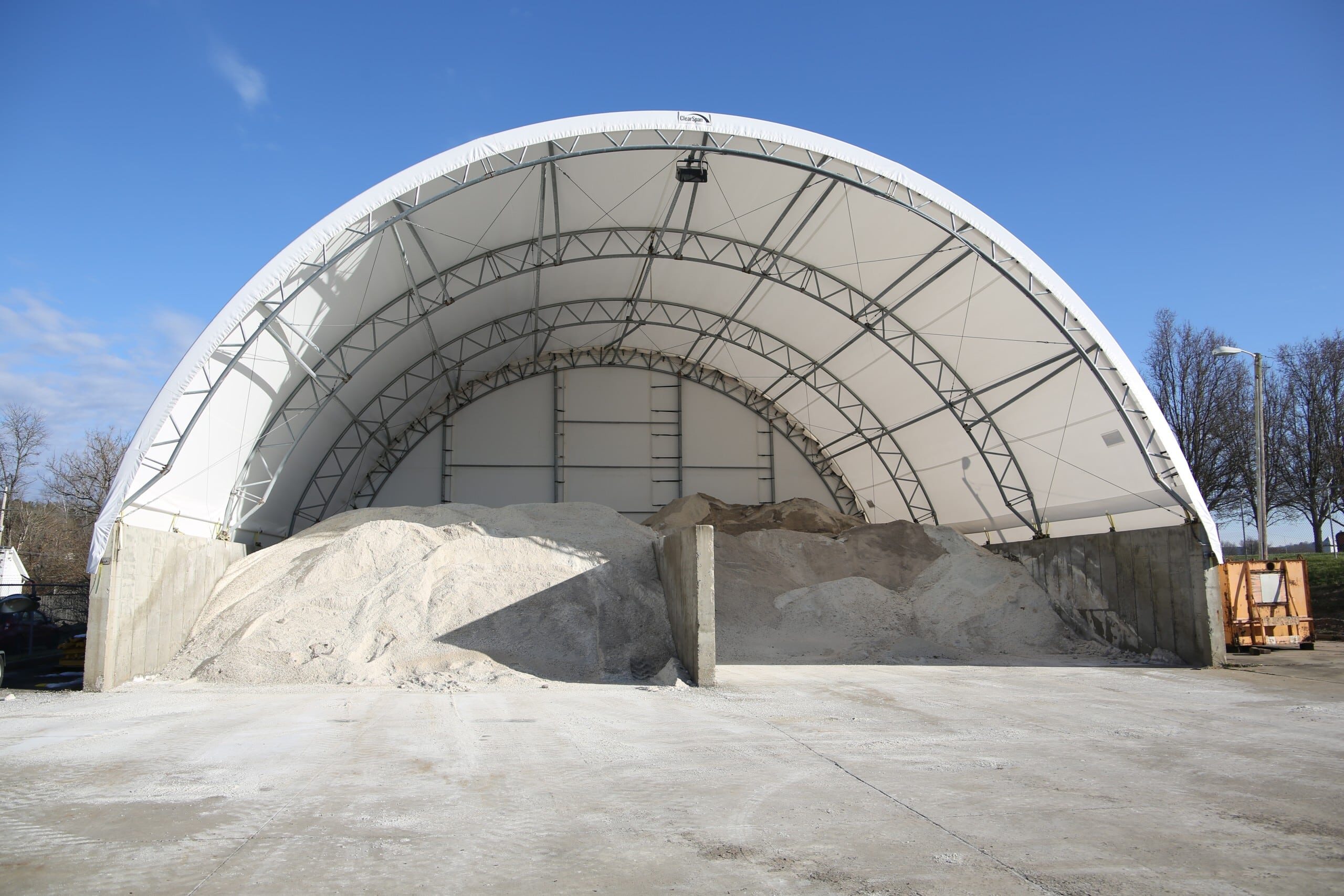

ATHENS, Ohio — A statewide program is working to reduce the amount of salt used on Ohio roadway by local, county and state governments — with the goal of limiting the impact of salt on the local environment.
H2Ohio is an initiative that was created by Ohio Gov. Mike DeWine to fund programs aiming to restore and maintain Ohio’s aquatic ecosystems, another being the H2Ohio Chloride Reduction Grant. The program aims to reduce the amount of sodium and chloride in Ohio waterways by upgrading salt storage facilities and salt trucks.
Road salting poses a problem for local waterways and ecosystems. It has been linked to increased wildlife mortality and heavy metal pollution, according to William Hintz, a professor and environmental researcher at the University of Toledo, who has published multiple studies about the impacts of road salt on local ecosystems.
“A lot of freshwater organisms are negatively affected by [road salts],” Hintz told the Independent. “We see reductions in reproduction and abundance. We see an increase in other unwanted substances in the environment, things like radon, mercury and lead. Road salts can mobilize some of those harmful substances.”
Matt Bruning, press secretary for the Ohio Department of Transportation, told the Independent that ODOT has been working to reduce salt use for years, and that partnering with H2Ohio has allowed it to better share information with communities across the state. ODOT does not get funding from H2Ohio.
“We, as a state, can help a municipality or county engineer be able to purchase the brine-making machine [a machine which mixes salt and water used for deicing], and teach them how to use it,” Bruning said. “We can extend those best practices that ODOT has been doing over the last several years to our local partners as well.”
The use of brine and adoption of new technologies has been the main focus of ODOT’s involvement in the project. Bruning said that ODOT’s brine mixture consists of 23% salt and 77% tap water.
It should be noted that the brine used by ODOT is not the same as fracking waste brine that is also used as a road deicer. ODOT stopped using fracking waste brine in 2021, according to the Columbus Dispatch; legislation in the Ohio House of Representatives also seeks to ban the practice statewide.
“We don’t want [salt] to scatter off onto the shoulder or into the grass on the side of the road,” Bruning said. “Brine is a lot more precise as to where the material ends up, which is in the driving lane. That’s where we want it.”
Bruning said ODOT sees salt reduction efforts as a win-win for taxpayers. If ODOT and other municipalities are able to use salt more efficiently, then it can save taxpayer money, while also protecting the environment.
“Anytime we can find a way to be more efficient with the finite resources that the taxpayers send our way, we’re going to do it,” Bruning said. “And, you know, obviously we all live here too. I have three kids. I want the state to be in a great spot environmentally for them as they grow up and they have their own families.”
City of Athens
In 2024, the city of Athens received a $24,294 grant from H2Ohio to purchase:
- Two new plows.
- A new road salt controller, which provides real time data on salt distribution.
- Equipment to study the feasibility of a low-cost truck tracking system which will allow the city to track trucks to optimize plowing and salting routes.
The city of Athens used part of its H2Ohio grant to purchase a salt controller mechanism that distributes the most efficient amount of salt based on road conditions, vehicle speed and temperature.
“There’s a reader that senses the road temperature and then talks to another sensor,” Steve Adams, the city water plant manager and former environmental coordinator for the city of Athens, said. “It’s dialed in so that it distributes a good amount of salt.”
Adams said that it’s still too early to tell how successful the city’s salt reduction efforts have been, especially given the unpredictability of winter weather severity; the city needs more data to accurately determine the effectiveness of the program.
Adams added that the salt controller is only installed on one truck currently, and that if it shows a significant reduction in salt use, the city will purchase more controllers.
Adams explained that he applied for the H2Ohio grant as part of his supervision of the city’s Municipal Separate Storm Sewer System program, which seeks to prevent pollution on the roadway from entering local waterways. This type of pollution, nonpoint-source pollution, does not originate from a single discrete location and is therefore harder to control.
“Any rain water discharge that escapes city limits is part of the [municipal separate storm sewer system],” Adams said. “What we’re trying to do is reduce nonpoint pollution, and road salt is part of that.”
Adams told the Independent that he likes to incorporate public education into environmental projects. He recently spoke with a group of Athens High School students about the salt reduction effort.
Afterwards, these students painted the two newly purchased plows, adding slogans, a yeti and a bulldog.


Athens County
The city isn’t the only local government that has received H2Ohio funding.
The Athens County Engineer’s office will soon begin construction on a new salt storage facility in Coolville. Athens County Engineer Jeff Maiden told the Independent that the previous building was about 50 years old and beyond repair.
Construction of the new building should start this spring and it will be built to hold 330 tons of salt, Maiden said.
Maiden told the Independent that the Athens County Engineer’s office has yet to experiment with brine and other alternative deicers, such as beet juice, due to costs. Maiden said that he may apply for another H2Ohio grant in the future to try out these alternatives.
“There’s a cost associated with building the infrastructure to use beet juice,” Maiden said. “You got to configure all your trucks and I’ve got 16 dump trucks. Many of them are old, many need replaced.”
Currently, the county engineer uses a mixture of road salt and fine gravel known as “grits” for road salting. The salt works to remove the ice and snow, while the grits provide traction for vehicles.
The primary reason the county utilizes this practice is that it is cost effective. Maiden said that one ton of salt is roughly $84, while one ton of grits is only $20.
Maiden told the Independent that he has been working to get “live beds” installed on all of the county’s salt trucks. Live bed trucks contain a conveyor belt that pulls the salt to the back of the truck for distribution, as opposed to raising the bed of the truck, which can cause visibility issues for drivers and pose other risks, like breaking electric and telephone lines.
Environmental impacts of road salting
Hintz told the Independent that younger animals suffer most from increased salt concentrations in the environment. He said that younger animals are often more sensitive to changes in their environment, whereas older animals can tolerate a wider range of conditions
“If we look at wood frogs or certain salamander species at early life stages, we can see negative effects on survival and growth, egg quality, and things like that,” Hintz said. “There’s a lot of evidence in amphibians, they are a sensitive group, and it depends on the species and the life stage.”
Hintz added that if a species were to go extinct in or abandon a local waterway, that would have far-reaching effects on the broader local ecosystem.
“I like to think of the environment as this kind of messy conglomerate of dominoes,” Hintz said. “Normally, when people play with dominoes, they put them in a nice line, and you push one domino and all the other ones fall. Well, an ecosystem is like this: You put dominoes all up next to each other, kind of in random fashion. When you push one over, you don’t know how many are going to fall and in what direction, all the time.”
“When we think about salt sensitive species in the environment, we don’t know what dominoes might fall,” he added.
Plants dependent on local waterways or closely located to roads are also impacted by road salt use. Road salts have been linked with reduced soil quality, increased plant mortality, and the browning of foliage according to the University of Massachusetts Center for Agriculture, Food and the Environment.
“There’s some studies out there that show that 15% of roadside trees show damage by road salts,” Hintz said.
The effects of winter road salting are a year-round problem, too –– “every winter, year after year, decade after decade,” Hintz said.Spring, summer and fall rains can dump a large amount of the leftover salt into local waterways.
“It might be flashy where we see a spike [in salt levels] throughout the wintertime, and then it kind of goes down in the summertime, but a lot of times we see [salt levels] stay almost exactly the same,” Hintz said.
Some academic studies have linked road salting practices to increased salt levels in drinking water, which poses health risks, as increased salt content has been linked with kidney issues, heart disease and stroke. Increasing salt content can also result in pipe corrosion, leading to more metals ending up in drinking water.
A 2018 study examining wells in New York found that the closer a well is to a major road or salt barn, the greater the concentration of chloride in the water. The same study reported that 82% of the wells tested had sodium levels higher than the recommended standard.
Hintz said that he hopes that H2Ohio’s chloride reduction efforts are successful and local communities will see the benefit of reducing the amount of road salt used.
“Getting funds to buy new plows or new equipment that we can use to apply salt in a smarter way in the environment can really help out,” Hintz said. “Best management practices can be a win-win on many different fronts, keeping people safe, reducing environmental impacts and also reducing the cost many municipalities have for purchasing deicing materials.”