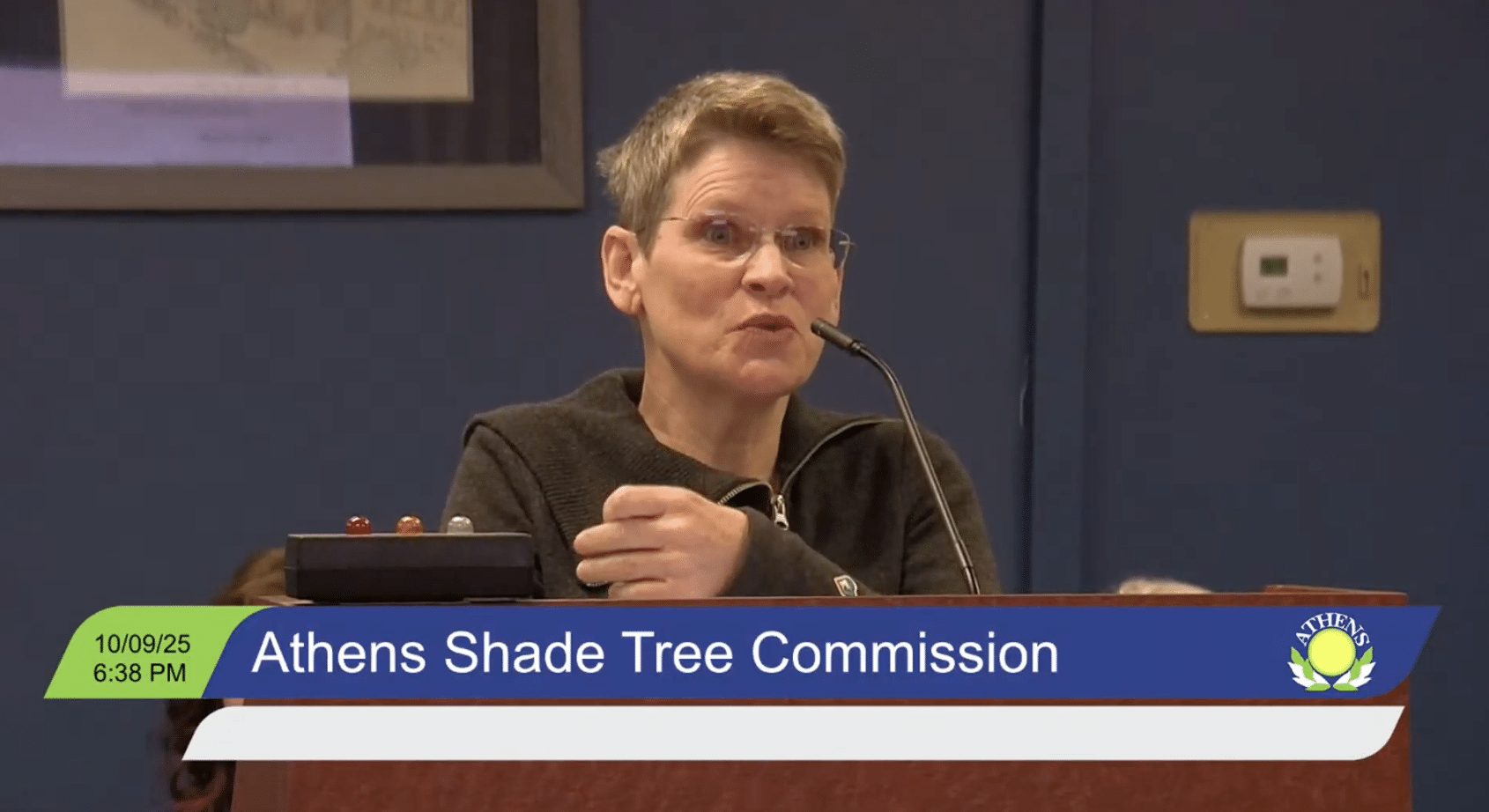

ATHENS, Ohio — An Oct. 9 meeting of the Shade Tree Commission drew a crowd concerned about code changes proposed by the Athens city administration that would change the commission from a regulatory body to an advisory one.
The meeting also featured discussion of revisions to the city’s proposed code changes. The revisions scrapped a previously proposed change to the city’s urban canopy requirements, which would have reduced the number of tree plantings required at new development projects.
Proposed code changes revised by city
Athens City Service Director Andy Stone sent a revised proposal for code changes to the Shade Tree Commission the day before the meeting, after the commission chair detailed opposition to the city’s proposed code changes in an email.
Stone told the Independent that the city revised its proposal to try to find common ground with the commission.
“I’m trying not to make this be adverse,” Stone told the Independent. “I don’t see this as a city administration versus the tree commission. … I’m disheartened that it’s being portrayed that way.”
“We really very much value the work that they do and their expertise,” Stone added. “I honestly think this will be a better change and create a better Athens.”
The city’s previously proposed change would allow new development projects to require fewer tree plantings.
“The much higher planting densities that are currently required will stay,” Shade Tree Commission Chair Tristan Kinnison said at the Oct. 9 commission meeting.
Stone told the Independent he scrapped that proposed change because “it seems as though there was strenuous opposition to the changing of the math.”
“At the end of the day, there is a mechanism if somebody is aggrieved with that to state their case for evaluation,” Stone added. “So, we’ll go ahead and enforce the standard as it’s written.”
Kinnison said the revisions also give “a little more freedom to developers in a good way” by removing requirements at new developments for a landscaping barrier in which plantings cannot be counted as shade trees.
However, Kinnison said the city is “really sticking with ‘the Shade Tree [Commission] should not have this approval process.’”
Commission members have argued that shifting the Shade Tree Commission’s approval authority to the Planning Commission could benefit developers at the expense of the urban canopy. Kinnison previously described the Shade Tree Commission as a “specialized volunteer commission with qualified people who are looking at this very narrow piece of city code and making sure that it’s done well.”
Stone told the Independent he left the proposed changes to regulatory authority intact because, “My main goal is to streamline the approval process and have the planning commission be the entity that’s the approval authority.”
Shade Tree Commission member Gene Deubler noted at the Oct. 9 meeting, “As far as I know, we haven’t had any complaints from developers about the process.”
“I would really like some specific examples cited from the city administration when we got in the way of development,” Deubler said. “If there are specific examples that you could cite, that would be really helpful for learning and growing from the experience and maybe being a better tree commission, but if there aren’t any specific examples, then I’d like to know why that’s being used as the reason for making these changes.”
Stone told the Independent that the proposed code changes could benefit the Shade Tree Commission because, as an advisory body, it is not subject to the same requirements and could “be more nimble.”
The revised proposed code changes also specify that the city must seek input from the Shade Tree Commission in its approval process for projects under Title 41.
“At least we are in the process, but still kind of leaves all the same concerns of us being left out or consulted very late in the game,” Kinnison said at the Oct. 9 meeting.
Public discussion
Several community members spoke at the Oct. 9 Shade Tree Commission meeting voicing their concerns about the proposed changes to city code.
“From a community benefit standpoint, I believe it is in those interests that a fully capable Shade Tree Commission must be supported,” Athens resident Carrie Gibbons said. “They need to retain the ability to be a check over development designs that would add additional unnecessary impermeable surfaces or skimpy and default planting plans that do not meet the important needs that healthy trees provide.”
Gibbons cited the urban canopy’s potential benefits in reducing the effect of heat islands, absorbing pollutants, sequestering carbon, reducing erosion and more.
“The long-term benefits of a healthy urban canopy throughout the city should not be underestimated or short-shifted in favor of business and revenue opportunities,” Gibbons said.
Aimee Delach, chair of the city’s Environment and Sustainability Commission, did not mention the proposed code changes directly but said the city’s urban canopy is important in reducing the city’s carbon footprint. Delach specifically noted the city’s 2019 Greenhouse Gas Inventory.
“One of the reasons that we did so well is because of the role that our local tree canopy played in sequestering our emissions. So it is critically important that we maintain and enhance the health of that tree canopy,” Delach said.
Molly Jo Stanley, an Athens County resident and another member of the Environment and Sustainability Commission, also referred to the 2019 Greenhouse Gas Inventory and the importance of the urban canopy in reducing emissions.
Stanley suggested the city is “losing sight of the fact that … we have a great tree commission that wants to continue to volunteer its time to provide the city valuable resources.”
Athens resident Mary Reed, a member of the Athens Arbor Day Committee, said that committee has had trouble communicating with people in the city outside of the Shade Tree Commission.
Reed noted that the Shade Tree Commission has two members who are certified arborists, and suggested the commission’s authority could be expanded.
“I don’t see giving the approval for development landscaping requirements to another commission that already has plenty on its plate really improving any of these issues that we’re talking about here that have come up tonight,” Reed said. “I see them only making that worse.”
“If anything, I think oversight should be increased,” Reed added. “I think the Shade Tree Commission and/or the city should be able to do a better and more comprehensive job of not only looking at these developments before they begin, but looking at them after they’re finished.”
Shade Tree Commission members thanked residents for offering comments at the meeting, with member Joanna Sokol noting that it was the “biggest group we’ve ever had.”
“It feels really good to have your support,” said Deubler.
Athens City Council member Michael Wood, 3rd Ward, sits on the Shade Tree Commission and encouraged residents to continue engaging with other community members and city officials on the issue.
Earlier in the meeting, Athens resident Jeanette Ammon asked commission members about which city meetings residents could attend to voice opposition to proposed code changes. Ammon noted that the code changes will ultimately require approval by Athens City Council, but that the code changes would not be on the agenda for its Oct. 14 council meeting.
Kinnison suggested that residents could share concerns with the city Planning Commission, next scheduled to meet at noon Wednesday, Oct. 15.
“They will be discussing if they even want to bring it to council to vote on this, and kind of talk it through,” Kinnison said. “So that would be probably the predecessor before this goes in front of city council.”