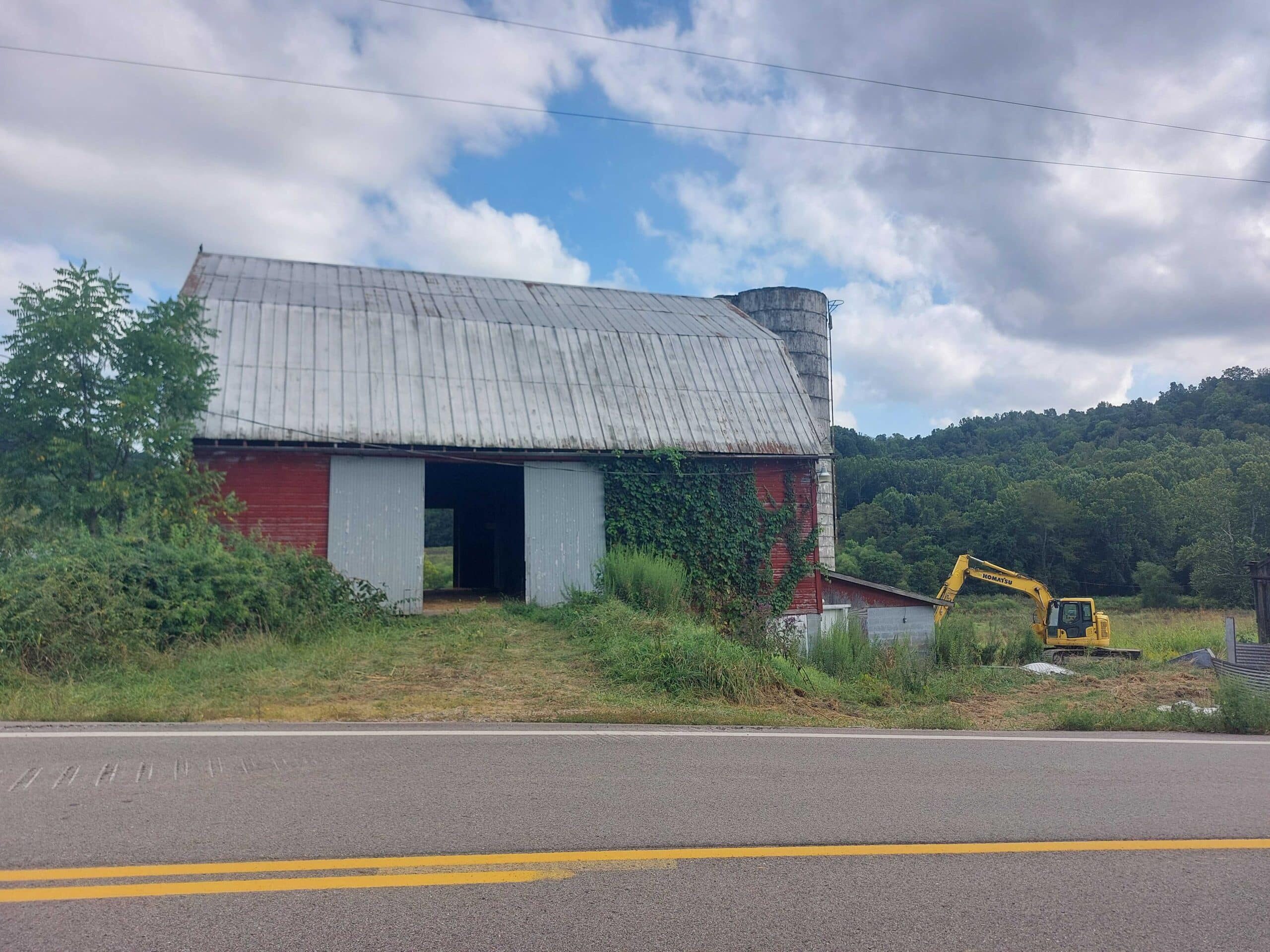

SHARPSBURG, Ohio — For over a century, a barn has stood on State Route 377 in Sharpsburg. Whether it stands for another 100 years — or six months — is uncertain, as concerned neighbors rally for its preservation during the property’s transition into a nature preserve.
Bobby Spaulding sold the 123-acre property to the Nature Conservancy in late 2022 for $342,941. As the conservancy ramps up its environmental restoration work in the area, the Nature Conservancy plans to remove former agricultural structures, including the barn.
Nature Conservancy Project Manager Jennifer McDonald told the Independent Aug. 21 that the destruction of the barn is not imminent — despite the machine currently sitting next to it. That equipment is being used for a different purpose and is only sitting at the site between uses, she said.

John Spaulding, his wife, Lauren Farrar, and their kids live across the road from the barn. His family has lived and farmed in Sharpsburg since 1976. Spaulding’s land split when Bobby, John’s grandpa, sold half to the conservancy. John still farms the land across the road from the barn.
While John Spaulding described the barn as a roadside marker for the Athens-Morgan county line, it’s much more than that to him: It also contains memories of work, play and family, having been experienced by three generations of his lineage.
“All my memories with my grandpa are here in the barn,” he said. “I’m heartbroken.”


Images of the barn’s interior. Photos by Lauren Farrar, provided by Loraine McCosker.
Nature Conservancy Mitigation Program Manager Devin Schenk said in an email, “the plans for the property remain the same as they were when Bobby Spaulding sold TNC the site in 2022: to be protected in perpetuity as a nature preserve and expand the Gifford State Forest by tripling its size.”
The project will consist of “restoring 40 acres of habitat and improving ecological functions, including improving water quality, floodwater storage, and nutrient retention for both the nature preserve and the surrounding watershed as well as improving recreational opportunities for visitors,” Schenk stated.
According to a copy of the project agreement between Ohio Department of Natural Resources and the Nature Conservancy, “The project will restore Opossum Run and its degraded tributaries and restore forested floodplain wetlands and upland buffer.”
“Additionally, the conservancy is partnering with [the] Ohio Department of Natural Resources Division of Forestry “to restore over 11,500 linear feet of stream, 10.4 acres of adjacent riparian habitat, 22.1 acres of forested upland habitat and 6.5 acres of wetland within Gifford State Forest. Over 23,000 native trees and shrubs will be planted. Acid mine drainage will be treated on several streams within the preserve,” he said.
Schenk also said that the ODNR Division of Forestry will be deeded the land next year; a public records request fulfilled by the ODNR provided the existing donation agreement between the ODNR and Nature Conservancy, signed in 2022.
Since Bobby Spaulding sold the property, John Spaulding and his wife have sought ways to keep the barn standing, they said, though they had become discouraged. They have known for a while that the Nature Conservancy wants to remove it.
“We asked if there was any way we can keep it, and they were just pretty much like, ‘No, it’s a liability,” Farrar said. “About a year-and-a-half of fighting with them, we had a conference call, and they pretty much told us, there’s no options. It’s going [down], and so we gave up.”
John Spaulding said his family has “offered to buy it, offered to lease it; We offered to lease it and paint a mural on the side of it.” He’d offered to use it for storage, too, he said.
Bobby Spaulding died in 2024. John Spaulding said his grandpa sold the property hoping the proceeds would support his descendants, and that the land would be stewarded. He isn’t sure how his grandpa would feel about the barn’s planned demise, though he’s sure he wouldn’t be happy.
When they saw the equipment a couple of weeks ago, John Spaulding and Farrar assumed the worst: That it was time for the barn to come down. Like good neighbors, they shared the news in a community Facebook group — only to spread awareness about potential traffic hazards from heavy machinery entering and exiting the highway.
That’s when Loraine McCosker, an environmental activist and former Ohio University instructor, became concerned about the destruction of the barn, too. She’s now circulating a petition to the Nature Conservancy that asks for the barn’s preservation.
Southeast Ohio History Center Director of Development & Outreach Director Emeritus Tom O’Grady said barns like the one in Sharpsburg not only represent Ohio’s history and heritage, but also add to its scenic beauty. He is a signatory on the petition to save the barn.
Contemporary pole barns are not the same as those built a century ago, O’Grady explained. The barn in Sharpsburg was likely built by immigrants who used old-growth timber; its foundation is cut from sandstone, John Spaulding said.
O’Grady lives in Morgan County and said he drives past the barn twice a day; he bought hay from the Spauldings in the ‘70s. He voiced concern for the destruction of buildings in the name of natural conservation, and questioned the sustainability of removing structures that are still in good shape.
Public records requested by the Independent show that the Nature Conservancy had reached out to Ohio History Connection, who “recommended that the Nature Conservancy conduct a history architecture survey of the barn to determine if it is eligible for a National Register of Historic Places listing,” Ohio History Connection Manager, Media and Public Relations Neil Thompson said in an email.
Thompson noted that registering the building as a historic site does “not prevent demolition of such structures but would only mean mitigation for the loss of the building would need to be done.”
Ohio History Connection advised that the Nature Conservancy would also first have to “determine the significance and integrity of the barn” using consultants, Thompson said in an email.
“This would entail determining the type of construction of the barn, age, and historic context, which would require research through deed searches and courthouse records, historic mapping, and general local history, which is something we do not do at this time,” Thompson stated.
Thompson said Ohio History Connection also referred the Nature Conservancy to Friends of Ohio Barns and Heartland Science as additional resources, as well as “checking with the local zoning office or township trustees to see if there are any local permits needed for the demolition.”
Athens County Commissioner Charlie Adkins also told the Independent Thursday that the commissioners are working on a letter of support, of keeping the barn standing. The commissioners signed the letter Aug. 29.
McDonald said that the Nature Conservancy hopes to find a solution within the next couple of weeks.
“We are taking a pause on demolition right now to evaluate the situation,” McDonald said. “We’re just evaluating this location, seeing if we can come up with a solution that works for everyone.”
In the meantime, as long as the barn stands, John Spaulding will carry on a tradition he took up from his grandma.
“Me and my grandma used to play this game whenever I was a little kid, like who could see the barn the first coming from that way,” John said, pointing towards SR 550. “I play that with my kids, whenever they were little. And now I have to explain to my 8-year-old son that they’re going to tear this down.”
Records obtained via public records request show that McDonald requested a pause on the barn’s demolition around Aug. 18. An ODNR Division of Forestry rep expressed in the same thread that the office would not be interested in maintaining the structure, if and when in its possession.
“We do not particularly want an old barn and definitely don’t want to be landlords for an old barn,” ODNR Division of Forestry Assistant Chief Greg Guess wrote in an Aug. 18 email. “If TNC [the Nature Conservancy] thought it was prudent to sell this portion of the property we wouldn’t argue with that either.”
ODNR Press Secretary Karina Cheung said in an email that “The Division of Forestry does not currently own the property and cannot speculate to its future use.”

Correction: This article has been updated to reflect that McCosker was an OU instructor, not professor. We apologize for this error.
Note: This article was updated around 2:30 p.m. Sept. 2 to add a picture and include information obtained from public records requests (email communications). This article was updated around 3:40 pm. Sept. 4 to include the county commissioners’ letter of support. This article was updated around 11 a.m. Sept. 8 to include additional information (donation and project agreements) from public records that were fulfilled after initial publication, as well as comment from the ODNR. This article was updated around 10 a.m. Sept. 16 with comment from Ohio History Connection.