
ATHENS, Ohio — Every year, hundreds of Ohioans report high energy bills because their electricity provider was switched without their knowledge — a form of scamming made possible because of Ohio law.
Ohio deregulated its electricity market in 2001, allowing multiple energy companies to offer electricity to American Electric Power customers. Ohioans can shop around and choose electric providers that they believe will offer them the best rate.
“No one regulates that price that the retail supplier will charge,” said Matt Schilling, the director of public affairs for the Public Utilities Commission of Ohio (PUCO). “The notion is that it’s competitive. The market will self enforce prices, right?”
But the same law exposed Ohioans to a form of scamming known as slamming.
Slamming occurs when one’s energy provider is swapped without their consent. Some customers only notice they’ve been scammed when their power bill suddenly goes up in price.
Kathryn Metz, an outreach and education specialist at the Ohio Consumer Council, told the Independent that slamming can happen in a few different ways.
“There are energy marketers who may go door-to-door,” Metz said. “They may stand in Walmart, Costco or Sam’s Club. They may call you and ask if you want to change energy suppliers.”
An AEP Ohio spokesperson told the Independent that the company has received 931 complaints since January 2025. Roughly 745 of those complaints have involved someone posing as an AEP Ohio employee in order to demand payment or gain access to information.
AEP has noticed an uptick in slamming complaints around the holiday season and after major outages, said Melissa Clark, a customer and external affairs manager for AEP Ohio.
“We did have a situation where customers were sent emails impersonating AEP Ohio and were offered a service interruption credit,” Clark said in an interview with the Independent.
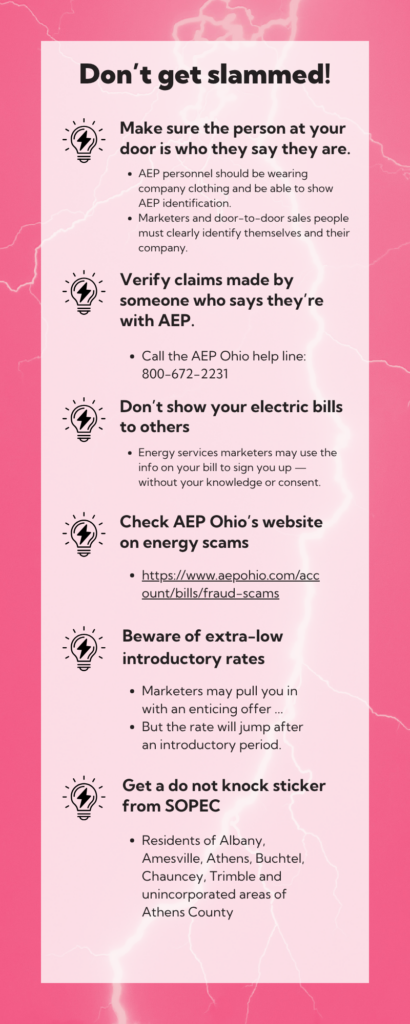
AEP staff should be wearing company clothing and be able to produce an AEP Ohio ID when asked for it, Clark said. Customers should call AEP Ohio’s help line (1-800-672-2231) if they want to verify the authenticity of mail or any statements made by people claiming to represent AEP Ohio.
Clark also recommended that customers consult AEP Ohio’s scam webpage to learn more about common scams and what they can do to protect themselves.
Ohio law requires marketers and door-to-door salespeople to clearly identify themselves and their company, and obey all local ordinances, said PUCO’s Schilling. This includes obeying “No Solicitation” signs. If marketers ignore local ordinances or no solicitation signage, PUCO encourages members of the public to file a complaint with PUCO and local government.
Tracy Galway, an Athens County resident, told the Independent that officials from an Ohio-based energy company were looking for her mother to “renew her contract.” The only problem? Galway had handled her mother’s bills for the last two years and had never heard of the company before.
“Such deceptive wording seems like it is preying on elderly people,” Galway said.
Although it’s not slamming, marketers may offer consumers an extremely low rate that will increase after an initial period, Metz warned.
“We see people’s bills increasing, definitely through slamming, but also through people signing with an energy marketer without doing all the necessary research before signing that contract,” Metz said.
Energy services marketers need three pieces of information to sign up a customer with a new supplier: name, address and a service ID or account number. All of that information can easily be found on an electric bill. For that reason, AEP Ohio recommends against showing past bills to anyone.
Energy aggregation
Ohioans can look at the second page of their energy bill under the supplier section to see who their current supplier is.
However, not every Ohioan who checks their bill and sees an unfamiliar energy provider has been slammed. Ohio law allows local governments to form aggregation groups containing all their residents in order to have a stronger position when negotiating with energy companies.
“If [local governments] aggregate all their residents, they can go out on their behalf and go to suppliers and say, ‘Hey, I’ve got 1,000 residents. What’s your best offer?’” Schilling said. “Oftentimes local government aggregation can get really good rates. If you live in that area and your municipality participates in aggregation, your government has to give you the opportunity to opt out, but if you don’t, you’re automatically put into this buying group.”
Locally, Athens County’s main energy aggregator is the Sustainable Ohio Public Energy Council, also known as SOPEC. Athens County communities that participate in SOPEC’s energy aggregation program include Albany, Amesville, the city of Athens, Buchtel, Chauncey, Trimble, Jacksonville, and unincorporated parts of Athens County.
Residents in these communities can request a “do not knock” sticker from SOPEC’s website to put on their door, which should reduce the number of door-to-door marketers attempting to sell energy.
Outside of aggregation and hunting for reduced energy rates, Ohioans may also take advantage of the energy choice law to power their homes exclusively using renewable energy. Several companies offer the option to exclusively purchase electricity generated by solar panels, wind farms and other forms of renewable energy.
“You can find a retail supplier that’s going to want to sell you all renewable energy, every kilowatt hour was generated at a renewable facility,” Schilling said. “Customers that have that kind of environmental mind and want to support those types of investments can do so.”
To aid Ohioans in making energy decisions, PUCO created energychoice.ohio.gov which lists certified providers, provider rates and more.
Investigating and punishing slamming
PUCO is the only body in Ohio that has the legal authority to investigate and punish energy providers in Ohio. Schilling told the Independent that investigations into slamming complaints have exposed forged signatures, spliced audio on sales calls and more.
The process of investigating and punishing slamming is generally a five step process:
- A complaint is made to PUCO.
- Investigators from PUCO speak with all parties involved in the incident.
- The investigators then present their findings to PUCO commissioners, who act as a panel of judges.
- The energy supplier presents their side of the case.
- The PUCO commissioners make their judgement and can issue punishments.
The commission can mete out several different punishments on offenders, including revoking their license, forcing them to offer restitution to customers, or imposing fines on the company and its executives. If a company disagrees with PUCO’s decision, they can appeal to the Supreme Court of Ohio, which is legally required to hear the appeal.
PUCO fields complaints directly from customers, the Ohio Consumer Council, community action groups and utilities, with utility companies often filing complaints on behalf of their customers, according to Schilling.
Editors Note 4/16/2026: Added Jacksonville to the list of Athens County communities aggregated by SOPEC.
