NELSONVILLE, Ohio — The Athens-Hocking Solid Waste District is seeking approval from 41 political subdivisions in Athens and Hocking counties for its solid waste management plan, which includes increased fees as a result of budgetary constraints.

The district updates its 15-year plan every five years. The new plan is intended to guide the district’s work from 2025 to 2040.
Each solid waste district in Ohio must develop solid waste management plans to further three main state priorities, the plan says. These are: to “reduce the amount of waste Ohioans generate and dispose of, ensure that Ohio has adequate, protective capacity at landfills to dispose of its waste, and reduce Ohio’s reliance on landfills.”
Solid waste management plans establish local paths to further those ends and meet specific goals set out by the state. The planning process is a major undertaking and can take up to 33 months, the Athens-Hocking Solid Waste District’s new plan says.
The district’s new plan keeps it on track with its existing programs and establishes new priorities that the district will pursue and implement as it secures new funding.
But as the district grapples with a budget deficit, maintaining current programs is the new plan’s major emphasis.
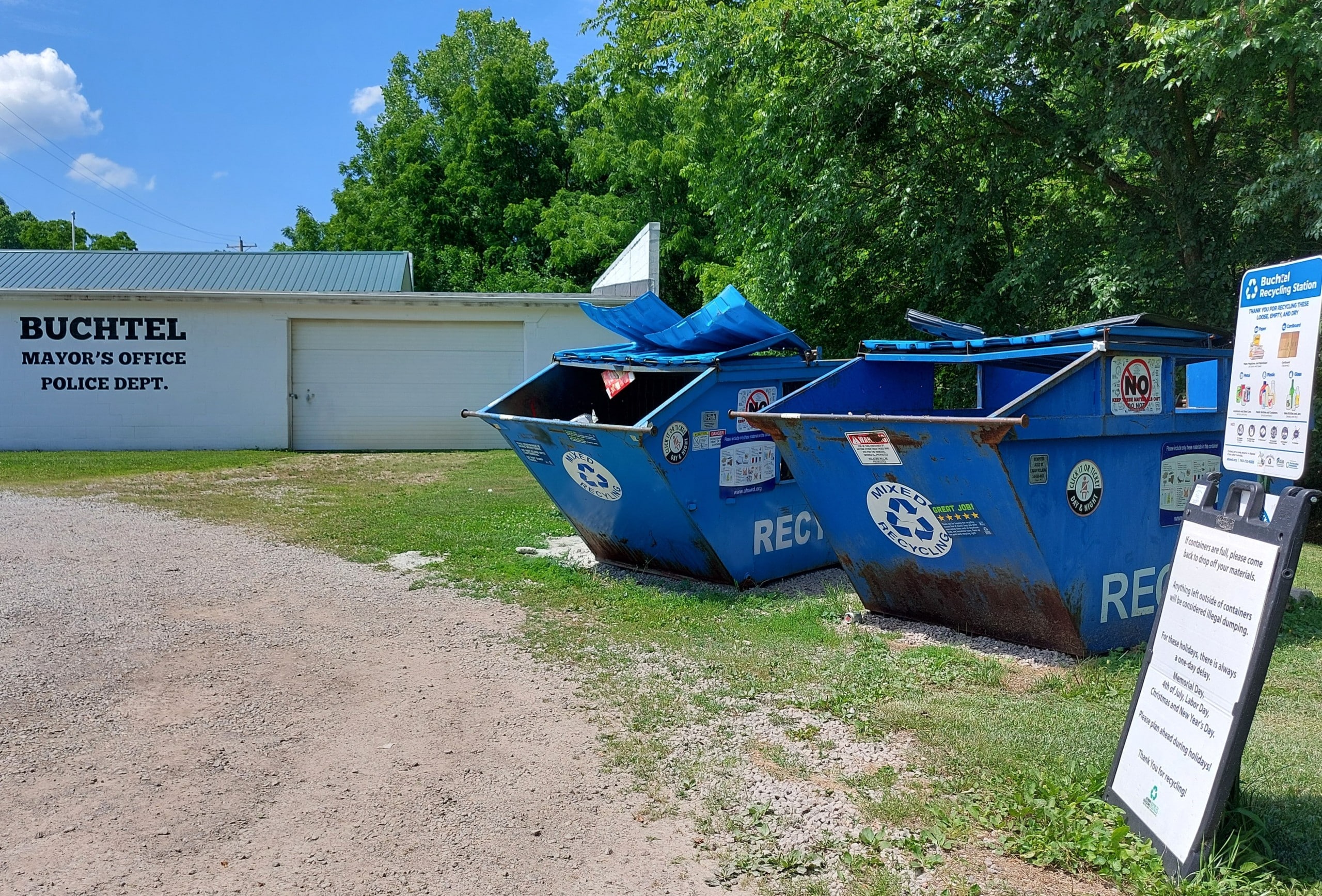
Among the district’s most significant programs is recycling drop-off. The district maintains 22 recycling drop-off locations in Athens and Hocking counties and contracts with the Southeast Ohio Recycling Terminal for collection services. The plan projects that the district will recover 1,600 tons of mixed recycling from the dropoff locations in 2025.
“The drop-off sites are the main avenue of household recycling, especially in the more rural / remote areas” where municipalities do not provide curbside recycling service, the plan states.
In 2021, the reference year used in the new plan, about 62% of the district’s nearly $560,000 in expenses went to recycling collection. That percentage is projected to increase slightly in 2025.
The new plan says maintaining the recycling drop-off program is “a must.”
Increased fees
The Athens-Hocking Solid Waste District is funded primarily by the waste disposal and waste generation fees it charges. According to the plan, the disposal fee represented just over half of the district’s more than $460,000 in revenue in 2021; the waste generation fee brought in another 41%.
Disposal fees are all paid by Rumpke Waste & Recycling, which owns the district’s only landfill, in Nelsonville. Rumpke pays for the fees by charging haulers for using the landfill.
Generation fees, meanwhile, are paid by any landfill or transfer station that accepts waste from the district. District Director Jane Forrest Redfern told the Independent that 92% of waste generated in the district goes to the Rumpke landfill in Nelsonville.
The new solid waste plan includes increases in both generation fees and disposal fees.
Currently, the district charges Rumpke “disposal fees” of $1 per ton of solid waste it accepts from the district; $2 per ton of solid waste it accepts from other districts in the state; and $1 per ton of solid waste it accepts from districts outside the state. The acceptable range for each tier in the disposal fees is set out by the state.
In the new plan, disposal fees will be raised to $2 across the board.
The district also charges landfills and transfer stations $3 per ton of solid waste it sends to those facilities. That will go up to $5 per ton under the new plan.
A Rumpke representative previously told the Athens County Commissioners that an increase in fees charged by the solid waste district would cause the company to reevaluate what it charges waste haulers. That could lead to increased garbage collection costs for residents.
The fee increase is necessary in part because of rising costs, Forrest Redfern told the Independent.
In 2021, the district’s total expenditures were just over $510,000, according to the plan. In 2025, the district projects expenditures of $649,000, with much of the increase coming from a jump in the cost of recycling collection.
As expenses have increased, the district has drawn down its savings account.
“Five years ago, we had $1 million, because [Athens-Hocking Recycling Centers] bought the district out, because we helped build the recycling center,” Forrest Redfern explained.
When the district last updated its solid waste management plan, for the period beginning in 2020, it decided to draw down its savings rather than increasing fees, Forrest Redfern said.
The district planned to avoid a fee increase for this go-round, too. Instead, the district initially proposed filling funding gaps by charging landowners a parcel fee. The parcel fee would also have allowed the district to buy Athens Hocking Recycling Centers’ property and facilities at 5991 Industrial Drive in Athens.
The Hocking County Commissioners shot down the proposed parcel fee, the Independent previously reported. The district therefore shifted to the fee schedule included in the current plan.
With the fees and budget detailed in the new iteration of the plan, the district projects that it will bring in slightly more than it spends over the next five years. The district estimates that it will end each year between 2025 and 2030 with a balance growing modestly from about $227,000 to about $240,000.
Priorities for the district
The proposed solid waste management plan sets priorities in three tiers.

The top tier largely addresses the district’s current programs. These include the recycling drop-off program, educational programs, and special recycling days and programs to ensure residents have a way to dispose of hard-to-recycle materials, such as electronics.
Another top priority is expanding and renovating its Sutton Road Recycling Center.
“It’s a full-service, hard-to-recycle material facility,” Forrest Redfern explained. “I’m not going to be buying metal from people. This is going to be where you take your refrigerator, you take your mattress, you take your TVs, you take hard-to-recycle materials.”
The primary goal for renovations at the facility is improving working conditions.
“I, first and foremost, am looking for money to renovate one of the buildings so that I can work in it safely with heating and cooling and a restroom and running water, an emergency shower and an eyewash station,” Forrest Redfern told the Independent.
The renovations could ultimately save the district money, Forrest Redfern added, if she can move her office to that location rather than paying for office space elsewhere.
The district will pursue second-tier priorities as funding and staff become available to implement them. Those include a year-round tire recycling program, education and outreach staff, assistance with school recycling and more.
Third-tier priorities also will be pursued as the district secures funding and staff to implement them. These include expanding medical equipment and pharmaceuticals disposal programs, offering grants to encourage organizations to expand recycling, and more.
Large-scale projects in the plan — including expansion of curbside recycling and the drop-off program — require a major commitment from the district or the region, Forrest Redfern said.
“If we have a chance to raise money on a particular thing and there’s a grant out there, you know, maybe we’ll get a grant for it — but if it’s not in the plan, you can’t do it,” Forrest Redfern said.
Where the new plan stands
The district’s policy committee ratified the plan at the district board meeting on Sept. 16, Forrest Redfern said. According to the draft plan, the ratification came after the plan was submitted to the Ohio Environmental Protection Agency and subject to a public comment period.
Political subdivisions within the district (such as townships and cities) must weigh in on its plan by Dec. 16, 90 days after the board’s ratification. The plan must be accepted by political subdivisions representing 60% of the district population to receive approval from the state, according to an Ohio EPA fact sheet.
Forrest Redfern told the Independent on Oct. 3 that the plan had already been approved by Good Hope and Marion townships in Hocking County and Rome and Troy townships in Athens County.
Athens City Council heard an ordinance to approve the plan on first reading at its Oct. 7 meeting, following a brief presentation from Forrest Redfern at the prior committee of the whole meeting. The ordinance moved forward on Oct. 7 without substantive discussion.
“There’s a lot of appreciation for the hard work that went into this plan and how that compliments our existing sustainability goals,” Athens City Council member Micah McCarey said at the meeting.
After political subdivisions approve the plan, it will go back to the Ohio EPA for final approval.