
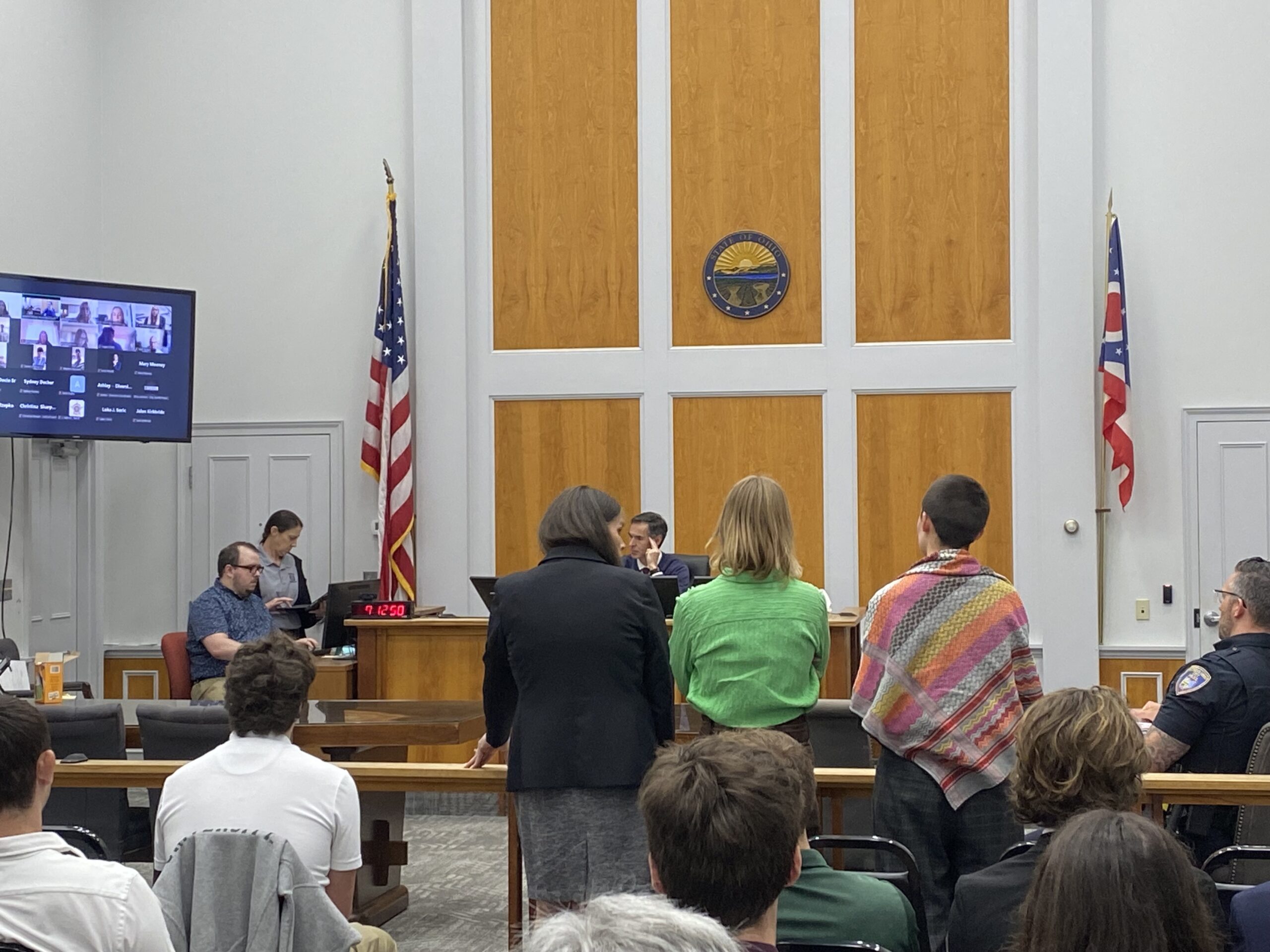
ATHENS, Ohio — Criminal cases against two student protestors arrested during the April meeting of the Ohio University Board of Trustees were dismissed on June 11 and July 8.
Both defendants agreed to pay court costs of $110 each, according to records provided by the Athens City Law Department. Both defendants also completed five hours of community service.
The pair were arrested while participating in a protest on campus over OU’s compliance with Senate Bill 1, the university’s response to student demands related to ICE, its investments in Israel, and a lawsuit related to the OU faculty union, according to reporting from WOUB.
The Center for Student Legal Services represented the two defendants in the case, which was prosecuted by the City of Athens. According to dismissal forms for each defendant, the cases were dismissed “Due to [the] prosecutor’s decision not to proceed to trial, but not due to lack of probable cause to arrest.”
The Independent did not receive responses to July 8 email and phone call request for comment to the Center for Student Legal Services.
The demonstration started outside before entering Walter Hall, where the board meeting was taking place. The Ohio University Police Department said in a statement on X after the arrests that the students had refused to leave the building and violated OU’s indoor space policy.
At a press conference following the defendants’ arraignments, protest attendee and founder of the student group Black Panther Legacy, AJ Jones, said the April 16 protest did not disrupt the board meeting.
Another student protestor, Henry, described the arrests as part of “a pattern of dismissal and disrespect by OU admin” that students had hoped to address at the April protest in the first place.
One of the defendants in the recently dismissed cases spoke with the Independent for this story and described their arrest as part of a nationwide crackdown by universities against pro-Palestine activists. They specifically referenced cases against students at University of Michigan, Stanford University, Swarthmore College and University of Pittsburgh.
“Our university is no different and would do the same,” they said.
The protestor said they are relieved their criminal case is over, but mentioned they are still in the midst of a student conduct case at OU.
Asked to comment on the outcome of the criminal cases, OU Senior Director of Communications Dan Pittman told the Independent in an email the university is “is aware that the legal proceedings in both cases have concluded.”
“We will continue to educate our University community on OHIO’s free expression policies, support their right to legally express their views and remind them that their actions, when in violation of law or University policy, can result in disciplinary and legal consequence,” Pittman said in the email.
Athens Law Director Lisa Eliason, asked to comment on her office’s approach to prosecuting the cases, emailed the Independent OU’s free expression policies as well as a case she said she “prosecuted in 1999 involving a similar issue.”
Local nonprofit United Campus Ministry paid one defendant’s court costs via a Legal Support Fund, the nonprofit’s Director Ari Faber told the Independent in a text message. UCM was unable to reach the other defendant to coordinate payment.
UCM raised over $2,300 for its Legal Support Fund through an online fundraiser. Faber said a small portion of funds supported licensing costs needed to operate a bail fund.
“The rest will be held for future cases in which an activist is arrested while engaging in nonviolent direct action. The person must live, work, or be engaging in an action in southeast Ohio,” Faber said in a text message.
Note: This story has been updated to include comment from one of the student protestors.
