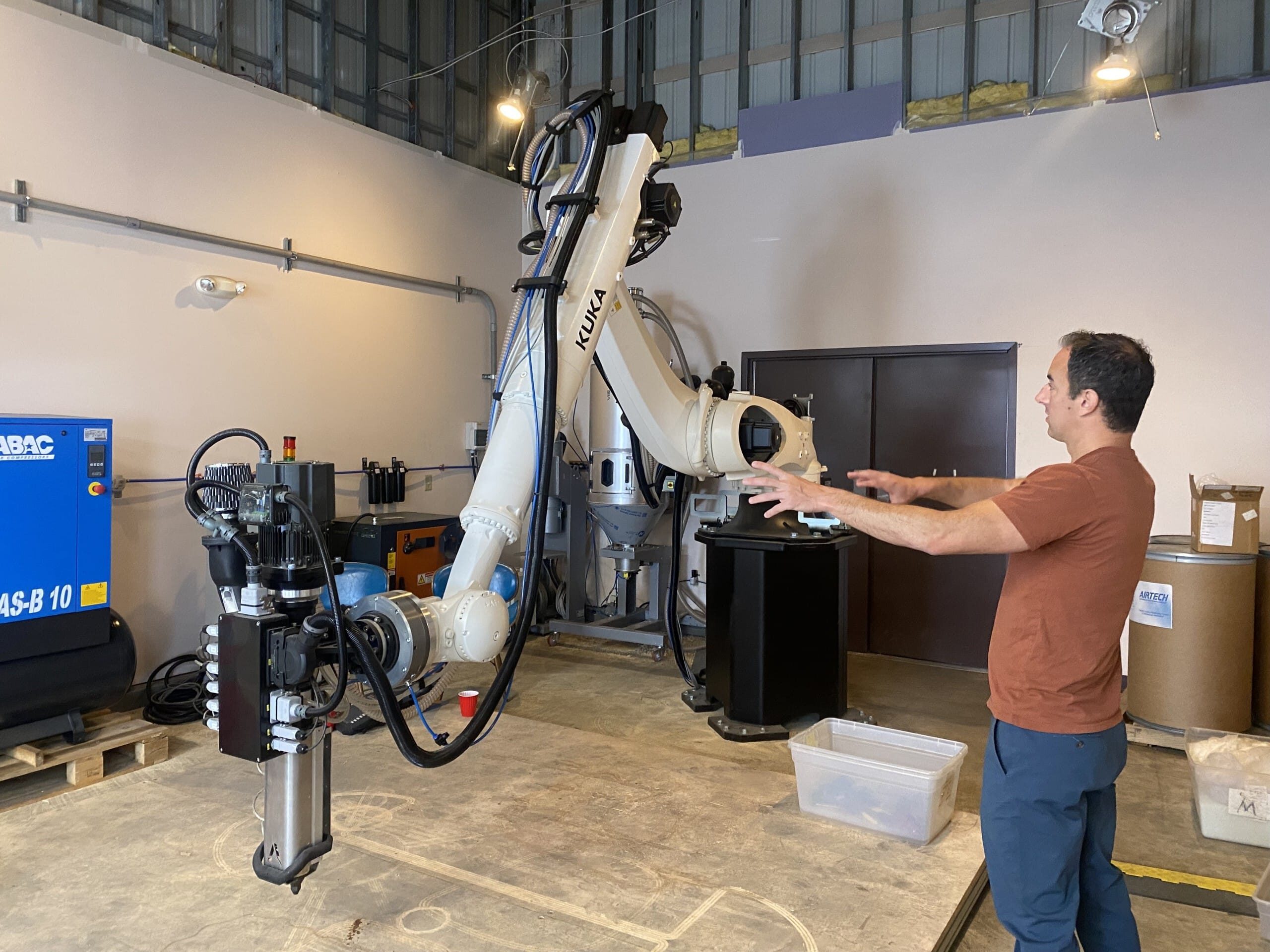

CHAUNCEY, Ohio — Drive down Mill Street in Chauncey, and you might see robots building homes.
The 3D-printed houses, developed by Vitruvian, are the product of the Survivor Advocacy Outreach Program’s Appalachian Community Grant, awarded by the Ohio Department of Development. The homes are just one part of SAOP’s current work in Chauncey.
SAOP Executive Director Madison Trace told the Independent in August that SAOP is working to build six homes in Chauncey, including the three 3D-printed homes plus another three in partnership with Habitat for Humanity.

Trace emphasized that the homes will provide affordable housing opportunities in the village, regardless of how the homes are constructed.
“Housing is just one of our number one needs, always. … There’s just not a lot of housing opportunities,” Trace said. “We’re hoping that we can provide really nice, energy-efficient, affordable homes for this area, at the end of the day. That’s kind of what we’re hoping to do — and a safe space for our survivors.”
SAOP hopes that the 3D-printed homes will be sold to first-time home buyers and those who might qualify for funding assistance, Trace said. Ideally, SAOP will sell the homes to its clients.
“Or, we have potentially talked about using one of them as a rental for clients or transitional housing space,” Trace said. “So we have options.”
Chauncey Village Council President Evelyn Nagy said the homes will provide “families nice, affordable homes to live in, and that’s always nice to have in the community.”
Council member Connaught Cullen put it more simply. “My thoughts are: They’re building houses, and that’s good. … A lot of people can’t get housing because it costs so stupid much.”
3D-printing technology deployed for home build
Vitruvian’s homes in Chauncey are constructed using a 3D-printable material that looks and acts like concrete. According to information from the production company, the material that Vitruvian uses is made up of “Portland cement and cement replacement from recycled waste material, selected fillers and aggregates, micro fibers, and special additives.”

Although the cost of construction is on par with traditional methods, Sentz said the speed and quality are much higher.
Vitruvian’s homes will be about twice as durable as homes made with traditional materials, Sentz said, making them more durable in the face of wind and water.
Eric Wooldridge, who did consulting on the Chauncey project, said the homes were constructed with a foundation designed to withstand seismicity and shifting ground, important in an environment impacted by legacies of coal mining.
Wooldridge directs the Kentucky Community & Technical College System’s Additive Manufacturing Center, which works directly on 3D-printing technology in Appalachia.
In addition to greater durability, Wooldridge said that 3D printed homes are more environmentally sustainable.
Multiple studies suggest that 3D-printed homes have a lower carbon footprint than conventional construction, with one study finding that “traditional buildings have a significantly higher cradle-to-grave environmental burden compared to 3D-printed homes when considering human health, environmental quality and global warming.” However, the same study found that available literature on the sustainability of 3D-printed homes is limited and more research is needed.
Wooldridge acknowledged that more research needs to be done to fully compare the environmental impact of traditional and 3D-printed construction methods. However, he said that due to the much higher durability of structures 3D-printed with concrete when compared to wood homes, it is “not even questionable” that the 3D-printed homes are more sustainable.
Nate Ames, executive director of The Ohio State University’s Center for Design and Manufacturing Excellence, questioned the purpose of comparing 3D-printed concrete homes to traditionally constructed homes.
“Like, it’s concrete, man,” Ames said, suggesting that comparing 3D-printed concrete homes to wood houses is like comparing apples to oranges.
Wooldridge said that because the comparably lower cost of 3D-printing concrete makes concrete a more viable material for home construction, it is therefore worth comparing the homes to those popularly constructed using traditional methods.
“It’s not that we can’t actually take concrete block or even ICF [Insulated Concrete Forms, or molds for poured concrete] and make a home out of it. It’s just that it’s way more expensive,” Wooldridge said.
Wooldridge also said the 3D-printing process has a different environmental calculus than other concrete construction methods, as a great deal of material is wasted in concrete construction that does not utilize 3D printing technology. The shapes produced using 3D printing have different characteristics, he added.
Ames told the Independent that he feels current implementations of the technology for home construction are “being brute forced.”
The OSU center Ames leads operated a 3D printer for a little over two years, but decided to transfer the printer in 2023 because of current limitations of the technology. The OSU center ultimately transferred the printer to Wooldridge’s program.
“As long as we’re using traditional concrete, we’re gonna have Mother Nature taking control more so than our process takes control,” Ames said.
Printing using concrete is “very temperature and humidity specific, and in the place where you and I live, temperature and humidity change frequently,” Ames said.
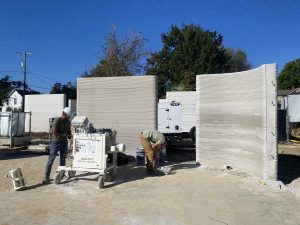
At Virtruvian’s build site in Chauncey, workers must monitor the printing to ensure the concrete is the correct consistency.
Ames also said that it is difficult to achieve cost-effective implementation of current 3D-printing technology because of the hilly environment in Appalachia. That’s in contrast to areas “like Texas, Arizona … because they have the opportunity to get lots of flat space.”
Wooldridge said deploying concrete-printing technology in the region is important for ensuring that local people can access quality, affordable, and durable homes. Under Wooldridge’s leadership, Somerset Community College recently buily Kentucky’s first 3D-printed structure, known as the Floodbuster1. Wooldridge said the name is a reference to the structure’s ability to withstand heavy flooding like that which Kentucky experienced in 2022.
Ames stressed that he doesn’t think it is bad to deploy 3D-printing technology for home construction before – in his opinion – the technology is fully ready.
“It takes an early adopter to seed the market so that people will invest in the technology to drive the cost down,” Ames said.
Home design
The 9-foot tall walls at the Chauncey homes are hollow to allow space for insulation, vertical supports, plumbing and electric, with thick concrete-like material on either side. The walls are printed by Vitruvian’s robot, which can fold up to fit through a front door and work from inside the home space.

Sentz said that the robot is capable of printing 1,300 square feet in a day, noting that seven of the walls already up on the Chauncey site were built within the last week.
“If we just ran it 24 hours, it would do a whole house,” Sentz said. “We’re running it very slow and steady.”
Sentz said the homes will be complete within a few months.
Sentz said the homes will feature a wide open space from front to back on one side with private rooms on the other side. The layout was the product of interviews with the demographic likely to live in the homes, which were facilitated by SAOP, Sentz said.
“There’s something that felt luxurious about having one big open space, that I can be in the kitchen cooking and see my kids, and then look out the back door and kind of feel like I have a full view of my environment,” Sentz said. “But, when I need my own space, I can get away in a room and feel enclosed and comfortable. The design really tried to take feedback as much as possible.”
Looking forward
Sentz said that Vitruvian is already looking toward future projects, though none have been firmed up. In the meantime, the company is researching materials, with the goal of replacing the material it currently uses with local materials.
That includes work with local cement companies as well as “large aggregate manufactures and coal mine folks to see if we can use stuff that comes out of coal mines,” Sentz said.
Sentz said he is not worried about incentivizing further coal mining, because the company is looking primarily to use materials that would otherwise be “in a waste cycle,” which he described as abundant. He said the company is looking at using waste materials already left in the local landscape, though he could not yet share more details about that project.
Sentz said the company’s research is supported by federal funding, including from the Department of Energy and the Department of Defense, which is interested in materials research for construction. He added that the government has an interest in supporting such research to lower the cost of construction and required material input in a military context.