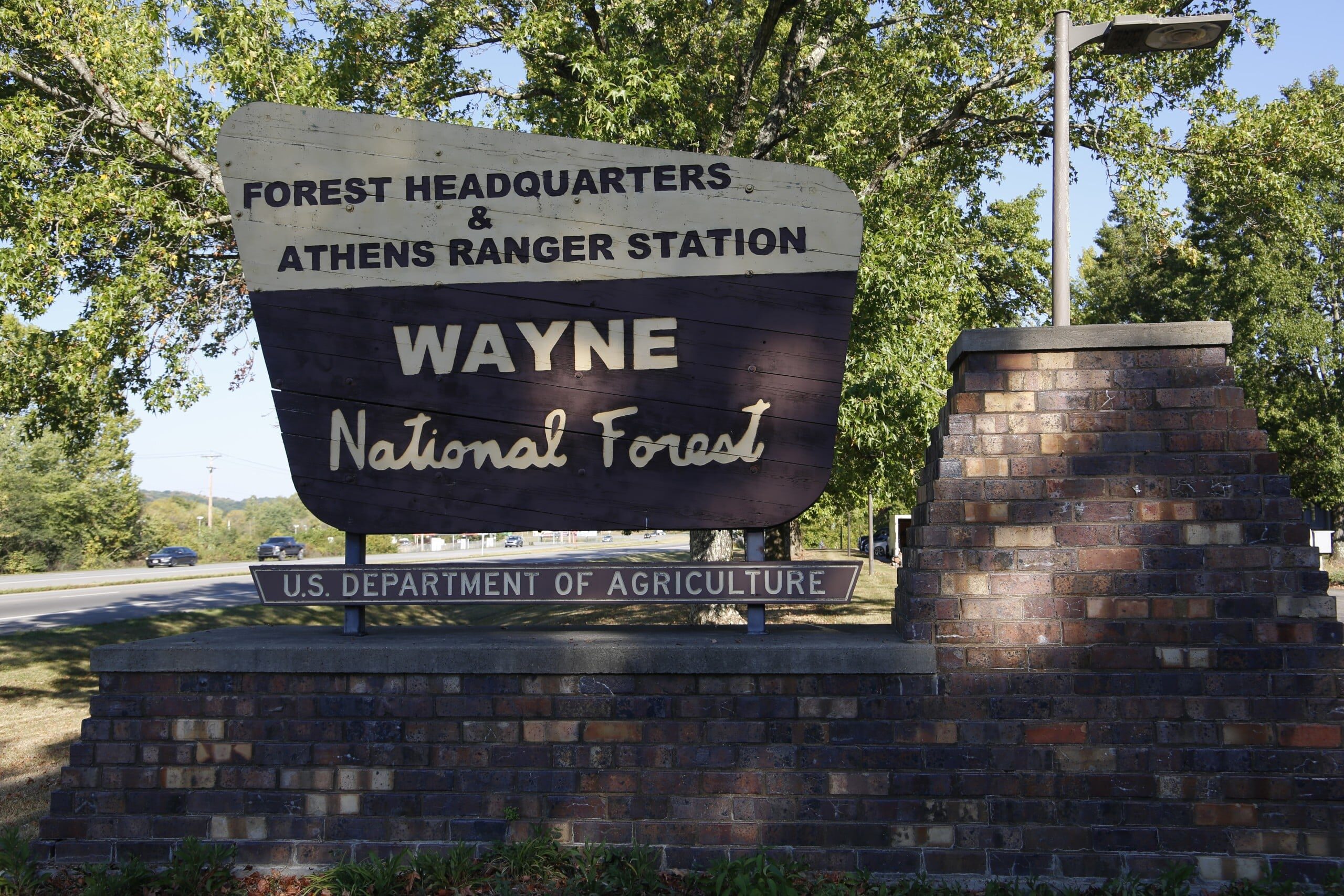
MARIETTA, Ohio — In mid-April, the Bureau of Land Management decided to allow new oil and gas development in the Marietta Unit of the Wayne National Forest. Now, an environmental group is considering new litigation to hold up potential fracking in the unit.
The environmental assessment behind the bureau’s decision ignored “a whole host of issues,” said Wendy Park, a senior attorney with the Center for Biological Diversity.
The center was among the plaintiffs that successfully challenged a 2016 BLM environmental assessment that recommended allowing fracking on the Marietta Unit. In a 2020 decision, the U.S. District Court of the Southern District Ohio Eastern Division identified deficiencies in that assessment and ordered the BLM to address them.
The BLM released a revised, preliminary environmental assessment last year that took those deficiencies into account. Following a public comment period, it released a final assessment and, subsequently, a “Finding of No Significant Impact,” in which the BLM accepted the assessment’s recommendation to allow new oil and gas leasing on the Marietta Unit.
That decision applies to 40,000 acres in the Wayne’s Marietta Unit. According to the environmental assessment, “it is expected that only a very small percentage of this acreage will actually be developed.”
Each lease sale and application for a permit to drill would be evaluated individually by the BLM, according to the recently released environmental assessment. Sixty-five leases approved since 2016 were immediately able to apply for permits to drill after the BLM’s April decision.
In an April 29 filing in the lawsuit filed by the Center for Biological Diversity and other environmental groups, the BLM estimated “that ground disturbing activities could begin in August 2025” if operators promptly submitted applications for permits to drill in the Marietta Unit. However, per BLM reporting, no such applications had been approved or were pending as of July 30, 2025.
Park said the Center for Biological Diversity was working “as quickly as we can” to consider options to prevent future fracking leases.
“We are considering all of our legal options and seeking to somehow challenge the environmental review that they completed back in April,” Park said.
Park argued there are still many gaps in the April environmental assessment, including inadequacies with the assessment’s evaluation of impacts to air quality, the Muskingum River watershed, and surface disturbance, along with how such disturbances affect wildlife. Those inadequacies could constitute grounds for an additional legal challenge, Park said. Such a challenge could again block fracking in the unit, at least temporarily.
A BLM representative told the Independent the agency would not comment on litigation.
Park previously told the Independent that fracking is “totally incompatible with how people want to enjoy public land.”
Fracking involves horizontal drilling beneath the earth and the injection of millions of gallons of water at high pressures to create fissures in rock, allowing gas to be extracted. This method is substantially more resource intensive than conventional drilling and creates toxic byproducts, which are injected deep underground.
The BLM environmental assessment states that fracking within the Marietta Unit could increase greenhouse gas emissions and disturb up to nearly 1,000 acres of land (including sensitive wetlands and riparian areas), affecting its ecology. The extraction itself, plus runoff and spills, could affect groundwater, surface water and aquatic life.
The analysis recommends opening the Marietta Unit to fracking anyway.
The environmental analysis does, however, create guidelines to mitigate harmful effects on bats, mussels and rare plants — for example, avoiding development in rare plant habitats.