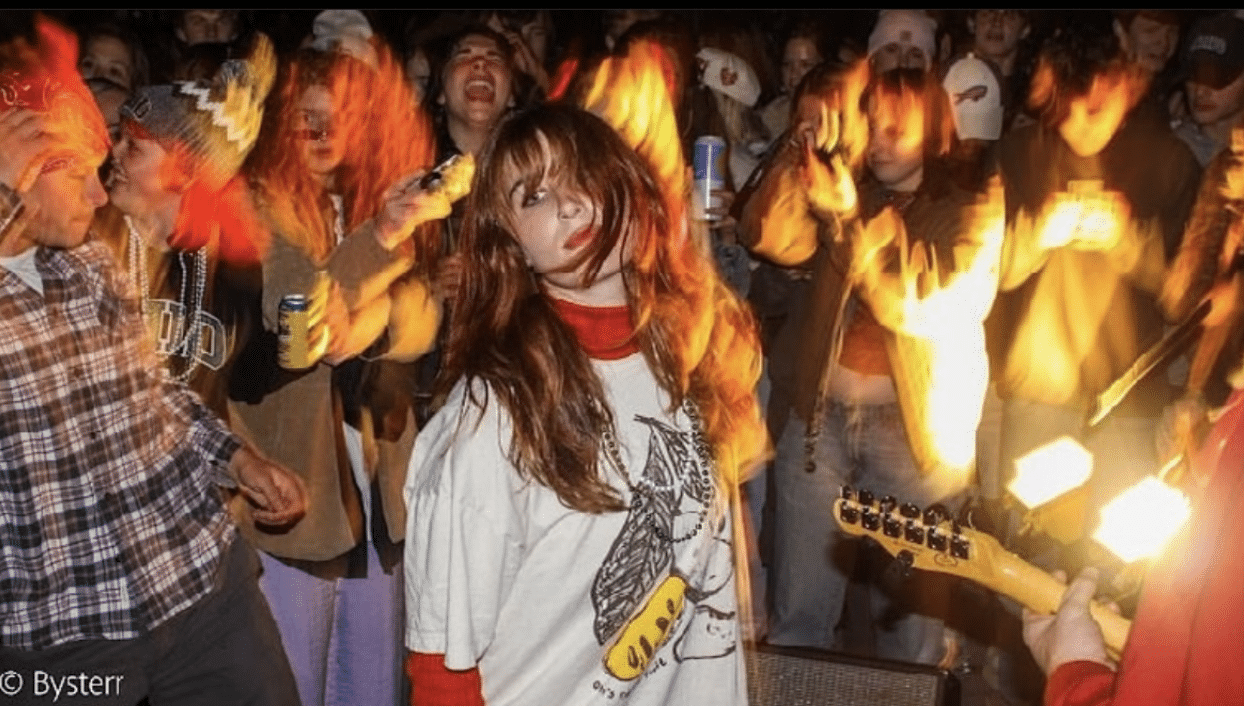
ATHENS, Ohio — The sun is setting on a long day in Athens. As is tradition at Ohio University, fall weekend festivities begin before the sun rises on Saturday; for some, the late night celebrations are just the exhausted finale of a bender that began the previous night.
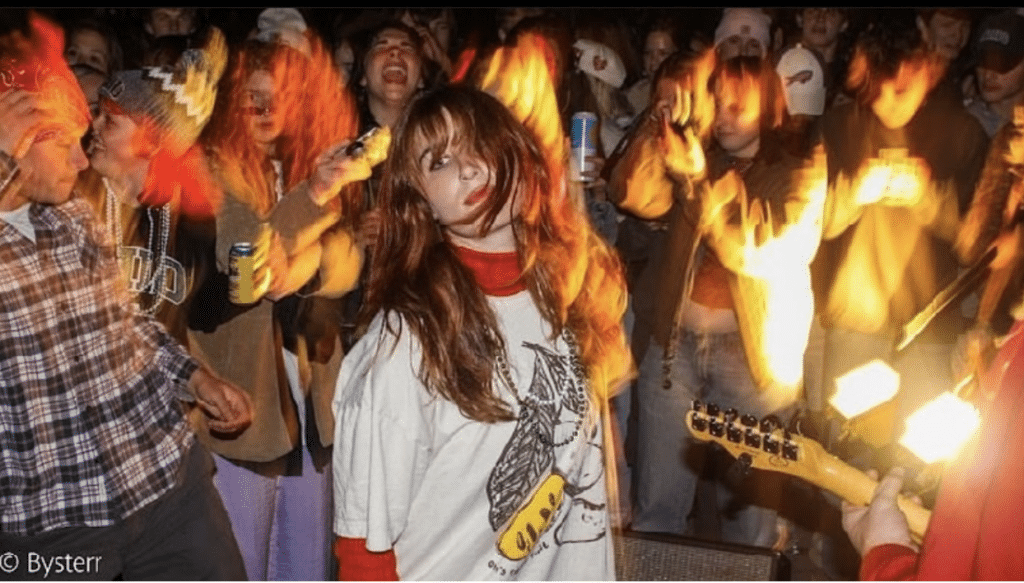
The final band for this Saturday night house party is Roman Candle. Headlining a show is nothing new for the band, even though just a few months have passed since its debut.
The band’s lead singer, Samantha Kruse, wanders around the crowd of the Saturday night house show, exhilarated. She wears an oversized, tan T-shirt — bearing a stencil of a pawpaw, the official fruit of Ohio — layered over a red turtleneck, and her long, fiery red hair falls around the neckline. Her outfit is both an homage to the ’70s rock stars she hopes to emulate and a subtle dedication to the state in which she lives and performs.
Kruse has spent the evening conversing with partygoers and observing the rest of the lineup, which includes Solon, False Teeth and The Fibonacci Fellas, a group composed of, as the name suggests, three fellas. In fact, there is only one other woman in the preceding acts.
“When you don’t see a lot of people like you onstage, it can be really intimidating, and also people look at women very differently … they just critique you a bit more,” Kruse said.
That’s not just Kruse’s personal experience, said Eve Ng, associate professor of media arts and studies and Women’s, Gender and Sexuality Studies at Ohio University.
“Sexism is still really alive in the music industry and elsewhere,” Ng said. “Traditionally, mainstream American media had a disproportionate number of male characters … especially straight white male characters. But in the last three decades there’s been a lot of improvement.”
The margin of error for female performers remains undeniably narrower than that of their male counterparts, Ng said.
“People talk about material outcomes or … significance, and by material, I mean money,” Ng said. “Part of it is that representation correlates with people’s material palette. So the groups that we see the most of are also the social groups that have the most economic and political power.”
Baby, you’re a firework
Kruse was drawn to performance from an early age despite “horrible stage fright.”
“I would force myself to perform and do singing lessons with my best friend in grade school,” said Kruse.

The Ohio University senior, born and raised in Cincinnati, performed on and off throughout high school and began consistently performing again upon her arrival in Athens. Kruse’s childhood friend and guitarist of Roman Candle, David Green, encouraged her to accompany his instrumental performances at open mic nights around town, both to bolster his own musicality and to help Kruse conquer her fear of the stage.
One of these open mics was the Donkey Coffee Open Stage, hosted every Thursday night by the Art Director Dave Deibi. In his two years in the position, Deibi has seen countless performers and acts come through open stage, including Green and Kruse.
“The stage presence, the talent, the attention to detail was all there at their very first Open Stage. The whole talent and skill set was present the very first time (Kruse) stood up and did a set,” he said. “Then to see her continue collaborating with other musicians and getting more confident, and just feel the warmth from the crowd, it was really heartwarming to be a part of that.”
After a successful run of open mic performances, Green decided to take the duo’s musical partnership to the next level. He commissioned a friend, Joey Garascia, to join him on guitar, and sought out a drummer and bassist via social media and flyers around town. That added Joe Krafft and Emma McGowan to the group on the respective instruments.
The band played its first show at The Union in late summer 2023, and was met with a remarkable reception.
“I did not expect that turnout, and that kind of set the precedent. After that show, we kept getting a pretty good following, which was … a beautiful surprise,” said Kruse. “We’re continuing to be a headliner, which I’m shocked and also happy about. I did not expect this at all. I think we have really supportive friends and they are rallying for us, which is really cool.”
Banding together
McGowan was brand-new to Athens when she responded to Green’s call, and she dived headfirst into the local culture. She found comfort in the Athens aesthetic and the power of its music scene — especially its women.
“I’ve had other girls come up to me after shows and (say), ‘I want to play bass,’ or some people come up to Sam and say, ‘You make me want to sing more,’” McGowan said. “Just the coolest thing to say.”
McGowan has found solidarity among the women of the Athens music scene, especially fellow bass players such as Ella Franks of Split.
“I think I inherently compare myself to the guy bassists,” McGowan said. “Having other girl bassists in the music community makes that disappear because there’s no competition.”
Like McGowan and Kruse, Franks says that being a woman in rock can be daunting.
“It’s definitely intimidating sometimes because it is such a male-dominated scene, especially in Athens,” Franks said.
Yet Franks believes that the scene is beginning to diversify, and an influx of support is coming along with it. She has become good friends with McGowan and Cora Fitch, the bassist of Saddlebags, and feels at home in that community of female bassists.
“I’m proud to be a woman in music and in this scene, and I want to try to do a project with all girls next year,” she said.


A few weeks before the October house show, Kruse and McGowan met up with Cassidy Lakes, lead singer of Snail Satan for an all-female jam session that left Kruse electrified.
“When we first jammed together I called it ‘a little girl jam,’” Kruse said. “It was really empowering and I felt really good after.”.
Collaboration between female artists has never been more important. According to a 2020 Rolling Stone article, only 22.5% of top songs in 2019 were written by women, and just 5% of the industry’s producers were female.
“We’ve written a song together and played it together. It’s just a very, very supportive community,” Lakes said. “Every show I’ve ever played in town, so many of the musicians will come up and compliment your work and you feel very close knit.”
Paying it forward
Kruse has found inspiration and a new motive in the gender disparity within the music scene: A chance to do something about it.
“I wasn’t thinking about it until I started performing, and people were coming up to me being like, ‘You’re so cool for being a female lead, we don’t see a lot of you guys,’ and … it hit me, the feedback of people saying that to me,” Kruse said.
According to Ng, visibility is important to challenging underrepresentation not only for members of the minority but also for those who aren’t.
“What you see in the media … is what you’re going to learn the most about them,” Ng said. “And that’s why it’s not just important for members of the traditionally underrepresented groups to see, it’s important for other people to see those groups in their mediascape.”
Deibi has enjoyed seeing the increase in female leads in the Athens music scene and believes it is an important step forward.
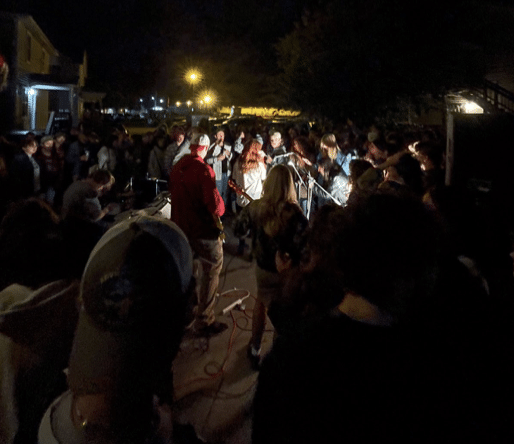
“I think it’s just a ripe environment for (female leads), and they get to pay it forward because then they get to inspire and invite other female artists to join,” he said.
On that cold October night, Kruse takes the stage with her usual psychedelic flair, any traces of fear unnoticeable. McGowan shreds the bass with a wry smile. At the front of the crowd, Solon — the only other woman who performed this evening — takes up enough room for five people with her wild dancing and thrashing limbs, moving in a display of musical passion and solidarity.
Behind her, a crowd of sleep-deprived college students mosh and yell with unfathomable energy, entranced by the feminine power before them.
Editor’s note: Sophia Rooksberry placed in the top 20 of the Personality/Profile Competition in the 2024 Hearst Journalism Awards program for this story. Congratulations, Sophia! We’re proud to have published your story.