CHAUNCEY, Ohio — Chauncey Village Council met for three hours on March 13, with ordinances and resolutions related to LGBTQ+ rights, a ceasefire in Palestine and tenant rights prompting contention among council and community members alike.
Ordinances and resolutions on each of those topics were initially suggested by member Evelyn Nagy. While each measure has drawn support from other council members, they have also prompted criticism, primarily from member Karla Dellinger. None of the items passed this month, with each requiring at least one additional reading.

“Unlawful discriminatory practices” ordinance
Chauncey again considered an ordinance on “unlawful discriminatory practices,” which Dellinger criticized for its establishment of protections for LGBTQ+ people in the village.
Nagy originally suggested such an ordinance as a way to ban discrimination in housing on the basis of “source of income.” This protection is intended to prohibit landlords from refusing to rent to prospective tenants based solely upon the tenant’s source of income — including use of government vouchers, such as those issued by the U.S. Department of Housing and Urban Development.
Ultimately, Nagy folded the ban on source of income discrimination into an ordinance banning discrimination across several identity categories in the areas of employment, public accommodation and housing. While federal laws against discrimination in the areas of employment, public accommodation and housing already exist, Ordinance 2024-3 adds a source of income protection for renters within the village.
The ordinance also enhances protections for people regardless of sexual orientation and gender identity in the areas of public accommodation and housing.
Village counsel Jonathan Robe advised the council that federal protections in the areas of sexual orientation and gender identity are in a state of flux amid litigation.
In a statement at the meeting, Nagy said the lack of established laws banning discrimination on the basis of sexual orientation, gender identity and source of income all prompted her to introduce the ordinance. Nagy also referred to recent state legislation barring transgender youth from accessing healthcare and participating in school sports, as well as other proposed legislation targeting the LGBTQ+ community.
“We live in a patchwork of legal approaches toward the LGBTQ community,” Nagy said. “This burdens our everyday lives as the LGBTQ community. And so, I really feel like this legislation is my obligation to protect our community’s safety, dignity and opportunities.”
Dellinger distributed a written statement at the meeting, apparently opposing village protections for LGTBTQ+ people in public accommodation and housing. The statement says ‘discriminate’ means “to distinguish between” and says “It is good to recognize our differences.”
The statement does not explicitly mention gender identity or sexual orientation — but in it, Dellinger suggests the village follow established law and explicitly notes support for other already protected classes.
Dellinger made the nature of her opposition more explicit during discussion with residents. She said that “if somebody felt very strongly against gay marriage” then it would be “infringing on their rights” if “they was forced to let somebody live in a residence that was a gay couple.”
Dellinger previously said she owns “a couple of rentals” in the village. She said her primary concern with the ordinance, however, regards establishing rights to public accommodation for LGBTQ+ people. Specifically, she said businesses should not be required to provide services that support same-sex weddings, describing such a requirement as an infringement on religious beliefs.
Chauncey residents Abby and Alex Hearne both spoke in favor of the ordinance at the meeting.
Abby Hearne said, “My sexuality doesn’t affect anyone else in this room. But — however — if somebody is barring me from living in a place because of my sexuality, that is infringing on my rights.”
Abby Hearne also noted that whether a place is welcoming to LGTBQ+ people has a direct impact on rates of suicidality.
“If we really are like, really interested in the health and wellbeing of people in Chauncey, especially our youth in Chauncey, we will make it very apparent that they are welcome here in all aspects,” Abby Hearne said.
Ellie Hamrick, who works in Chauncey and spoke in their individual capacity, said, “Housing is a human right and a human need, and not everybody is having the need met in our community. … And in some cases identity based discrimination is a factor there.”
They added, “No one has a right to own multiple properties and rent them out for profit in the first place. I mean, not everyone can do that. That’s something only a lucky few people are able to do. And so then, for them to be able to wield that extra power that they already have on top of everyone else in order to discriminate against a population that’s already at a disadvantage — to me, that seem very, very unfair.”
Alex Hearne, who is nonbinary and bisexual, said religious beliefs shouldn’t affect “whether someone has an ability to rent or buy land.”
Resident Barbie Chatter, however, supported Dellinger’s position, saying, “It’s just not conducive to good business to start over regulating them.” Resident Zachary Buck said the council should be “very careful” about infringing on “religious freedom.”
In response to resident comments, Dellinger emphasized that her opposition to the ordinance is primarily in the realm of public accommodation, not housing — despite her previous comments that landlords should not be required to rent to gay couples.
Because the ordinance will be amended before next month’s meeting, it will be heard on second reading again in April. The earliest the ordinance could be up for a vote is May.
Palestine ceasefire
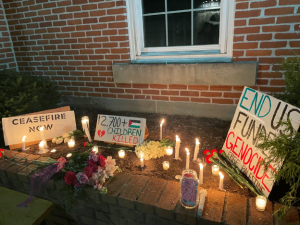
After preliminary discussion at last month’s council meeting, the council considered a resolution to call for a ceasefire in Palestine, modeled on that passed by Athens City Council last month.
Like the Athens resolution, Chauncey’s draft resolution urges federal and state leaders to “urgently end the current violence,” with Chauncey’s resolution specifically mentioning the need for a ceasefire. The resolution also calls upon “the federal government to halt funding for the war” and “calls upon the Biden administration to promptly send and facilitate the entry of humanitarian assistance into Gaza.”
Council member Connaught Cullen introduced the resolution for first reading; Nagy, who initially suggested a ceasefire resolution last month, seconded. All members voted to consider the resolution, with the exception of Dellinger.
“This is clear outside of our jurisdiction and way above my pay grade to even be able to comment or to say, and then even if this is passed, it’s not something that we have any control over in the village of Chauncey,” Dellinger said. “Like, we are the Chauncey government and this is something that is in a completely different country.”
“It might be another country, but we are participating, and our government is participating, and so is the state of Ohio,” Cullen responded, referencing Ohio’s investments in Israel bonds. Ohio is among the largest holders of such bonds in the country.
Cullen also cited federal financial support for Israel.
“Money spent — that our government spends over there — could be coming to people in this country,” Cullen responded. “It won’t affect anything, but I would like to make a statement that, you know, I want all that coming to our people.”
The Athens resolution also prompted concerns among council members related to jurisdiction. The Athens city law director’s office issued an opinion that it would not be “appropriate” for the city council to pass a ceasefire resolution. Ultimately, however, the law director clarified that the office’s opinion was not binding, and the council could proceed as it wished.
Related coverage from the Athens County Independent:
Robe, the village’s attorney, said, “I tend to think that legal opinion is sound, but I also agree with the Athens City Law Director that it’s an issue for council to decide.”
During resident comments, multiple speakers echoed Cullen’s comments about financial support for Israel.
“I want our tax dollars here and helping us here, not overseas,” said Abby Hearne.
Chatter questioned why the village should issue a resolution related to Israel’s war on Gaza when other countries “are going through some real tough times.”
“You’re picking one cause and saying we don’t like it, when there’s other causes of other countries that are going through the same thing,” Chatter said.
Hamrick said, “What makes this different is that our tax dollars are paying for the wrong side. Like, they’re paying to perpetrate a genocide. … I think it’s on us to say we don’t want to do that anymore.”
Alex Hearne noted that more than 100 cities have passed resolutions calling for a ceasefire. Hamrick said that “all of these cities coming together” is important, because “the momentum around the world is shifting in favor of ending this genocide.” Therefore, Hamrick said, it is important that Chauncey “add its voice to the chorus.”
A recent United Nations report warned of an imminent famine as result of the war, with 70% of Gaza’s 2.3 million residents already facing “catastrophic hunger.”
Resolutions in Chauncey require three readings, Robe told the Independent. The earliest the resolution would be formally up for a vote by the council is June.
Pay to stay, amended
Nagy has worked since last fall to pass tenant protections in the village known as “pay to stay.”
Pay to stay is intended to prevent evictions due to unpaid rent, in situations where the tenant is able to pay after the due date but before an official, court-ordered eviction.
Nagy withdrew a pay-to-stay provision from a separate ordinance last fall because it generated controversy. Nagy introduced Ordinance 2024-2 to authorize pay to stay in January.
Dellinger expressed concern at multiple previous council meetings that the ordinance would make it more difficult for her and other small landlords to evict tenants whom they find difficult to work with.
At the February council meeting, Dellinger, Nagy and council member Tammy Hawk agreed to meet to build consensus around the ordinance. Multiple amendments appeared in the latest version of the ordinance.
A previous draft of the ordinance would have prevented landlords from charging fees for late rent payment that were more than $25 or 5% of the monthly rent, whichever was higher. The most recent version increases those figures to $100 or 10% of the monthly rent.
Other changes in the new version of ordinance are an expiration date — March 31, 2025 — unless it is renewed by the council and a limit on “frequency of use” to “once per property per owner” — meaning tenants at each Chauncey property would only be protected by the ordinance a single time.
Related coverage from the Athens County Independent:

Like a ban on source of income discrimination, pay to stay has been adopted by several municipalities across the state. Athens City Council passed pay to stay legislation in June 2021 and a source of income discrimination ban in September 2022.
Southeast Ohio Legal Services managing attorney Lucy Schwallie previously told council members she has frequently worked with tenants facing eviction over nonpayment and said a pay to stay ordinance in Chauncey could be “incredibly impactful.”
Amendments to the ordinance have delayed its final vote. Council will hear a third and final reading of the pay to stay ordinance at its April meeting.
Other business
Also at the meeting, council:
- Passed on first reading ordinances to establish regulations and a charge system for its water and sanitary sewer systems.
- Passed an emergency ordinance to adopt the Ohio Basic Code, which Mayor Amy Renner explained is a comprehensive set of regulations to govern municipalities, in situations where the municipality has not established its own separate regulations.
- Heard from a representative of Rural Action about the possibility of bringing on an AmeriCorps member to support the capacity of the village government.
Renner also noted that the village held a successful groundbreaking ceremony for its sanitary sewer collection system project. The village is in the process of applying for funds for the second phase of the project, Renner noted.
The next village council meeting will be held at 5:30 p.m. April 10 in the Chauncey Village Hall, 42 Converse Street.
Correction: A previous version of this story misrepresented federal protections for LGBTQ+ people in housing. While LGBTQ+ Ohioans are not protected by state or federal public accommodation laws, in housing, LGBTQ+ people are protected federally as a result of a 2021 executive order from President Joe Biden, relying on his interpretation of a 2020 Supreme Court decision. Housing protections in the areas of gender identity and sexuality are not explicit within federal statute.
Disclosure: Robe completed and filed incorporation papers for Southeast Ohio Independent News, the nonprofit that publishes the Athens County Independent. He also has provided the Independent with legal advice.