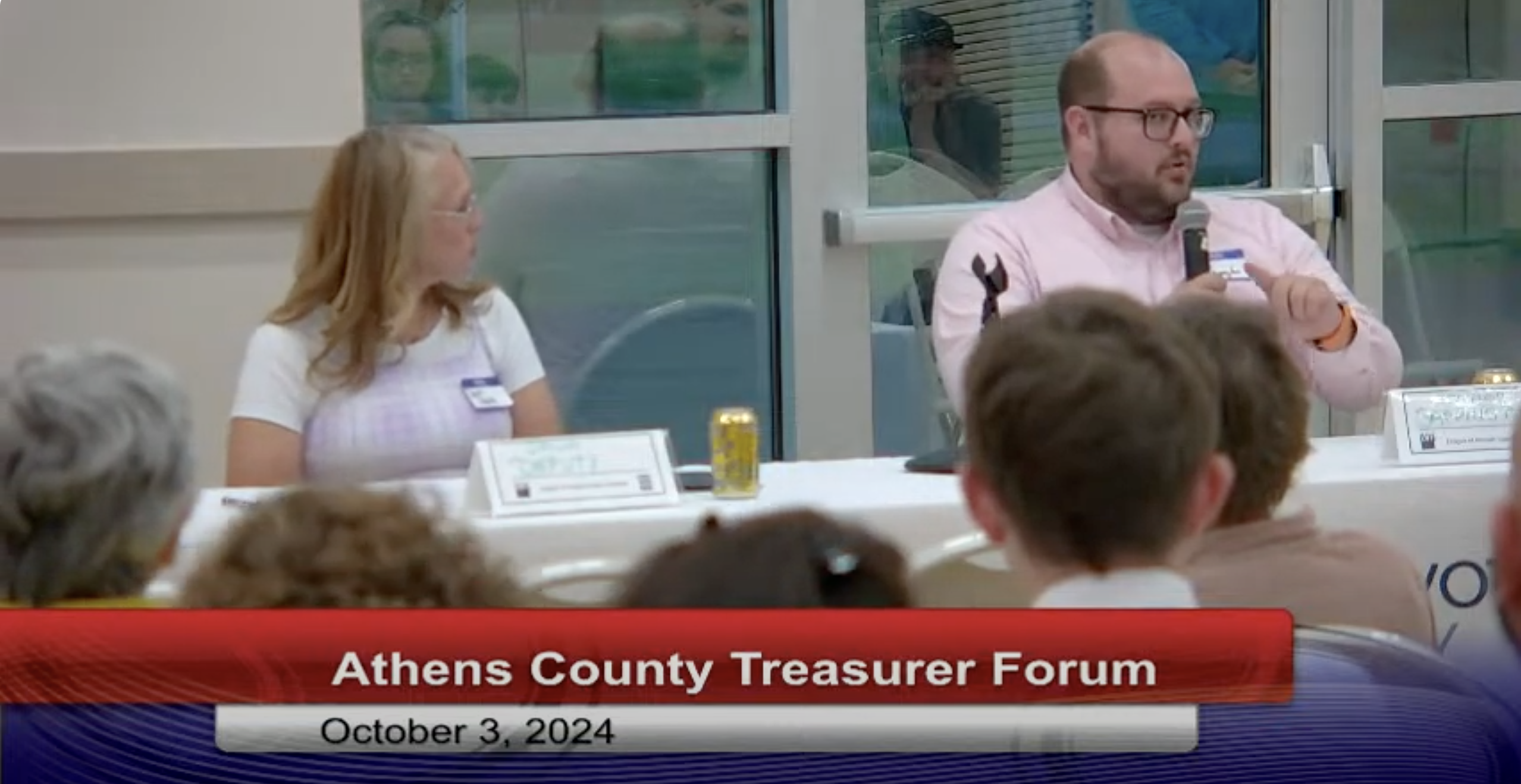
ATHENS, Ohio — The two candidates for the Athens County Treasurer race participated in a League of Womens Voters of Athens County forum on Oct. 3 at the Athens Community Center.
Democratic candidate and current Nelsonville City Auditor Taylor Sappington and write-in candidate Dawn Deputy, an independent, largely agreed on the issues and duties of the office. The two are running to replace Athens County Treasurer Ric Wasserman, who has held the office since 2018.
County treasures in Ohio are elected every four years and take office in the September following their election. County treasurers oversee counties’ investments, expenditures and tax collection.
The candidates first gave opening statements before answering questions from media representatives and the public.
“With over 25 years of experience in accounting, I have a strong background in overseeing budgets, improving financial processes, finding cost-saving solutions,” Deputy said. She later added she is soon to sit for her Certified Public Accountant exam. She also later cited her experience as a fiscal officer for the Athens County Sheriff’s Office. “My goal is to ensure our county’s financial health.”
Deputy said she wanted to be “a full-time, hands-on treasurer with an open-door policy for both local officials and residents, something that has been lacking in the current administration.”
Sappington thanked Deputy for running, because otherwise he would’ve been unopposed in the race. He shared his qualifications: two Ohio University degrees, experience on Nelsonville City Council and experience as Nelsonville City Auditor.
“I found in my experience in government that moments of transition are the most important moments in that seat and in that office, and so we have to get this right,” Sappington said. “I’d also just like to take both my education and frankly, my experience in Nelsonville, where we took on a bad census and recounted the city and made it back to a city status. We’ve turned deficits into surplus. We took on corruption and beat back theft multiple times, and frankly, have done the job and done it well in my office, and I want to take that track record and can-do spirit to the treasurer’s office.”
Forum questions have been paraphrased for clarity. Watch the YouTube video for a full look at the forum.
What should be people’s main takeaway from tonight’s forum?
“I want folks to know that I have the experience to do the job on day one,” Sappington said. “I think my track record shows I’d be good at the job. And I think if I can make an understatement, if anybody’s up to date on current issues in Athens County, Nelsonville City Hall can be one of the most challenging environments to get good work done — bar none — and despite those challenges, and despite arguments, and despite so many other things, I’ve worked with folks of all parties, of no parties, and frankly, folks who don’t even care about politics, to get stuff done and to get it done well.”
Deputy stressed — as she did throughout the forum — that she’d like to be a present and accessible public official.
“I feel, over time, the listening of the taxpayers has gotten lost with the current administration,” Deputy said. “To me, the taxpayers is who votes you in; that’s who you’re working for. You need to listen to them, see what they need … I want to make the taxpayers the number one priority.”
How do you intend to work with the Athens County Land Bank?
The Athens County Treasurer sits on the board of the Athens County Land Bank, an agency that exists to obtain, remediate and sell abandoned properties.
“As treasurer, what I want to make sure to do is be a good caretaker, be a good board member,” Sappington said. “I want to assist the other board members and in helping achieve their goals, but I also want to make sure that it’s growing in a way that it can continue to impact communities like Nelsonville, but also Glouster, Albany, The Plains, so that it has a future, because I think it’s an important part of Athens County now, but also its future.”
Deputy said the land bank “has its time and place, for what its purpose it is for,” specifically for “getting the abandoned buildings taken care of properly to maybe make them again revenue producing for tax purposes, or if needed to be that they’re beyond that, torn down and make their space available for new things, so that way we can get more tax revenue in.” She agreed with Sappington’s point of cooperatively working on the board.
What are the responsibilities of the treasurer, as opposed to those of the auditor?
“The treasurer’s office itself is in charge of bringing in all the monies, getting them deposited, getting them to the right accounts, distributing all the funds to the different entities,” Deputy said. She also noted that the treasurer oversees the county’s investments.
Sappington answered by pointing out what the treasurer doesn’t do: “The treasurer does not set your property tax rates or how much you owe or your property value,” which is set by voters. “The county auditor’s office appraises the value, assesses the tax that the voters approve, and then the treasurer is required to collect those taxes,” Sappington said. “Some of the other important things the treasurer and the office does, specifically, the position will be to sit on the board of revision.”
How should the treasurer consider the environmental impact of the county’s investments?
Both candidates agreed that the county is limited in what it can invest in, per state law.
How do you deal with conflict?
Deputy said she is accustomed to dealing with conflict with the public — and unhappy customers — in her work life, as well as the problem-solving it entails.
“With conflict, I think that’s one way to — is open communication, ask them what they need to make it okay in their eyes, and see if it’s something you can meet realistically, and then hopefully it’s a good outcome for everybody involved,” Deputy said.
Sappington agreed.
“One of the things I tell everybody is that I have to give you the answer you need, not the answer you want,” Sappington said.
How do you deal with people who don’t pay their taxes?
Sappington explained that navigating conflict and communicating is inherent to working with delinquent taxpayers.
“In many cases, you just need to listen,” Sappington said. “Usually, we’re just dealing with half-information, especially when it comes to property taxes … We need to listen and have the information that we need to make the right choices, to make the right decisions, and frankly, to make sure we know what we’re dealing with, with places or individuals behind on their taxes.”
Deputy agreed with Sappington, and added “one thing is to reach out to the taxpayers, the property owners to find out if there’s a reason [they’re] behind.”
“Another thing is, what if somebody through that year came disabled, has lost their income? There’s ways out there to help them, and there’s ways to seek to advocate for them, to be able to help them pay their bills, not that they don’t owe it — because yes, they do owe it,” Deputy said. “That is actually how our county runs, is off of taxpayers and property taxes and stuff. But instead of just being cruel to them and taking their property, we got to work with them, listen to them, and help them be able to meet their obligations.”
What motivates you to be a public servant?
Deputy said she is a longtime public servant, including a volunteer firefighter. She’s also served as treasurer for her children’s sports leagues, and again mentioned her work as a fiscal officer at the sheriff’s office.
“To me, this is just another way to meet with the county residents and be there for them and help them and advocate for them,” Deputy said.
Sappington said his mother inspired his work as a public servant and union organizer.
“When she raised my brother and I, she fortunately imparted that same care into him [and myself],” Sappington said. “And so I care about people, and I think they deserve good things; I think they deserve people who will fight for them, even when that fight is a losing one, and you know you’re going to lose, and it might be unpopular.”
Any instances that you believe help qualify you as treasurer?
Sappington gave an example of his experience as a Nelsonville City Council member.
“I proudly wear on my sleeve that I actually was later bumped from the [Nelsonville] Finance Committee in a political fight because there was an effort to spend six figures that the city did not have,” Sappington said. “I was the only council person willing to say that we didn’t have it. I said so, and they bumped me from the committee for doing just that.”
Since then, Sappington successfully ran for Nelsonville City Auditor, an office he has held for the past five years.
“I’m the manager of the state audit at city hall; we do payroll, we do delinquencies, tax assessments, we kind of do everything,” Sappington said. “And although that’s maybe not good division of fiscal authority, it’s the nature of working in a small town with not a lot of resources … I think all of that experience will serve me well as treasurer, particularly working in a challenging environment, balancing relationships and policies.”
Deputy said her ability to budget is what stands out to her as a great asset for county treasurer.
“That is the root of the finances,” Deputy said. “You got to be able to plan for the unseen. Sometimes you don’t have to have that, and that’s great. But then [if] you don’t plan for it, then that’s when you probably most likely need it.”
Anything to add that you haven’t already addressed?
Deputy stressed that she is a write-in candidate, and that in order to vote for her, voters need to literally write her name; it does not appear on the ballot.
Sappington said something he had not addressed during the forum was “management.”
“I manage a staff of three, and one of the things I’ve found that I really, really care about is the success and the future of the employees,” Sappington said. “I found that’s become really important to me, and would follow through to the treasurer’s office. I want to see those folks in the office succeed.”
If elected, what will be your top priority on day one?
Sappington said his priority on day one would be meeting his subordinates, the treasurer’s office staff.
Deputy agreed. “That’s the first thing you got to do, is get to know your employees,” she said. “However, the other thing to me that’s going to be very important is the other county elected officials in the county to find out what their needs are from a treasurer. What is it that they need and was not getting from the previous administration? So that way we can start working together from day one, because it is a group effort to run the county.”
Other questions
The candidates received a couple of questions that they could not specifically answer:
- What does the county budget commission do?
According to Ohio Revised Code, county budget commissions consist of county auditors, county treasurers and county prosecutors. The body’s duties include local government tax distribution, the verification of tax levies authorizations and allocations; setting tax rates and millages, and more.
- What percentage of the county budget consists of property taxes; and what are other sources of revenue that the county treasurer oversees?
According to Athens County Auditor Jill Davidson, 41.68% of the county’s current budget is permissive sales tax, generated by vehicle registration. The treasurer oversees investments, which make up 8.34% of the county’s budget, this year thus far.
Election Day is Nov. 5. Early voting is currently underway. Find more information on voting, refer to the Athens County Board of Elections.