ATHENS COUNTY, Ohio — The Athens County Independent published nearly 350 news stories this year, our third and most productive yet. Here’s a recap and update of some of the year’s top stories, based on your page views and engagement, as well as our own focus topics.
Be sure to also check out our visual roundup of the year’s news and events here.

Did we miss something? Let us know!
Government
City of Athens
Read our coverage of the City of Athens here.
Cybertheft
In December 2024, the city revealed it had lost nearly $722,000 to an email scam perpetrated by someone posing as a representative of Pepper Construction, the company that built the new fire headquarters on Stimson Avenue.
Around the same time, the thieves also scammed Florida-based developer Regency Centers out of $327 million.
Both Athens’ and Regency Centers’ money — totaling $1.05 million — landed in the same account at Kentucky-based Republic Bank. The bank was able to recover about $349 million of the money. That left a question for the bank: How should it split the remaining funds between the two victims?
Because the city had filed a civil complaint against the unknown perpetrator(s) in Athens County Court of Common Pleas, Republic Bank and Regency Centers filed their own motions to join the legal fray. Both want Judge George McCarthy to decide who gets how much.
Status
In October, all parties agreed to enter mediation in hopes of reaching an agreement before a scheduled status conference on Feb. 19, 2026.
The Auditor of State’s office had issued a bulletin in April 2024 warning government entities about a rise in email scams and setting out specific guidelines to be followed to avoid falling for them. Those guidelines included checking email addresses carefully for subtle errors and verifying emailed requests to change banking information — both of which were involved in the city cybertheft.
The bulletin also stated that failure to follow the guidelines could result in a finding in an audit, and that employees who were found to be at fault could be held personally liable.
The City of Athens’ audits historically have been released between August and October, with a few coming out in November or December. At press time, the city’s 2024 financial audit had not been released.
Income tax refund
Almost a year to the day after the city filed its civil complaint in the cybertheft, the administration announced that an unnamed local business was using a 2014 state law to seek a $750,000 income tax refund.
The law in question allows businesses to deduct net operating losses for up to five years and demand an income tax refund for the full value of those losses from the municipality where the revenue was earned. Previously, municipalities could choose whether to allow such losses and for how long.
Status
At Athens City Council’s Dec. 8 meeting, Mayor Steve Patterson said the city has enough money to pay the refund. Asked by council member Solveig Spjeldnes, 1st Ward, if the city should proceed to set staffing levels for 2026 without changes, Patterson said he did not need to reduce staff levels at this time.
Income tax levy failure
Citing increased costs for health insurance and other expenses, the city asked voters to hike the income tax from 1.95% to 2.25%. In May, the issue failed by 14%. It was the first time city voters rejected a tax issue, at least in the 21st century (Athens County Board of Elections data is available online from 2001 onward).
Status
The city will place a smaller income tax increase — raising it to 2.15% — on the May 2026 ballot.
Other Athens issues
The city’s ban on plastic bags, which took effect in January 2025, was struck down by the Fourth District Court of Appeals in July. Athens Law Director Lisa Eliason announced in early August that the city would not appeal the case to the Republican-dominated Ohio Supreme Court.
A spate of heavy rain in early spring touched off a slow-motion landslide on Joneswood Drive — including the gradual collapse of a vacant home at 10 Joneswood Drive. By early May, the house had completely collapsed and the remains hauled away by cleanup crews. The street reopened in August, following a $593,000 repair.


City of Nelsonville
Read our coverage of the City of Nelsonville here.
Jan. 1, 2026, has loomed over Nelsonville since nearly 70% of city voters passed Issue 23 in 2024 that set out to abolish the city charter and return the city to a statutory form of government.
This year began in Nelsonville with the plan to set Issue 23 in motion, with help from an ad-hoc advisory commission that examined how to transition the city’s government in accordance with Issue 23.
Two council members resigned in February, Tony Dunfee and Justin Booth. Dunfee first joined the council in 2018, and Booth in 2020. It marked Booth’s third resignation from the body, total, and Dunfee’s second.
In late March, former City Manager Tom Cangemi resigned after months of paid administrative leave, following an alleged altercation with Service Director Jason Coen in July 2024.
In April, former Council President Rita Nguyen was arrested at a council meeting, accused of disruption. She, along with former council member Sue Powell, filed suit against the city in July 2024, accusing it of unlawfully removing her from her seat.
Nelsonville voters in the May primary election rejected an effort to retain the city charter but implement a mayoral government. Also in May, the council hired Fred Holmes as city manager.
Over the summer, as part of implementing Issue 23, the city worked on ward maps, too, with the help of the League of Women Voters of Athens County.
In August, Wesley Henderson joined the council, and it repealed Issue 23 through Ordinance 54-25 — prompting legal questions that continue to perturb the city. Henderson resigned in September.
Also in August, the council lost former city treasurer Michael Milane and former council Vice President Nancy Sonick, who both resigned. Athens County Treasurer Taylor Sappington left his longtime position as city auditor Sept. 1. Nicholas Smith became city auditor in September.
But because no court said otherwise, candidates in the November election were elected for offices based upon Issue 23 — including one-month terms, for December, and mayor, auditor and city law director seats.
This month, Cory Taylor, Nic Joseph-Saul, Cameron Peck, and McCray Powell swore-in for their December terms. Gregg Clement was reappointed to serve through December. Additionally, Amy Hollenbaugh and Sonick were appointed to the council, following the end of terms for Opha Lawson and Jonathan Flowers. Flowers ran for mayor, unopposed. He will be the city’s first mayor in decades.
The council also got a new clerk this year, Mary Moffat, replacing longtime clerk Susan Harmony, who resigned Nov. 30.
Status
Council member Cory Taylor filed suit Dec. 8 in the Athens County Court of Common Pleas in an attempt to prevent candidates who were elected this November from taking office. Those candidates races’ were based upon Issue 23, and include:
- Mayor-elect Jonathan Flowers, who ran unopposed.
- President of Council-elect Daniel L. Sherman, who ran unopposed.
- Auditor-elect Andrea Nicole Thompson-Hashman, who ran unopposed.
- Treasurer-elect Brian Elkins, an unopposed write-in.
- Council, at-large: Lynn Bishop, Wesley M. Henderson, Jessica L. Hollenbaugh, McCray Powell, Nic Joseph Saul and Glenn A. Smith.
Nobody ran for law director. Those elected are expected to take office Jan. 1, 2026, as planned, unless a court orders otherwise.
Nguyen and Powell’s July 2024 lawsuit was remanded to the appellate court by the Ohio Supreme Court in February — it remains active. An Athens Municipal Court jury found Nguyen not guilty of her public disruption charge in July, but the state filed to appeal in August.
The state’s appeal is not of her acquittal, rather it is seeking the appellate court to review the trial court’s decision and interpretation of law. Specifically, the appeal argues that “the trial court provided a jury instruction that inserted an element into the offense” that does not exist in Ohio law.
The city is currently seeking applications for interim city manager and auditor, for a term ending Dec. 1, 2027. Holmes resigned as city manager Dec. 9. Nelsonville Police Department Chief Devon Tolliver is currently serving again as interim city manager, for the fourth time.
Economy
Road construction
County drivers faced several major obstacles trying to get into or out of Athens and The Plains this year. Reconstruction of the Stimson Avenue bridge, in conjunction with construction of roundabouts in The Plains, and now at 682 and SR 56, made roadwork unavoidable for commuters in Athens County.
Rehabilitation of the Stimson Avenue bridge began in late spring, with one-way traffic controlled by lights. At peak times, traffic backed up along Stimson Avenue, North 1804 Way and Rock Riffle Road as drivers waited for their green lights. Snarls also built on East State Street and Richland Avenue during occasional bridge closures as well.
The cost of the project skyrocketed between its proposal in June 2023 and March 2025, when Athens City Council authorized the work. Additional funding from the Ohio Department of Transportation later reduced the city’s share, but it still was much larger than originally planned.

The main access to The Plains was blocked for months as the Ohio Department of Transportation installed roundabouts at the top of both the northbound and southbound ramps on U.S. 33. While the northbound exit was closed, traffic was routed to the SR 682 cutoff just north of town — an exit ODOT has already said it wants to remove.
On the county’s eastern border, ODOT installed a reduced collusion U-turn, or RCUT, on U.S. 50 at the intersection with Brimstone Road. Eastbound drivers can make right-hand turns into Coolville, but cannot turn left onto Brimstone; westbound drivers can make a right-hand turn onto Brimstone, but cannot turn left into the village. Instead, drivers use a designated U-turn area to reach the opposite highway. ODOT says the setup will reduce collisions; opponents fear it will increase them by forcing drivers to pull in front of uphill traffic.
Before the RCUT project began, however, Coolville faced a different traffic problem when heavy rains in July washed out part of a culvert on SR 144. ODOT and Coolville officials had been aware of the deteriorating culvert since 2023 and had applied for a grant from the Buckeye Hills Regional Council to cover the cost of repairs. After the washout ODOT agreed to cover the cost of repairing the road but that Coolville was still responsible for moving the sewer and water lines. State Representative Kevin Ritter then stepped in and negotiated with the Buckeye Hills Regional Council to cover the cost of moving the water and sewer lines.
The culvert replacement is one of a number of emergency infrastructure repair projects around the county after intense rains caused landslides and washouts. In June, the City of Athens estimated that it would cost $750,000 to repair storm damage, while the county engineer estimated that the rest of the county had about $1.6 million in damages.

Status
Stimson Avenue, SR 144 and the roundabouts at SR 682 north of The Plains are now all open, as is the Coolville RCUT. Work on the roundabout at the intersection of SR 682 and SR 56 on Athens’ west side started in the fall remains underway; the city’s web page on the project does not include a completion date.
OU faculty union
Ohio University faculty voted overwhelmingly to unionize in March, and OU has contested the outcome ever since. OU appealed a decision from the State Employee Relations Board that determined the faculty’s vote to unionize occurred under fair conditions.
OU argues that United Academics of Ohio University violated state administrative law by holding members-only meetings during the course of its election campaign. The university claims SERB did not fully investigate its claims.
The union, meanwhile, called OU’s arguments “absurd.” The union argues that preventing members from meeting during the course of a campaign could severely hamper employees’ ability to organize at all.
The case remains pending before the Franklin County Court of Common Pleas.
In the meantime, Ohio University and the faculty union have been in contract negotiations since Aug. 5. In that time, the union and university have reached tentative agreements on only two of the 24 proposals currently on the table. All proposals were put forward by the union, with the university having responded to very few.
Status
On Dec. 18, the union posted on its Facebook page that the university has not responded to a proposed compensation and benefits plan submitted 49 days earlier.


Housing
Housing was a major topic in Athens County this year — particularly housing for those who don’t have it or can’t afford it.
In October 2024, Hocking Athens Perry Community Action announced that it was buying the former Sunset Motel on Columbus Road to convert it into an emergency shelter. Work on the project began in July with lead abatement. The former motel is set to become a non-congregate family shelter that can host up to 48 people.
The City of Athens this year wrestled with two proposals related to temporary shelter for unhoused people. The council heard extensive, majority supportive, public feedback about the two ordinances that dealt with housing this year.
The first was an ordinance that the council passed unanimously in November to allow The Gathering Place to place three Conestoga Huts in its parking lot at 1, 5 and 7 N. Congress St.
Additionally, the council passed an ordinance in December that allows the conditionally permitted uses of temporary shelters, like the Conestoga Huts, in R-3, multifamily, and B-3, general businesses, zones. That ordinance originated out of an Athens Planning Commission recommendation.
The Athens Board of Zoning Appeals must provide initial approval of applications to erect shelters; continued use is subject to annual reapproval by the safety-service director. Shelters must be within 200 feet of a building and have access to at least one toilet and sink per three units.
In 2024, the city partnered with The Gathering Place to provide an emergency warming shelter at the former fire department station on Columbus Road. Since that location is now leased, the warming shelter for this winter will be at United Campus Ministry, 18 N. College Street. People (and a limited number of pets!) may stay overnight and receive dinner and breakfast.
Status
At city council’s Nov. 19 meeting, The Gathering Place Director Ginger Schmalenberg said that the Conestoga Huts were ready to be occupied. The Independent could not reach Schmalenberg for comment in time for publication.
Nobody has yet applied to the Athens Board of Zoning Appeals for the permitted use of a temporary shelter.
In mid-December, HAPCAP announced that two rounds of competitive bidding for a construction contract to continue restoration efforts at the Sunset Shelter had failed. Whether the shelter will open in 2026 as planned is uncertain; HAPCAP is looking for ways to move forward.



Affordable housing was also a major topic of discussion among Athens City Council and countywide — specifically, proposed Low-Income Housing Tax Credit program projects.
The LIHTC program allows property owners of qualifying affordable housing projects to claim tax credits against state taxable liabilities over a 10-year credit period, according to the Ohio Housing Finance Agency.
Following vocal neighborhood opposition to a proposed project in Athens’ Southside neighborhood, a Columbus developer in February withdrew its zoning request for a proposed affordable housing project.
Athens City Council tabled Ordinance 0-06-25, set for third reading, which would have rezoned the 8 acres on Pomeroy Road for a 50-apartment project called Pomeroy Landing. Numerous neighbors voiced their concerns and opposition to the project for various reasons, including traffic, flooding and access to public transportation. At the time, the developers were applying for the LIHTC.
The Pomeroy Landing units would’ve been rented to people earning 30–80% of the median area income. The median income is $37,059 for the city and $53,837 for the county, according to the U.S. Census Bureau.
The council in June approved the rezoning for an affordable housing project for 5 acres at 111 Hooper St. That project also faced opposition from neighbors, who voiced concerns about a blind curve in the roadway. Hill Tide Partners of South Carolina sought to develop 80 housing units on 5 acres, part of 18 acres overall, including plans for homes outside of city limits, too.
The property is heavily wooded, along a hillside, across the road from Monticello Village Apartments. Those developers, too, were to apply to the LIHTC program.
Two LIHTC projects were proposed in The Plains: Cornerstone at Eclipse Run by Fairfield Homes Inc., and The Lofts on First by Woda Cooper Development and Hocking Athens Perry Community Action. Both are located along East First Street in The Plains and are adjacent to two prehistoric earthworks, Dorr Mounds 1 and 2, which prompted concern from individuals who spoke at an Ohio Housing Financing Agency meeting in July.
The $19.8 million Cornerstone at Eclipse Run project is proposed to be multiple two-story apartment buildings containing 58 apartments, with one to three bedrooms that will rent for $700–$1,200.
Woda Cooper and HAPCAP’S $19 million The Lofts on First project proposed 51 one- and two-bedroom apartments, earmarked for seniors (ages 55 and older), in a three-story building similar to Woda Cooper’s Kershaw Greene complex.
Status
Ordinance 0-06-25 has not returned to the council since being tabled in February. The Ohio Housing Financing Agency did not approve the developers, Spire Development, for the LIHTC program, according to Ohio Housing Finance Agency Director of Public Affairs Penny Martin. Spire submitted a 9% LIHTC pre-application, but did not submit a proposal application.
According to Athens County Auditor records, 111 Hooper St. still belongs to Sean White, co-owner of Little Fish Brewing Company. The state did not approve Hill Tide Partners for the LIHTC program.
According to a press release from Fairfield Homes, Inc., Cornerstone at Eclipse Run was awarded funding from both LIHTC and the Ohio Housing Trust Fund.
Martin said The Lofts on First received approval for a $2.5 million Housing Development Loan, $9.4 million in LIHTC and $4 million from the Ohio Housing Trust Fund. In July, the developers received conditional approval to authorize up to $10.1 million in Multifamily Housing Bonds.



As part of its ambitious plan to provide end-to-end services, the Survivor Advocacy Outreach Program partnered with 3D-printing construction company Vitruvian to build homes in Chauncey. The company started construction earlier this year.
While one expert told the Independent that 3D-printing construction technology was being “brute-forced” in its early deployment, the project will provide affordable housing to people who need it. SAOP hopes that the 3D-printed homes will be sold to first-time home buyers and those who might qualify for funding assistance. Specifically, SAOP hopes to sell the homes to its clients.
The project is also providing job training opportunities for students and professionals alike.
Status
Vitruvian co-founder Chris Sentz told the Independent that printing is complete for two homes in Chauncey, and construction efforts are shifting to final touches. Vitruvian expects to host an open house for the structures early next year.
The third building will be constructed in the spring.
Meanwhile, the company continues its educational programming. Sentz said the New Lexington City School District digital masonry program just completed its first full class and that students printed a wall for their school with the company and its technology.
“Athens-Meigs ESC, Nelsonville-York, Morgan High School, Eastern High School, Southern, Meigs are all joining New Lex as partners offering the digital missionary coursework to their students in the spring,” Sentz said. “So we’re really excited that it’s growing and we’ll have more people involved.”


Nonprofits
Survivor Advocacy Outreach Program
As SAOP moves forward with the major initiatives initiated under its former director, Jen Seifert, through an Appalachian Community Grant, it also continues to deal with fallout from the period of Seifert’s leadership.
In August, Seifert sued SAOP for alleged defamation, arguing that the organization was baselessly harming her reputation and consulting business.
SAOP denied Seifert’s allegations and responded by filing a counterclaim shortly afterwards. The nonprofit argued that Seifert misused nearly $1 million in organizational funds.
In a November filing, Seifert sought to throw out part of SAOP’s counterclaim, arguing that allegations related to a $700,000+ transaction for 3D-printing technology the nonprofit never received were plainly meritless.
In December, Athens County Court of Common Pleas Judge George McCarthy disagreed with Seifert, finding there are “genuine issues of material fact” at play related to that transaction.
Status
The case remains pending in the local court and may take up to three years from initial filing to resolve due to its designation as complex litigation.

Passion Works Studio
Passion Works Studio, an iconic Athens institution focused on opportunities for people with developmental differences, started the year in a period of internal upheaval. The nonprofit terminated its longtime studio manager Nancy Epling Dec. 3 over allegations of religious discrimination, stemming from her activism against Israel’s war on Gaza and related statements.
Amid the fallout, two other employees resigned from the studio’s small staff.
Status
Passion Works Studio Director Patty Mitchell told the Independent in June that the organization was now “working well” and “looking forward to a healthy future.”

Rural Action
Rural Action parted with its longtime executive director Debbie Phillips earlier this year and said she was not in a position to discuss if her exit was voluntary.
Status
Rural Action has since appointed Joe Brehm and Bryn Sowash as interim co-CEOs.
“Together, they bring two decades of experience in nonprofit management, community development, and environmental restoration,” the nonprofit said in a press release. “Their shared leadership approach reflects the organization’s long-standing belief that collaboration and collective vision drive the most lasting change.”
Education
Trimble Local Schools’ financial woes
In late 2024, Trimble Local School District Treasurer Ashley Miller — newly hired to the position — made a grave discovery: The district faced a $1.6 million deficit. As she continued to review the district’s accounts, her projections of the deficit grew to nearly $3 million.
In April, the state determined the district to be in fiscal emergency, which allowed the district to obtain solvency assistance that it will have to pay back.
Between March and June, the district eliminated more than 30 positions due to the financial crisis. For perspective, according to the National Center for Education Statistics, for the 2023–24 school year, the district had about 60 classroom teachers and fewer than 800 students.
While in fiscal emergency, the district’s finances will be overseen by an additional body, the Ohio Department of Workforce and Education’s Financial Planning and Supervision Commission for the Trimble Local School District.
In alliance with state urging, the district decided in July that it would seek a 1% earned income tax levy. District voters passed the levy in November, by 34 votes. That levy goes into effect Jan. 1, 2026, for five years and is estimated to generate $655,000 annually.
The district’s woes had an impact on the board of education as well. Board Vice President Kevin Coey lost his seat to newcomer Carl Fouts, who received the most votes of any candidate in the race. Voters reelected incumbents John Standley and Board President Gary Arnold.
Status
ODEW Office of Financial Analysis and Oversight Fiscal Consultant Christopher Wright said in an October email that the district’s 2024–25 school year deficit ended up being around $1.2 million, reflecting the nearly $3 million in solvency assistance the district received.
The district’s deficit for the 2025–26 school year is projected at around $2 million, Wright said.



Federal Hocking’s controversial leader
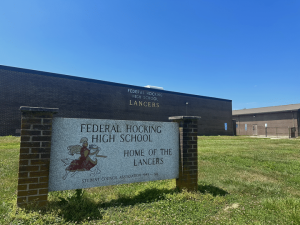
Federal Hocking Local Schools was consumed by controversy over actions of Superintendent Jason Spencer, who joined the district in July 2024. As WOUB reported, teachers and staff were troubled by Spencer’s my-way-or-the-highway administrative style and apparent dislike of Federal Hocking High School Principal Jake Amlin. District residents were disturbed by Spencer’s social media behavior, such as posting an image of himself wearing armor and riding a rearing white horse.
The major uproar, however, began when the board of education approved Spencer’s recommendation to eliminate six teaching positions and to fire Amlin as high school principal. Dozens of residents showed up at board meetings to praise Amlin’s work and denounce Spencer.
Spencer’s rocky tenure came to an abrupt end in June, when he announced his resignation. His separation agreement with the district — which included a one-time payment of $70,000 — hinted at an investigation that would not proceed “unless required by law.” What that investigation may have been for has not been disclosed.
Status
Amlin sued the district over his firing, but voluntarily dismissed the case in August 2025. However, the dismissal was “without prejudice” — meaning he could revive his suit later.
Sara Brumfield was the only full-term member to run for re-election, but her bid was unsuccessful. Aaron Tate, who had been appointed to complete a term ending in 2025, successfully ran for an unexpired term ending in 2027.
George Wood returned as superintendent on a one-year contract starting in August 2025. When contacted by the Independent on Dec. 16, Wood said the district would have an announcement regarding the search for a new superintendent in early January 2026.


Ohio University and Senate Bill 1
As a result of Ohio Senate Bill 1, known also as the Advance Ohio Higher Education Act, Ohio University closed its three diversity centers: the Pride Center, Women’s Center, and Multicultural Center.
Students and faculty protested against the closures over the loss in community and material support the closures would cause for marginalized students. OU said the law clearly dictated the closures, however.
Less clear was OU’s responsibilities toward the people who staffed those centers. While some universities reassigned employees to other positions, OU let go most of the centers’ staff without trying to find them different jobs.
SB1 also affected OU faculty and additional programs. In addition to DEI programs, the law mandates elimination of low-enrollment courses and majors, revamps tenure provisions and requires a specific course in American civics. To comply, OU eliminated many courses with low enrollment and restructured various departments.
The bill’s impact spilled over into the community, too.
In spring — before SB1 had been voted on — OU abruptly cancelled its triennial Black Alumni Reunion. The event went on anyway because community organizations banded together through the leadership of the Racial Equity Coalition of Appalachia.
While SB1 was moving through the legislature, OU’s Mahn Center for Archives and Special Collections began preserving materials accumulated by and belonging to the Pride, Multicultural and Women’s centers. That included extracting data from outdated storage devices, like floppy disks, so the information is readable with modern technology.
What the archives couldn’t keep, it gave to local nonprofits aligned with the centers’ missions. More than 15 boxes of books and other items from the Multicultural Center went to the Mount Zion Black Cultural Center. Materials from the Pride Center — including clothes available to transgender students — went to United Campus Ministry.
The Athens County Foundation also opened a fund to support LGBTQ+ programs in the area.
Status
Archives staff are still sorting and cataloging items, which will comprise a new collection called Memories of the Ohio University Student Centers. The Mount Zion Black Cultural Center is expected to open in October 2026.
Since the Independent published its story on OU’s separation with DEI staff, OU fulfilled a records request showing that the university reemployed just four of the terminated 14 DEI staff members.







Environment
EHD epidemic
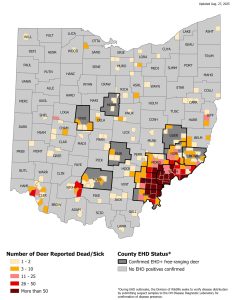
Epizootic Hemorrhagic Disease swept through Southeast Ohio this fall. The disease can cause deer to lose their fear of humans and causes a number of symptoms including swollen facial features, loss of appetite, cardiac hemorrhaging, and fluid-filled lungs.
The Ohio Department of Natural Resources recommended that the public avoid eating deer infected with EHD and to avoid contact with any dead deer, though the disease does not infect humans.
In response to the spread of the disease, ODNR hosted a town hall on Sept. 17 at the Athens ODNR office to discuss limiting the deer bag limit for Athens, Washington and Meigs Counties. Over 100 local hunters, landowners and concerned citizens attended the town hall with the majority of attendees speaking in favor of cancelling or imposing restrictions on deer season.
Status
The last major outbreak of EHD in Athens County was in 2022, when 169 deer deaths were reported to ODNR. The recent outbreak has resulted in 9,281 deer deaths being reported to ODNR, as of Dec. 18.
As of Nov. 6, deer harvests in Athens, Meigs, Morgan and Washington counties were down by 75% on average. On Nov. 12, the Ohio Wildlife Council voted to reduce the deer bag limit for Athens, Washington and Meigs counties down to one with Morgan county being reduced down to two. The reduced bag limits went into effect Dec. 1, coinciding with the start of deer gun season.
Mike Rex, chair of the Ohio Wildlife Council, called this year’s outbreak unprecedented, and other members of the Ohio Wildlife Council have said that the public response to the outbreak affected their vote to limit this year’s hunting season.


Austin Powder explosion
On June 11, Vinton County residents evacuated their homes after a leaky tank at the Austin Powder factory released a plume of nitric oxide into the sky.
The leak was first discovered by an Austin Powder employee at 8:30 a.m. Residents were allowed to return home later that day.
The leak began after a chemical reaction triggered the nitric acid in a storage tank to transform into nitric oxide. The national weather service, multiple county emergency management agencies, the Ohio Environmental Protection Agency and hazmat teams from Jackson, Vinton and Ross counties responded to the leak.
A representative for Austin Powder said that no nitric acid, which is substantially more lethal than nitric oxide, was released during the event. Austin Powder and the Ohio EPA also reported that they had not received reports of harm to livestock or pets and that air and water testing revealed no health hazards to the local community.
It wasn’t the first time the Austin Powder Company’s safety procedures have come under scrutiny: in 2009, two employees were injured and a third employee died in an explosion at the factory. Multiple Occupational Safety and Health Administration inspections of the plant have resulted in hundreds of thousands in fines for safety violations.
Status
Austin Powder officials did not respond to questions from the Independent about what caused the chemical reaction which led to the incident.


Fracking and injection wells
A broad social movement against approval of new fracking waste injection wells in Washington County turned to the legal system this fall, with the ODNR facing multiple challenges to the permits it approved for new wells.
The ODNR Division of Oil and Gas Resources Management granted the permits at issue this year under outdated permitting rules. The wells are owned by DeepRock Disposal Solutions, a company with ties to sitting state senator Brian Chavez (R-30).
The ODNR applied the rules in place at the time of the initial permit applications. Those rules were revised in 2022, however, after the old rules proved insufficient to protect against the migration of fracking waste from Southeast Ohio injection wells.
DeepRock has had a history of issues with brine migration. Brine from one of its Noble County wells caused an environmental disaster in 2021, affecting multiple oil and gas production wells.
Additionally, Washington County oil and gas producers allege that fracking waste stored by DeepRock is leaking underground and allege the brine is interfering with oil and gas production and poses a threat to drinking water.
Status
The City of Marietta appealed the ODNR Division of Oil and Gas Resources Management decision granting one of the permits at issue to the Ohio Oil and Gas Commission, which hears cases challenging the division chief’s orders. The case remains pending before the commission.
Meanwhile, Buckeye Environmental Network’s case against the ODNR challenging multiple permits remains pending in the Franklin County Court of Common Pleas.




Hocking River report
In late 2024, the Ohio EPA released a report detailing its analysis of water quality in the Hocking River. The report found that the Hocking was an “exceptional warm water habitat” for 75 species of fish and nearly 400 macroinvertebrate species.
On the other hand, the river’s high levels of E. coli pose a risk of harm to human health. Swimming or wading in water contaminated with E. coli can lead to diarrhea, vomiting, and a variety of infections, according to the U.S. Environmental Protection Agency.
Status
The Hocking’s designation as an exceptional warm water habitat means that the river will be subject to stricter standards for temperature, dissolved oxygen and ammonia.
The Ohio EPA has worked for years to reduce E. coli levels in Ohio waterways, primarily by upgrading infrastructure at water treatment plants. Today, most E. coli levels contamination comes from failing home septic systems. The Athens City-County Health Department runs multiple programs to inspect and fund upgrades to home septic systems.


Policing & Courts
Ohio State Highway Patrol crash
Two elderly residents of Albany were killed July 31 when their vehicle was struck by an Ohio State Highway Patrol cruiser. John and Le-An Horton were turning left from U.S. 50 across the highway to Fisher Road when their Toyota Prius was slammed by a cruiser driven by Trooper Zachary Tackett.
The Independent’s analysis of dashcam footage from Tackett’s cruiser indicated that he hit speeds up to 130 miles per hour and was going about 116 mph just before the crash.
The OSHP said Tackett had observed a moving violation and was trying to catch up to the motorist when his cruiser collided with the Hortons’ car. However, the patrol stressed that Tackett was not in an active pursuit of a fleeing suspect –– that would have required him to run his lights and siren. Although OSHP would not confirm whether the cruiser’s lights and siren were on, multiple individuals who said they witnessed the crash stated on social media that they were not.
Status
Tackett was placed on administrative duty after the crash, but had returned to full duty by the end of October. The final report of the patrol’s investigation of the crash has not yet been released.

Athens County and ICE
Victor Laverde Laguna and Gregory Laverde Laguna entered the United States legally as asylum seekers. The brothers fled Venezuela amid fear of what Victor Laverde Laguna described to the Independent as repression targeting him for his outspoken opposition to the government of Nicolás Maduro.
Then, the brothers took a gig as couriers and were arrested in Athens County as part of a sting operation targeting an alleged extortion scheme. The brothers maintain they didn’t know they were doing anything illegal.
Neither speaks English, and Gregory Laverde Laguna has Down syndrome.
Criminal charges against the brothers were ultimately dismissed with prejudice, meaning the state cannot bring the charges against them again. The Athens County Prosecutor’s Office said it requested the dismissal because the case had been referred to the FBI.
Both brothers remain innocent in regard to the charges they faced, Athens County Court of Common Pleas Judge George McCarthy wrote in orders.
However, before their criminal cases were dismissed, the brothers were transferred to ICE custody, in a move their immigration attorney called atypical.
Status
The brothers are still detained by ICE at the Northeast Ohio Correctional Center, with their immigration cases moving slowly amid guidance from the Trump Administration that limits the authority of immigration judges to release detainees on bond.
The brothers will seek an intervention from the federal court system to release the brothers from detention while their cases remain pending.


Meigs County Sheriff
This summer, a federal court ordered Meigs County to pay $60,000 to a Pomeroy man and his son, who sued the sheriff’s office over alleged police misconduct. The judgment followed an offer by Meigs County to resolve the case.
The deputies named in the suit left Meigs County to work at the Gallipolis Police Department, where one was soon terminated for unrelated issues.
Meigs County Sheriff Scott Fitch, who moved to Meigs County after working at the Nelsonville Police Department chief, said the December 2022 incident that became the subject of the lawsuit contributed to the deputies’ departure from the sheriff’s office.
However, the attorney for the Meigs County men who sued argues that the sheriff’s office appeared to defend the deputies’ conduct at the time, and there is no record that the officers were disciplined for their conduct. Instead, it appears deputies were embroiled in a separate investigation related to an incident in which they did not arrest a suspect for whom they had a warrant.
Status
Although the lawsuit over the December 2022 incident settled, the Meigs County Sheriff’s Office faces multiple other lawsuits revolving around incidents since Fitch took over.
One suit alleges Fitch forced out a deputy because of his age, and brought on a series of younger hires to remake the sheriff’s office. Many of the people Fitch hired were former colleagues from the Nelsonville Police Department.
Two of those former Nelsonville officers are among the defendants in a separate, wrongful death lawsuit stemming from a 2023 incident when a deputy deployed spikes in a high speed chase. The fleeing individual lost control of his vehicle and ended up colliding head-on with an uninvolved individual. Both died.
The lawsuit alleges the Meigs County Sheriff’s Office did not adequately train the deputies.

Culture
Good Neighbors
The Independent documented the many ways that individuals and organizations came together to help those in need during 2025.
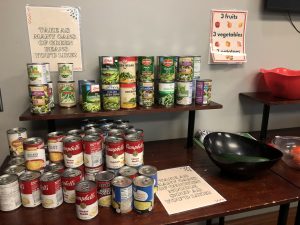
When the government shutdown paused distribution of SNAP benefits in November, nonprofits across the region created lists of food banks, community meals and other ways to keep folks fed. The Independent, which had been publishing its own resource list in The Scoop for many months, combined all that information into a single, searchable database that now lives on our website.
Multiple organizations held food drives. Several restaurants — including Avalanche Pizza, Hot Box Chicken Fingers & Tots, Kiser’s BBQ, Larry’s Dawg House, and Mitzi Lou’s — offered free meals to SNAP cardholders. And Athens residents Melissa and Michael Link organized a grocery buddy program that covered grocery expenses for over 50 households.
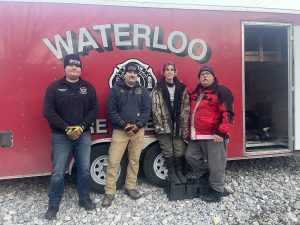
We also wrote about the Waterloo Fire Department’s ongoing support for those affected by Hurricane Helene in 2024. In October, the department was preparing to deliver its fifth shipment of food for both humans and pets, cleaning supplies and other basic necessities to western North Carolina.
Earlier in the year, the Joe Burrow Foundation teamed up with Hocking College and other organizations to create the 740 Rescue Kitchen. The kitchen uses surplus food from grocery stores, farms and other providers to craft soups and meals that are then distributed to schools, food pantries and others.
Other Good Neighbors we celebrated this year were Emily Christine, whose Tavolino restaurant provides free lunches every Tuesday; Millfield residents who banded together to revive the village park; the Trimble Local Textbook and Supplies Foundation, which has given the district nearly $1 million in materials since 2002; and the Threshold Singers of Appalachia, a group that sings to people who are dying.




Wilson, the Taco Bell dog
For months, Athens County residents followed the saga of an abandoned dog named Wilson who lurked near the Taco Bell on East State Street in Athens. The “Taco Bell dog” was not only a fan of burritos, but also an elusive target for rescuers trying to capture him.
Wilson was finally caught in October, six months after he and his sibling (who was caught right away) were dumped along U.S. 50. After receiving care at the Athens County Dog Shelter, Wilson is now available for adoption … to someone with a fenced yard.

‘Fallout 76’
Gamers in Southeast Ohio eagerly awaited the early December release of an expansion to the Fallout 76 video game that is set in the region. Players of the Burning Springs expansion move through fictional post-apocalyptic versions of Athens, Albany, Shade, Jackson, and the Hocking Hills.

Rhys Carr
One of our most-shared stories of the year was a profile of Athens High School alum Rhys Carr, who described how the Factory Street Dance Studio, Ohio Valley Summer Theater and ABC Players helped propel them to Broadway.