
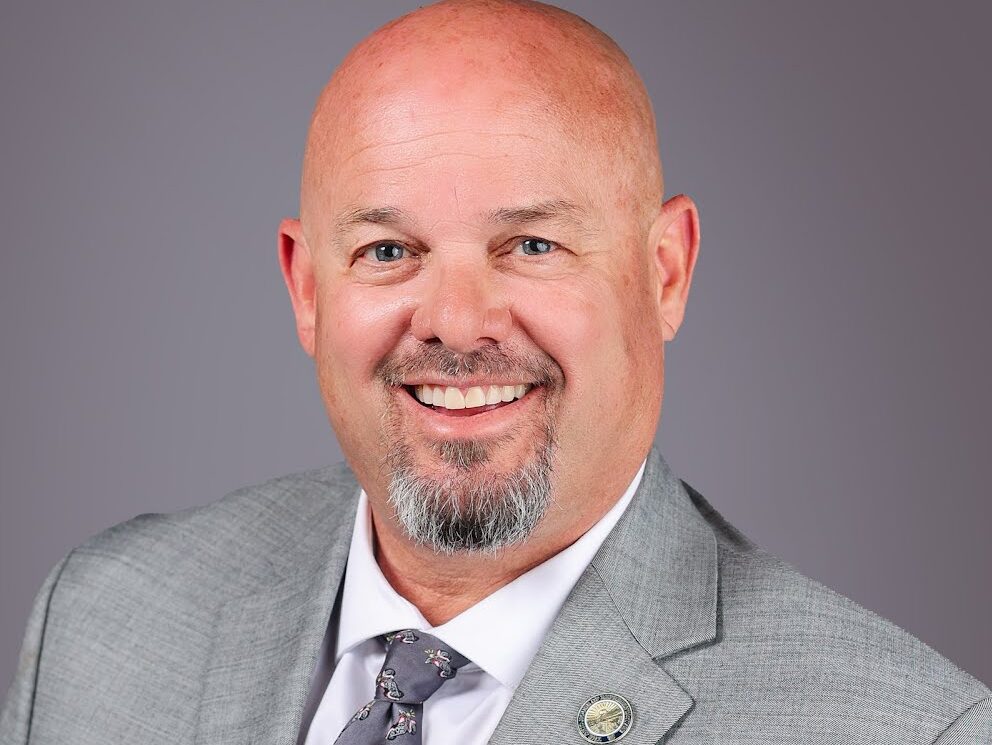
OHIO HOUSE DISTRICT 95 — Incumbent State Rep. Ty Moore (R-Caldwell) is seeking reelection to represent portions of Athens County in Ohio House District 95. He serves on house committees for agriculture, local government, natural resources, and veteran and military development.
The district comprises the City of Athens; rural swaths of Athens, Belmont and Guernsey counties; and all of Harrison, Morgan and Noble counties.
Moore ran unopposed in this year’s Republican primary. He faces Democratic candidate Paul Cameron of St. Clairsville in the general election.
Originally from Caldwell, in Noble County, Moore attended Bucknell University in Pennsylvania and studied political science. He is a third-generation woodworker.
He was elected three times as Noble County commissioner beginning in 2016. Moore held the office for nine years until mid-2025, when he was appointed to the Ohio House seat vacated by Don Jones.
Moore said he is most proud of his family. One of his children attends Ohio University.
In the realm of public service though, Moore said he is most proud of his support for the revitalization of a community pool in Caldwell. Through grassroots efforts, the community raised hundreds of thousands of dollars, he said. He served as president of the pool committee. “We brought our local pool back,” he said.
As commissioner, Moore said one of his biggest accomplishments was expanding water infrastructure in Noble County.
“I think we got 185 homes water,” Moore said. “I had a lady tell me one time, ‘All I want to do, Ty, is one day to wash my car.’”
The Independent interviewed Moore via phone Sept. 28 to talk about his campaign, his politics and what he hopes to achieve if elected. The interview has been edited for clarity and brevity.
What are your political beliefs or identities?
I’m a conservative Republican. I’m in government, but I want less government in my life. I believe that’s the Republican ideology. I think sometimes that Democrats want more government in their life, and I’m a Republican because I want more accountability.
What are your top issues to address in office?
We got to get costs down — take care of the property taxes and get them down, get the food prices down and get down the gas prices. If we can get all that stuff down, we’re all gonna be better off.
There’s been a recent push in Ohio to abolish property taxes. What’s your take?
Here’s the way I look at property tax. So property tax, what I pay in my hometown, I pay $1,900 a year for my property taxes. So for that $1,900 a year, I get a lot — I’m just talking on a personal level. I get senior care if I’m old, I get protection from the sheriff, and I get fire department protection.
When I was a commissioner, we could only run one ambulance out of our levy, so we finally got enough money in our levy where we could run two ambulances. If I do away with property taxes, and I’m for it, and there’s a guy having a heart attack in the town of Batesville, which is about 25 minutes outside of Caldwell, and I live in Caldwell and a pink elephant steps on my kid outside my house and my kid is bleeding out and going to die because the only ambulance is in Batesville helping a guy with a heart attack — did I do any good by saving my $1,900? That’s how I look at property taxes.
I think it’s essential that we pay some, but I think in the last seven to 10 years, it’s gotten outrageous. And Columbus needs to do something about getting it back under control. We need to get back to where everybody pays their fair share.
How do you feel about large-scale data centers?
I’m on the agricultural committee, so I’m against using farmland to put these data centers on. One of these days we’re going to run out of places where we can cook beef and different things like that. I think there’s places that you could put them, but they have to be accountable to their surroundings.
Local leaders have to read the room, and they have to know whether their communities want them or don’t want them, and that’s where guys get sideways on it. They expect Columbus to do it for them. To me, it should be the trustees — it should be the county commissioners — and what do people want, and go with the decision from there.
When I think about the data centers, I just want to put the pros up on the blackboard, and I want to put the cons on the blackboard, and I want to write everything down. And then, as a community leader, think about, “Where are we at, guys? What do we want to do? Is this good for us or is this bad for us? If you think it’s good for us, then let’s do it.”
Do you think our current district maps are fair?
I can’t answer if the maps are fair because however you roll it out, there’s going to be someone upset. I’m smack-dab in the middle. You live with it, and instead of crying about it, I just try to grind it out and be the best I can be in the 95.
What are your thoughts on SNAP and Medicaid? Do you support work requirements?
I think there should be work requirements. You got to have a little accountability, but we got to take care of people that can’t take care of themselves. That always worries me. What happens with all the SNAP benefits and the Medicaid thing is people take advantage of the system. And I don’t know how to fix that. But I wish people were honest.
Somehow we have to regulate it ourselves and find out who’s cheating the system and who’s not. There’s got to be some kind of ability where we can still keep [SNAP and Medicaid] to help the true people that need them.
What’s your position on regulating marijuana use?
I have no problems with anybody smoking weed. If they do it, and they do it legally, it helps them in a lot of different ways. I’m not the marijuana connoisseur, but to each their own. I’m behind the voters.
In 2025, Moore voted in favor of legislation for what became House Bill 56, in which legislators made changes to the law that Ohio voters adopted in 2023 to legalize adult-use of recreational marijuana.
Moore can be reached at 740-581-0581.
