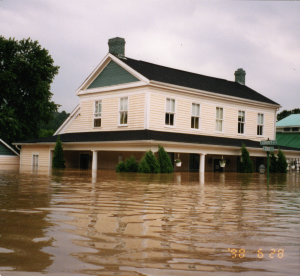
TRIMBLE, Ohio — Historic flooding in 1998 scarred the village of Trimble for years.
“It was just a disaster for us, and people left. A lot of them got [relocation assistance], and they just left their properties, so they just deteriorated over the years,” said Mayor Doug Davis. “It was just a bunch of unwanted properties, just trash here, where we had a hard time with it.”
Those properties are now gone, thanks to a flood mitigation project funded by the Federal Emergency Management Agency. In February, the village completed the final paperwork for a $189,000 FEMA grant that funded the removal of 17 old structures from the floodway, Davis said.
That was just one FEMA-funded project over the past decade, Davis said. He also just completed paperwork on a grant for a costly bridge repair in the village.
The demolition project took more than a decade from the time the village initially approached FEMA, Davis said. Before the village successfully obtained funding to tear the structures down, it had to collaborate with multiple local government agencies, including the Athens County Prosecutors’ Office and the Athens County Land Bank.
“We went about foreclosing on those properties because the owners were completely gone. And since at that point we had a land bank, we had a place for those structures to go once the foreclosures were done,” said Athens County Treasurer Ric Wasserman, who also serves on the board of the Athens County Land Bank.
The Land Bank helped transfer the properties to the village in 2018 and 2019. The village finally received FEMA funding in 2020, Davis said, allowing the village to finally tear down the abandoned buildings.
One of the requirements of the FEMA demolition project was that the cleared area remain undeveloped, maintained by the village.
“Now we just gotta keep it some green space,” Davis said.
That’s part of a broader effort, Davis said, to make the village “more presentable for someone to want to live in.”
Restoring floodplain ecology
It’s not just government agencies that are contributing to that goal in Trimble.
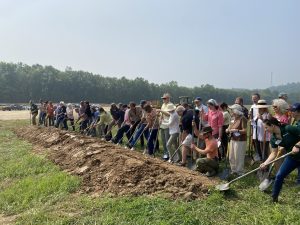
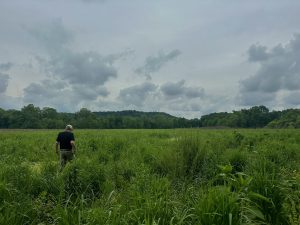
Davis said he was “tickled to death” when Rural Action contacted him about writing a letter of support for its own floodplain management project in the village, which will restore a 10-acre floodplain in Trimble off Walnut Street.
For Rural Action, the project is as much about ecology as economic development.
The nonprofit’s watershed team received a $120,000 grant for the project from the state’s H2Ohio program, which Gov. Mike DeWine launched in 2019 to improve Ohio’s waterways, reduce pollution and promote access to clean drinking water.
“We’re going to remove nonnative invasive species first, that’s going to occur in 2025,” said Nate Schlater, director of Rural Action’s Watershed Program. “Then in 2026 we’re going to install about 3,000 native hardwoods as well as grasses and other herbaceous species, and hopefully re-establish the native floodplain.”
Rural Action plans to maintain a presence at the site once the project is completed, Schlater said, using it to educate others about a healthy riparian corridor — the area adjacent to a waterway that contains trees, bushes and shrubs.
A healthy floodplain collects sediment and nutrients carried by local waterways, Schlater said. That provides nutritious soil for plants, whose root structures prevent erosion.
Without floodplain maintenance, “all that sediment is being transported downstream,” Schalter said. “Furthermore, the nutrients and sediment are staying within those waterways. Maybe more water is staying within those waterways and cutting more sediment out of the banks as well.”
Sediment and nutrients that flow downstream wind up in larger waterways and, eventually, the ocean. Those nutrients feed algae; when those algae die, they decompose — which uses oxygen. Enough dead algae can deplete oxygen in the water, creating a dead zone. The annual dead zone that develops in the Gulf of Mexico off the southern U.S. coast is the second largest in the world.
Repairing local floodplains will prevent local nutrients from contributing to the problem, Schlater said. But repairing just one part of the floodplain isn’t enough, he noted; a healthy floodplain requires that the entire watershed be maintained.
“A healthy floodplain [in one area] is not going to make a noticeable difference, but at the watershed scale, yes,” Schlater said. “People have to respect the floodplains, we can’t build in them.”
Accordingly, Schlater said, Rural Action is pursuing many floodplain management projects, including:
- A “significant wetland complex” as part of the True Pigments project in Millfield;
- Partnering with the Hocking River Commission to create the American Eel Preserve in Chauncey; and
- Tree plantings on private land along Federal Creek outside Amesville.
Healthy riparian corridors do more than improve the environment. Connor LaVelle, the Athens County planner and floodplain administrator, said they also can reduce the impacts of flooding.
“If you have this sort of more natural riparian area that’s going to have a more porous soil, that’s going to be able to absorb that water better,” LaVelle said. “It’s going to be able to catch it — not catch physically, but hold the flood water at bay.”
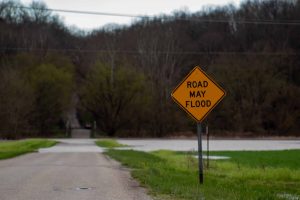
Floodplain administrators increasingly understand that maintaining those areas involves more than restricting building, LaVelle said.
“There’s been sort of a shift in approach to new floodplain management,” LaVelle said. “Maybe it’s not man-made infrastructure guiding the waterways, but letting the waterways be themselves. Then it’s just figuring out how your development can coexist within that.”