
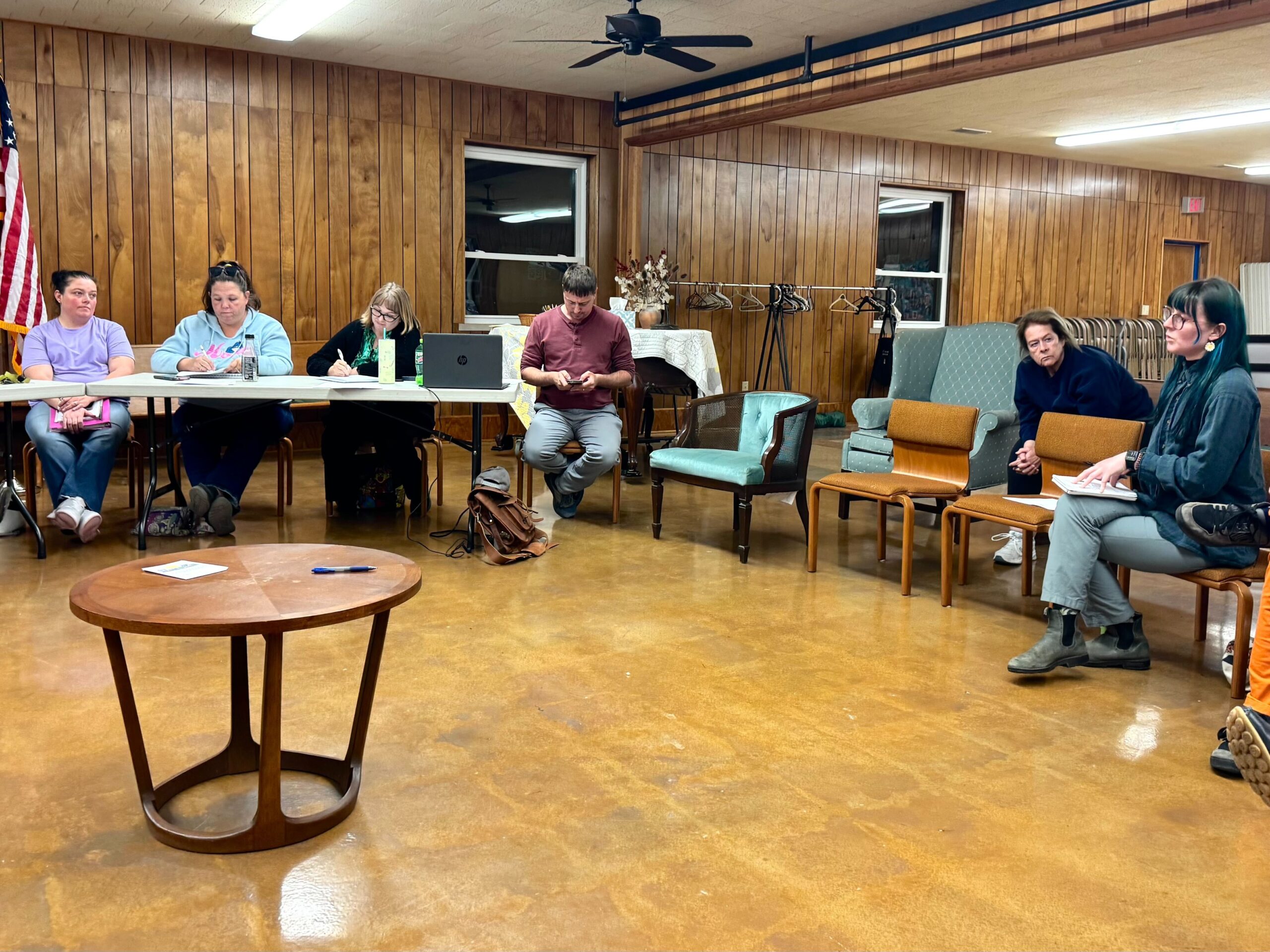
CHAUNCEY, Ohio — Chauncey Village Council met for nearly four hours on May 14, discussing plans to repeal discrimination protections for renters and LGBTQ+ residents and a resolution that called for a ceasefire in Palestine.
The ordinance and resolution were both initially passed in 2024. The repeal ordinance and resolution each passed on their second readings this month. Both the ordinance and resolution will come before the council for a third and final reading next month.
Steps to repeal measures passed by the previous council follow a leadership transition in the village that took place earlier this year, with Frank Campbell taking over as mayor and Amanda Moore, Joe Jenne and Natasha Taylor joining the council.

In addition to the repeal measures, council also discussed Chauncey’s involvement in the Sustainable Ohio Public Energy Council’s electric aggregation program, allowing a business owner to use an empty space, and a possible Fourth of July decorations budget.
Council member Dylan Skees was not at the meeting.
Repealing anti-discrimination ordinance
Council heard the second reading of an ordinance that would repeal an anti-discrimination measure that established local protections against discrimination on the basis of gender, sexuality, age, marital status, and other categories. Ordinance 2024-03 also protects renters from being discriminated against for their source of income.

Chauncey’s 2024 “pay to stay” ordinance, which established protections for tenants facing eviction, expired in 2025, leaving 2024-03 as the only locally established renter-protection measure in Chauncey.
The ban on source of income discrimination prohibits landlords from refusing to rent to prospective tenants based solely upon the tenant’s source of income — including use of government vouchers, such as those issued by the U.S. Department of Housing and Urban Development.
After reading the title of the repeal ordinance, Campbell told the council, “Before you guys even step into this, I’m going to state that I need to have this removed, and that I’m hoping you guys pass this.”
Councilmember Connaught Cullen opposed the repeal ordinance, asking the mayor, “Why do you want people to be able to discriminate?”
Campbell said that there are already state and federal anti-discrimination laws protecting against discrimination. Cullen countered that Chauncey’s ordinance extends protections at the local level and said the ordinance “makes people feel welcome and appreciated in the village.” Cullen noted the ordinance includes protections based on age and religious beliefs.
The ordinance also established clearer protections for LGBTQ+ village residents amid a shifting federal legal landscape. Ohio law does not protect LGBTQ+ people from discrimination in employment, housing, or public accommodations.
Federally, the Fair Housing Act protects people from housing discrimination based on race, religion, sex, national origin, familial status, and disability. Title VII of the Civil Rights Act of 1964 protects employees from discrimination over race, religion, sex, and national origin.
Jenne said Chauney’s anti-discrimination law was “fake.”
“There’s no meat to it,” Jenne said. “It’s not real. Like, if you want to do some philanthropy, why don’t you go out and help a veteran, or help someone’s home? This is just fake stuff that you can put your name on.”
Dellinger said, “I think we [Chauncey] are accepting of everyone. It’s just there’s already laws in place.”
Dellinger, who owns multiple rental properties in Chauncey, opposed the initial anti-discrimination ordinance. She said during the March 2024 council meeting that landlords should not be forced to rent to gay or same-sex couples, because this would infringe on landlords’ rights.
While initial council deliberation on the repeal ordinance ended in under three minutes, members of the public spoke about the issue during the meeting’s resident comment section.
“You are putting residents of Chauncey that are queer in potential danger,” Alex Hearne, a former Chauncey resident said. “Queer people are already disproportionately homeless and affected in so many different ways.”
Jenne responded, “So don’t move here.”
Joanna Mitchell, a member of the Athens Friends Quaker community that hosts council meetings, told the council, “As a person of faith, it’s a very important matter to me that in our civil life we protect everyone’s equality and protect them against harmful practices.”
Mitchell said that she had been victim to housing discrimination for being unmarried in the past. She said that this experience was not in Chauncey.
“It made me feel less welcome in that town, and those are impacts that people can be worried about, especially if they face much more systematic discrimination than I do,” Mitchell said.
Council members Moore and Taylor did not speak on the issue during the meeting but voted to advance the repeal ordinance.
Repealing the Palestine ceasefire resolution
A resolution to repeal a previous village resolution, 2024-05 Ceasefire in Israel and occupied Palestine, also entered its second reading during the meeting.

Mayor Campbell and the majority of council supported repealing the resolution.
“I don’t like it just because that’s way, way above my pay grade,” Dellinger said.
“We’re here for potholes and stop signs and parks,” Jenne said.
Cullen was the lone council member who voted against the repeal resolution on second reading. She said that she “still agreed with the sentiment” of the initial ceasefire resolution.
Cullen also pointed out that the version of the resolution that council was discussing was not the final language that was passed in 2024. Council members were emailed copies of an earlier version by village clerk Roxanne Chiki before the meeting.
The copy of resolution 2024-05 on the official Chauncey village website is not the version that was passed on third reading in 2024, which had added language in support of the U.S. military.
When Hearne questioned why the council wanted to repeal the resolution, Jenne responded, “Why was it ever village council’s issue?” Jenne then asked Hearne to answer the question.
“Ohio pays thousands of dollars in Israeli bonds, that money could be into our community,” Hearne said, before Jenne interrupted to ask, “But what are we going to do here to change that?”
Jenne was asked by Campbell to let Hearne finish.
“This resolution was a step forward in saying that the residents of Chauncey do not agree with our taxpayer money being used for such violence, and that we’d rather it be invested into our communities,” Hearne said.
Campbell encouraged council to repeal the resolution.
“It should have never been put in place,” Campbell said. “As a municipality, we’re not supposed to lean one way or the other. We’re supposed to be down the middle, and we’re supposed to do what’s right for everybody in our town.”
At the time Chauncey initially passed the resolution, over 150 communities had passed similar resolutions calling for a ceasefire, including Athens.
After the repeal resolution was read by Dellinger, Jenne read the village council mission statement on Chauncey’s website.
The mission statement details that Chauncey council will “act on any business matters of the Village and to set policy and introduce and act on legislation that would be in the best interest of the citizens.”
“That’s what I stick with,” Jenne said.
Council members Moore and Taylor did not speak on the issue during the meeting but voted to advance the repeal resolution.
New business
Campbell proposed a $1,000 budget for Fourth of July decorations this year in anticipation of the United States’ 250th anniversary, but discussion was tabled to the village’s next Planning and Development meeting in order to create a list of supplies the village would purchase.
Council also discussed renewing Chauncey’s participation in the Sustainable Ohio Public Energy Council’s Electric Aggregation program.
The Sustainable Ohio Public Energy Council is a council of governments partnered with AEP that acts as a “statewide energy manager,” according to their website. SOPEC’s Electric Aggregation program buys power in bulk to provide power at a fixed rate to enrolled residents and communities. Chauncey voted to become a SOPEC member in 2017.
The Electric Aggregation program is opt-out, meaning residents and business are automatically enrolled and must mail or call in to SOPEC in order to withdraw from the program.
Mary Nally, SOPEC’s regional liaison for Southeast Ohio, said that SOPEC’s electricity rate will be 11.262 cents per kilowatt hour. SOPEC expects AEP’s standard rates to hit 10.1 cents per kilowatt hour this June, and anticipates further increases throughout the rest of the year, according to Nally.
“So we’re starting off a little higher than the standard service offer, but we anticipate in a couple months, we’re going to be on par or actually below that,” Nally said.
Councilmember Jenne expressed dissatisfaction with the opt-out business model, saying that he feels it’s “kind of dirty.”
“I think it’s a good business model to force that on somebody and then force them to opt out,” Jenne said.
Jenne also alleged that he and his family consistently opt-out of the program, but the one time that he was unable to, they paid “essentially close to three cents more per kilowatt hour.”
SOPEC is also pursuing potential installation sites for an electric vehicle charger at the Baileys Trail System visitor center. Jenne opposed the idea, saying the Chauncey fire department is “not in a position right now to combat” lithium-ion battery fires due to a lack of training and equipment.
Chauncey resident Alison York attended the council meeting to request permission to use an empty office space at 50 May Avenue to house her thrift business, York’s Cozy Corner Thrift. York started the business in March, and currently operates as an online-only storefront.
Campbell said he is supportive of the business but has concerns over potential traffic coming through the area, which houses a trailer park.
“If traffic increased to the point it was being a nuisance for the neighbors, the business should maybe be moved to the main road where the business area is,” Campbell said, “because at that point, she’s big enough, she has a business, right? This is kind of an idea to let her get her feet in the water and do something good for the community.”
York was advised to apply for a zoning variance, as the area is zoned as residential.
Campbell also mentioned that he wanted council to discuss the matter because he wants to “do a soft kind of transition from zoning into a new idea.” Campbell didn’t share any details, but said that he had provided Chauncey Solicitor Jonathan Robe an outline of what he wanted to do. The Independent requested the outline but did not hear back by press time.
Chauncey Village Council meets at 6:00 p.m. on the second Thursday of the month at the Quaker Meeting Space at 22 Birge Drive, Chauncey. The next meeting will be June 11, 2026.
