
This is the third installment in a series. Read the introductory story here, and the second story here.
CHAUNCEY, Ohio — Shortly after it was awarded $1.5 million in state funding in June 2025, the Outdoor Recreation Council of Appalachia convened its regular July 2025 monthly meeting. Athens Mayor Steve Patterson — then president of the ORCA board — said the main thing on the agenda was “to discuss the plan for the $1.5 million over the next two years,” according to a recording of the meeting.
Jay Kline, Buchtel’s representative on the board, asked at the meeting what restrictions were in place as to what the organization could use its funding for.
“Is that earmarked in one way, or is it just a given and we’ve got it, and now we decide how to use it as best we can, and then somebody’s watching up there to see how we do it?” Kline asked.
Patterson told Kline, “That’s exactly right.”
However, Patterson did warn that the organization’s use of funding would face scrutiny.
“We’re at a point with getting this money from the state with all eyes on ORCA, to where, if there’s any — I don’t mean this as in nefarious way, but any misuse of this money, it’s gonna be seen and recognized by those who really supported us getting this money from the state,” Patterson said at the meeting.
Executive Director Jessie Powers replied that she had already spoken with John Carey, director of the Governor’s Office of Appalachia, which administers ORCA’s state funding.
“He does know that that’s intended to cover operations to allow us to complete all the projects that the state is invested in,” Powers said.
However, Ohio Rep. Kevin Ritter (R-Marietta) says he had a different impression about how the money was intended to be spent, based on conversations with Patterson.
In a July 6 interview, Ritter told the Independent that Patterson led him to believe ORCA’s funding was intended to be used for “cabins along the Baileys Trail, so that overnight hikers could stay right on the trail, they would pay for those overnights, and that would be the sustainable revenue for ORCA.” When he learned funding was instead supporting salaries, Ritter began reconsidering the state funding award, he said.

Patterson told the Independent earlier this month that he did not recall any conversations with Ritter from around the time funding was awarded. He said that a lobbying firm operating under his direction — Sunday Creek Horizons — had asked legislators for “sustainability assets for the Baileys.” At some point in conversations with Ritter though, Patterson said, “I’m sure I mentioned that the money could be used for cabins.” But, he said the main purpose of funding communicated to legislators was “anything that is sustainable in the Baileys.”
Drabold and Space declined to comment on the record about exactly what they had requested the funding for. They deferred to Patterson.
Regardless of what Patterson or Sunday Creek Horizons may have told Ritter, the Independent’s review of ORCA board meeting recordings and minutes found that the organization never voted to devote any of the funding to cabins or short-term rentals.
Funding with ‘no strings attached’
In the recording of the July 2025 board meeting, Patterson described the funding as coming “from the state with basically no strings attached. It’s like, ‘Use it for what you need to use it for.’” He said that his top priority was completion of the final miles of the Baileys Trail System.
“Get the damn thing done,” Patterson said, prompting laughter and agreement from ORCA Director Jessie Powers at the July 2025 meeting.
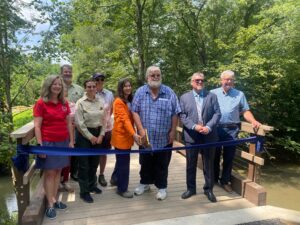
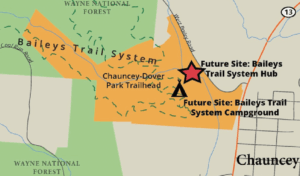
The trail system has since been completed, with a completion celebration held July 22 this year.
In addition to completing the Baileys Trail, Powers said she wanted to use some of the state funds to pay back a line of credit, contract with a third party for financial administration, and expand staff capacity.
Patterson disagreed that the funding should be used for more staff.
He said, “One of the things I don’t want to see is for this 1.5 million to pay for additional staff, if there’s other grant money that can be gotten, or if we can get the [visitor center] up and going” to support revenue-generation.
Patterson also said he’d like to see some of the second year’s $750,000 allocation invested in CDs to generate interest, if ORCA ultimately has more funding than it needs.
Mostly, though, Powers said the state funds were needed to support ORCA operations. The month before, she had told the board, “We’re not in a great place.” If the state money didn’t come through, she said in June 2025, “We really are going to have to think critically, quickly, to kind of come up with some scenarios to allow the work to continue that is underway, as well as be financially solvent.”
At the July 2025 meeting, then-ORCA Vice Chair Tim Warren (now the board chair) seemed to agree that funding would need to be used for general operations, stating that if ORCA hadn’t received state funding, “we was going to need to figure out how to wind [ORCA] down.”
Patterson told the Independent in his June 25 interview with the Independent that he had “no recollection” of conversations around ORCA winding down operations prior to the July 2025 meeting. He added that Warren “was the fiscal watchdog,” however.
Kline, Patterson, and Powers agreed at the July 2025 meeting that ORCA would need to develop a strategic plan to ensure the organization could become more financially sustainable. Kline said that strategic planning and smart use of the state investment could hopefully allow the organization to take its work “a little further.”
Kline said at the July 2025 meeting he was happy to see the board and staff on the same page on how to proceed.
“I had my concerns coming into today,” Kline said. “But I am telling you, I am spectacularly, enthused. … It’s united you stand, divided you fall. So I think that I’m very pleased, at least on this front, to have a united stance.”
However, the group didn’t remain united for long.
Strategic planning stalls
Over the course of the next three months, ORCA staff and the board worked on preparing for the strategic planning process. When the possible price tag of such work became apparent, the group began developing a scope of services to include in a formal request for proposals for an in-depth strategic planning process involving various ORCA stakeholders.
With that process underway, at the November 2025 meeting, Patterson proposed a smaller step to get things started: a half-day “strategic alignment workshop,” to be facilitated by consultant Ty McBee, who serves on ORCA’s regional advisory committee. The board approved a $2,000 contract with McBee.
Patterson told the Independent in June that a smaller workshop was really all he felt was needed anyway. “I felt like the strategic plan should be simple, it should be, ‘Hey everybody, let’s let’s sit down on an afternoon or a full day or whatever, and be smart about how we’re going to become sustainable, in particular with the $1.5 million that the state has given,’” Patterson said.
McBee was present at the December 2025 meeting, as the board and staff talked about who should attend the workshop and how the workshop related to the full request for proposals. Although Powers and Patterson expressed different ideas on those subjects, the board resolved them during the meeting.
Tensions between Powers and Patterson surfaced in emails after the meeting, however. Powers said in a Dec. 23, 2025, email that all board members should be copied on communications about strategic planning. She noted that having three board members at the planning meeting with McBee could trigger Ohio’s open meeting laws. She also suggested the preparatory meeting could include discussion on the content of the workshop.
Patterson replied by reminding Powers of his authority within ORCA. In his response to Powers, he said he was setting the terms of the preparatory meeting “as the Chair of the ORCA Board” in alignment with what had been “discussed with the ORCA Board.”
The December 2025 meeting and subsequent emails came after a conflict over ORCA’s contract with Sunday Creek Horizons surfaced in November 2025. Warren told the Independent that “the real tension” within ORCA started when that dispute began.
The dispute over ORCA’s relationship with Sunday Creek will be explored in a subsequent story in this series.
The disagreements and communications between Patterson and Powers apparently spooked McBee, who withdrew his services before a workshop was held.
“The core issue isn’t the workshop itself — it’s that the Chair and Executive Director are not aligned on scope, authority, communications, or the role of an external facilitator,” McBee wrote in a December 30, 2025, email to Patterson. “In that environment, any strategic or alignment work risks becoming entangled in governance dynamics rather than helping move the organization forward,” McBee added.
Patterson apparently took McBee’s observation to heart. Discussing McBee’s withdrawal in a Jan. 7 email, Patterson wrote, “It is clear there is a communication breakdown between the Executive Director and me.”
McBee did not respond to requests for an interview with the Independent emailed to him July 14 and July 20.
After McBee’s withdrawal, ORCA was left without immediate next steps for its strategic planning. That was concerning, Patterson told the Independent in June 2026.
“It got pushed, ‘Well, we’re going to do it in April, and we’re doing whatever,’ and I’m sitting there thinking myself, ‘We’re talking about a strategic plan for the $1.5 million and it’s already into 2026,’ and to my knowledge, anything from that $1.5 million hadn’t been drawn down yet, at least not to our knowledge,” Patterson said.
“It just felt like this constant back and forth and back and forth with nothing really getting accomplished,” he added. “It really started to become frustrating for me.”
In this context, Patterson began pushing more aggressively on using the state funding to develop assets that could help it move toward sustainability — particularly, cabins or short-term rentals.
No agreement on cabins
Discussion of cabins or short-term rentals appears nowhere in ORCA board meeting minutes from 2025. However, meeting recordings and internal emails show that the topic became a central debate within ORCA in early 2026. Patterson raised the issue at least 17 distinct times over three regular monthly board meetings in January, February and March of this year.
That debate was directly tied to discussions on ORCA’s use of state funding. In emails from the first quarter of the year, during the three meetings, and in his public statements after he resigned from the board, Patterson repeatedly said that he wanted the organization to use the funding to build tangible infrastructure — specifically, short-term rentals.
“We need to use this money to have something that we can demonstrate physically, something that’s tangible, that’s quick, that’s generating revenue,” he told the Independent.
Other members of the board, and ORCA staff members, did not immediately agree with the idea.
Kline told the Independent that he ultimately came to oppose short-term rental development, feeling it should be left to the private sector.
“I thought we were taking away economic opportunities from other people and the public,” he said.
Patterson’s recollection of Kline’s perspective differed.
“Jay Kline was all in favor of these cabins,” he said in his June 25 interview with the Independent. “He thought it was brilliant.”
Although board meeting recordings show that Klein demonstrated openness to the concept on sustainability grounds, they also show that he emphasized that the idea should be vetted during a strategic planning process.
Warren told the Independent he was open to building cabins, although he shared Kline’s concerns about the private sector. Regardless, Warren felt the idea should be considered in a strategic planning process.
“Steve is great — I mean he has a lot of ideas, and everything’s well taken that he says,” Warren said. “There was some things he wanted to do that I’m not totally opposed to, but we needed to check them out.”
“It’s going to take time to flesh out what [ORCA’s] role is gonna be and how we were gonna accomplish it and stuff like that, and it seemed like [Patterson] was in a hurry,” Warren added.
In meeting recordings, Powers repeatedly said she wanted to complete strategic planning and have an economic analysis done before committing to developing cabins or short-term rentals.
“The standard that ORCA has utilized for every development effort that we’ve had has really required a high level of investigation, project planning, thorough vetting, and analysis,” Powers said at the March board meeting.
When asked in June 2026 about others’ belief that more planning was needed, Patterson told the Independent he’d done his homework himself, finding multiple options for affordable builds.
“It makes perfect sense that it would work,” he told the Independent.
Responding to others’ concern that more careful analysis was needed, however, Patterson suggested that Sunday Creek Horizons assess the cabins idea. By that point, the organization had already been mired in conflict for months over its relationship with Sunday Creek. (That relationship will be explored in a separate story.)
Powers, on the other hand, told the board at the January meeting she’d rather contract with Quantified Ventures for “the economic projections around revenue generating streams and outdoor recreation sector.” Powers told the board at that meeting she’d learned the firm could do the job at no cost to ORCA, through its work with the U.S. Forest Service. She added that ORCA had had good experiences working with the firm on similar projects.
But in March, as ORCA weighed a draft agreement with Quantified Ventures for the firm to lead ORCA’s strategic planning process, Patterson suggested striking language directing the firm to look into short-term rental development. Patterson said he had already been doing “all the leg work,” so didn’t see the need for short-term rentals to be considered in strategic planning. The board added the language back in after other members pushed back on Patterson’s cuts.
Patterson moves alone
Under ORCA’s bylaws, a majority of board members must reach agreement to steer the organization in a given direction. But Patterson pursued the idea of short-term rentals on his own, even though the board had not agreed to develop them.
“Could I have been doing other things with my life rather than researching pre-built cabins that could end up ultimately creating sustainability for the ORCA as an organization?” he told the Independent in June. “You know, who else was going to do it? Was everyone else just going to sit around on their hands?”
“I’m a worker,” he added. “If I have something that I’m doing, I work, I roll up my sleeves, and I’ll do whatever I need to do.”
The ORCA board knew he was pursuing the idea, Patterson emphasized in the interview. However, other board members did not necessarily agree with his approach.
“Just because you’re the president of the board, don’t mean you run the board,” Warren said in an interview. He added that, in his perspective, Patterson “felt that his point was more important than anybody else’s” and sometimes acted accordingly.
That included apparently directing Sunday Creek Horizons to write a funding proposal for the initiative to build cabins. Will Drabold, Sunday Creek’s senior vice president, told the Independent in a June 23 interview that their work on the proposal was done “at the direction of the mayor, still as the board chair.”
On Feb. 25, Sunday Creek President Zack Space wrote in an email to ORCA that the firm intended to apply for federal funding for ORCA to develop short-term rental units in the Wayne National Forest.
In a March 3 emailed response, Powers said ORCA had not contracted with Sunday Creek for such services, that the ORCA board had not approved development of short-term rentals, and that the proposed project did not align with the priorities of ORCA’s partners at the Wayne National Forest.
Jason Reed, the Athens District Ranger for the Wayne National Forest, was copied on the thread. Reed replied, stating that he had been “left out of the conversation.” He added that seeking funds for the proposed project would be “premature.”
Space replied that Reed should talk to Patterson and Dawn McCarthy, a Wayne National Forest operations staff officer, who had made the project sound “doable.”
Patterson told the Independent in an interview that he should have included Reed in his initial conversations about the idea. He described the incident as a “miscommunication.”
Powers emailed ORCA’s legal counsel Sky Pettey March 4 with concern that Sunday Creek would advance the funding proposal without approval from ORCA’s board.
“I’m concerned about potential harm to ORCA’s reputation for advancing a request without the support and planning we’re known for from the Baileys project,” Powers said.
In response, Pettey wrote that Sunday Creek was not authorized to submit requests for funding on behalf of ORCA without the approval of the ORCA board. Pettey declined to comment on the record for this series.
The firm ultimately did not submit the proposal.
Dispute over budget proposal
At ORCA’s Feb. 24 board meeting, Patterson asked Powers if there was a grant agreement outlining ORCA’s use of its first year of state funding. Powers replied, “We made it very broad and vague.”
Patterson asked, “So what is it gonna be used for?” Powers replied, “Anything we want. So basically, operations costs, so anything from maintenance staff, marketing, to regional brand.”
Powers offered at the Feb. 24 meeting to send Patterson the agreement, and he said, “I would like to see that. I need to see that. The board needs to see that.”
On the morning of Feb. 25, ORCA staff sent the board the Special Projects Grant Agreement with the Governor’s Office of Appalachia. The agreement, which Powers had signed on Dec. 8, 2025, included the scope of work and a budget for its two years of state funding.
Powers told the board in a Feb. 25 email that an agreement was needed in order to retain access to the funds.
“This is essentially a placeholder budget that was critical to establish; it can be amended,” Powers said in the Feb. 25 email. “Our intent was to ensure funds were not lost and operations could continue.”
The fiscal year 2026 budget allocated $506,000 for operations and programming; $120,000 for legal, accounting and contract services; and $124,000 for consulting, planning, regional branding, “activation programming,” whole product purchase, and marketing. In FY 2027, the amount allocated to operations and programming would rise to $521,000, while the consulting and marketing line would drop to $109,000.
Project metrics included applying for Appalachian Regional Commission grants; maintaining, marketing and supporting the Baileys Trail System “and its social enterprises”; overseeing development of the Baileys Trail Visitor Center and the Baileys Buchtel-Snow Fork trailhead; and strategic planning.
Warren told the Independent in a July 29 interview the board was “well aware” of what was in the grant agreement.
“Now, some people’s ideas of what was in it, what wasn’t in it, I guess has changed over the time, but we was well aware. It wasn’t something that just popped up on us. We had discussed it in two or three meetings before it was sent in,” Warren said. Though he said he had not reviewed the grant agreement before ORCA submitted it, he said he felt Powers acted appropriately and in accordance with the directives of the board as a whole.
“She done what we told her to do,” he said.
As far as Patterson was concerned, the grant agreement identified the wrong goals for the funding. The scope of work as drafted “flew in the face of what I’ve been working on for the past six months, in terms of how could we truly benefit the Baileys Trail with the $1.5 million,” he told the Independent in June.
Powers preempted Patterson’s concerns in her Feb. 25 email, writing, “Respectfully, we’re already working on infrastructure that’s not yet complete and without funds for staff there’s no one to complete the ongoing development.”
Patterson shot back in an email the same day, saying, “it is a Board decision as to what the $1.5 MM is used for when it comes to long-range sustainability.” In a subsequent email to the same group, he added, “This State Budget Agreement has never been communicated with or approved by the OCRA Board of Directors.”
“This is in direct conflict with the discussions which started at ORCA Board meetings,” Patterson added.
The ORCA board had not approved Patterson’s stated priority of pursuing short-term rental development.
In reply in a Feb. 26 email, Powers said “ORCA staff are not attempting to hoodwink the Board” and noted that the budget included only expenditures that had been previously approved by the board. She reiterated that the budget could be easily amended after submission, if the board later approved additional projects.
ORCA attorney Pettey agreed with Powers’ interpretation of events in a Feb. 26 email to the board.
“I am not sure at this point whether we have any new construction projects fleshed out enough to make an immediate application for a change in the Scope of Work likely to succeed, but strategic planning for such projects is definitely within the existing Scope of Work, so the Board can definitely begin strategic planning for new projects,” Pettey wrote in his Feb. 26 email.
Patterson disagreed in an email the same day, stating that the board had discussed “responsibility utilizing the award” at meetings in summer 2025, and that he had wanted “a Sustainability Strategic Planning meeting/retreat and consideration of cabins for the trailheads to generate revenue for the Baileys trail management.”
“Never had the Board discussed $750k being spent in 2026 and $750k being spent in 2027 for personnel. However, the ED sent an appropriation grant to [the Governor’s Office of Appalachia] … without Board approval,” he wrote.
As documented above, however, the board discussed using state funds for operations in summer 2025 — and in July 2025, Patterson appeared to agree with the idea, so long as the trail system was also completed.
In a Feb. 27 email, Powers wrote that she’d submitted the grant agreement on the advice of the Governor’s Office of Appalachia and that “the budget items reflect all of ORCA’s Board approved activities and their costs.”
She continued, “To add additional infrastructure activities a Board approved: budget, site, and operations plans would likely be required.”
In an email to the board the same day, Pettey wrote that he remembered the board discussing using the funding “at least in part, to pay staff expenses, along with discussions about using the funds wisely and strategic planning.”
“The Scope of Work in the Agreement is broader than just staff expenses, and it lets the Board do whatever it wants by way of strategic planning, which would include planning for construction projects and anything else,” he wrote.
Nevertheless, Patterson said in the email thread that he would share his dissatisfaction with the organization’s budget proposal with Carey at the Governor’s Office of Appalachia, which oversees ORCA’s use of the funding. At the March 27 ORCA board meeting, he said he had spoken with Carey.
When a concerned constituent reached out to Carey following the Independent’s prior coverage of the issue, Carey replied that his office “only has an administrative role” and “did not request” the proposed funding cut. (The constituent provided the Independent with the correspondence.)
Carey declined to comment for the Independent but said at a July 22 completion ceremony for the Baileys Trail System that the governor’s office “fully supports ORCA and the mission that is taking place.”
At the March 27 board meeting, Patterson raised the same concerns about the grant agreement with the Governor’s Office of Appalachia. Warren chimed in after Patterson and Powers had a back-and-forth on the subject to say, “We knew that some of that money — I’m not saying all that money — but some of that money was gonna have to go to sustain what we had.”
Kline agreed with Warren and described determining the path forward as the board’s responsibility, stressing that the board needed to come together to determine a course of action moving forward.
Patterson told the Independent that after he learned the budget had been submitted for use of state funding without going before the board, he determined, “I couldn’t be party to the ORCA board anymore.”
“I was completely unaware of it, and when I did see it, that was when, you know, I’m sitting there going, ‘This isn’t acceptable, because we’ve been talking about how we could possibly be using this money. Yet the executive director went ahead and wrote the grant,’” Patterson told the Independent.
In Warren’s view, however, the grant agreement left the use of funding up to the organization’s discretion.
“We can use the grant for whatever we deem purposes for ORCA,” Warren said in a July 29 interview. “Now, there were certain people that wanted to use it for a specific purpose, but there was nothing in there that had to be used for any specific thing.”
Patterson resigned from the ORCA board March 31.
The very next day, Patterson spoke with Ritter, according to a text message the Independent obtained through a records request to Ritter’s office. In an April 2 text message, Patterson drew Ritter’s attention to ORCA’s grant agreement, asking, “Is it possible this agreement did not receive Board approval?”
Patterson’s discussions with Ritter prompted the state representative to begin reconsidering the organization’s state funding.
Since Patterson withdrew from the ORCA board, the organization began its strategic planning process with Quantified Ventures in April, according to ORCA’s report to the legislature.
Warren told the Independent the process is going well and he feels the organization is making progress in planning for sustainability.
On July 22, the organization held a groundbreaking ceremony for a Baileys Trail System visitor center in Chauncey, which will help deliver earned revenue to ORCA through leased space for commercial tenants.
ORCA also helped coordinate the submission of two federal grants with regional project partners on May 29 that would bring about $2.6 million to Appalachian Ohio, according to ORCA’s report to the legislature. One would create a digital platform to help market businesses associated with the tourism economy while generating revenue for ORCA over the long term. Another would support workforce development opportunities for the rural tourism sector.
Powers previously told the Independent the grants would leverage the state investment in ORCA as a match, helping the partners on the applications better position themselves to secure the federal investment.
