
This is the second installment in a series. Read the introductory story here. The third story is available here.
ATHENS, Ohio — When Ohio legislators abruptly proposed to cut already-awarded funding for the Outdoor Recreation Council of Appalachia in June, the organization’s staff and leadership were caught off guard.
At risk was the second installment of the $1.5 million allocated to ORCA in the 2025 biennium budget bill. The proposed cut was added to the bill June 10, just one day before Ohio legislators passed it and sent it off for Gov. Mike DeWine’s signature within 14 days.
“I really didn’t know that the funding could be revoked, nor that any of our legislators had any concern about this,” Powers told the Independent at the time.
After the proposed cut was revealed, ORCA leadership, local residents, and former Ohio House representative for the 94th district and Republican candidate for Ohio Treasurer Jay Edwards urged DeWine to veto the funding cut.
Edwards, who helped ORCA secure investments from the state during his time as a state legislator, told the Independent he spoke with DeWine multiple times about his concerns with the funding cut, as well as “everybody that I had contact to that I thought could help me get the veto in the budget.”
“I really wanted to make sure we saw this to fruition,” Edwards said.
DeWine issued a line-item veto of the cut on June 24 — his last day to act on the legislation.

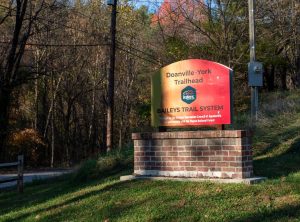
If DeWine hadn’t taken that action, Powers feared ORCA — the entity that created and maintains the Baileys Trail System in Athens County — would collapse. The system, completed earlier this year, cost $9.1 million to build, Powers said.
What Powers didn’t know was that the proposed cut stemmed in part from discussions between the 94th district’s new representative, Kevin Ritter, and the former ORCA board president, Athens Mayor Steve Patterson. Ritter (R-Marietta) also communicated with former ORCA contractor Sunday Creek Horizons regarding concerns over ORCA’s funding.
On ORCA, legislator communicated with Athens mayor, lobbying firm
In a July 6 interview, Ritter told the Independent that he was the first legislator to raise concerns about ORCA’s use of its $1.5 million in funding. Raising those doubts was an about-face for him, Ritter said.
“Understanding the potential benefit to my district, I fought hard to secure $1.5 million in funding for the Outdoor Recreation Council of Appalachia, ORCA, during the last budget process,” Ritter said in a statement he’d prepared for his interview with the Independent.
Ritter’s concerns, he said, arose from a conversation with Athens Mayor Steve Patterson after the mayor’s departure from the ORCA board. Patterson, Ritter said, told him that ORCA was spending its state funding “outside the original intent of the allocation.”
An April 2 text message Patterson sent to Ritter, obtained by the Independent through a request to Ritter’s office, establishes that the two had a conversation about ORCA’s funding April 1, the day after Patterson’s resignation from ORCA.
“We had a conversation talking about his reasons for leaving the board, and Steve let me know that he disagreed with what the board wanted to spend [the state funding] on, and I don’t remember exactly what their intent was, but it wasn’t what we had originally talked about.”
Ritter said discussions with Patterson led him to believe the funding would be used to build “cabins along the Baileys Trail, so that overnight hikers could stay right on the trail, they would pay for those overnights, and that would be the sustainable revenue for ORCA.”
Minutes and recordings from ORCA board meetings suggest the organization did not begin discussing the possibility of using the funding on cabins in earnest until Patterson began bringing up the topic regularly starting in January of this year. The board never approved a project to build cabins on the trail system.
Before our July 6 interview with Ritter, the Independent asked Patterson if he had spoken with legislators about ORCA after his resignation. Patterson told the Independent, “No.” He added that he’d had “no conversation at all about funding” with legislators. Patterson acknowledged talking with Ritter about ORCA only after the Independent reached back out to him, following our interview with Ritter.
Following his discussion with Patterson, Ritter looked into how ORCA was spending the state money. He was concerned to learn that a portion of ORCA’s first funding installment had not been expensed, and that what was spent went to operations and salaries.
According to ORCA’s May 2026 report to the legislature, ORCA had by that time spent about $413,000 of the $750,000 allocated for its first year of funding. Of the first year’s allocation, ORCA stated in the May report that it would use just over two-thirds on operations and programming.
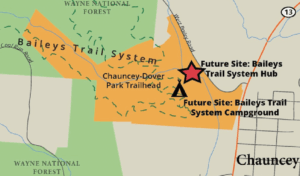
In its report, ORCA said the funds were being used “to ensure completion” of the organization’s previously funded projects, which it said included staff support. These projects included the finishing work on the final miles of the Baileys Trail System and constructing a visitor center in Chauncey.
The budget for ORCA’s use of state funding was laid out in a grant agreement between ORCA and the Governor’s Office of Appalachia, which Powers signed Dec. 8, 2025. The Independent received the agreement through a public records request to ORCA, and also requested the agreement through a July 30 public records request to the Governor’s Office of Appalachia, though the latter request was not fulfilled by publication time.
On April 2, the day after Ritter apparently had a conversation with Patterson about ORCA, an Ohio Department of Development representative sent Ritter the grant agreement by email. The representative referenced a phone call Ritter had with Governor’s Office of Appalachia Director John Carey, during which Carey apparently spoke with Ritter about that document and others related to ORCA’s use of funding.
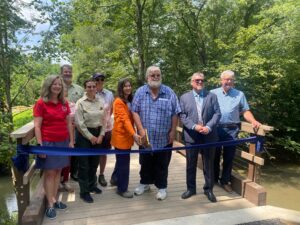
Ritter told the Independent he did not remember details of his phone conversation with Carey. Carey declined to comment for the Independent. At a July 22 completion ceremony for the Baileys Trail System, Carey said that DeWine “fully supports ORCA and the mission that is taking place.”
Just 12 minutes after he received the grant agreement by email, Ritter forwarded the document to Sunday Creek Horizons Senior Vice President and Co-Founder Will Drabold.
“Yikes,” Drabold said in an email a little over a half hour later. “The board did not approve this to my knowledge.” Drabold told the Independent in a July 28 interview Patterson is “where I got my impression” on that issue.
The Independent asked Drabold three separate questions about whether he or others at Sunday Creek had had any communication with legislators this year related to ORCA’s funding in a June 15 interview. Drabold said the issue was “completely off my radar” because ORCA was no longer a Sunday Creek client.
“I did not bring up money for ORCA with Brian [Chavez] or Kevin [Ritter] this cycle,” he said.
Asked again if he’d had any discussions related to ORCA’s funding at all, he replied, “Not to my recollection.” He added, “We worked on a lot of different requests,” and, “I can’t explicitly tell you that … no one brought that up to me.” In a follow-up conversation with the Independent on July 28, Drabold said he had interpreted the Independent’s previous inquiries as pertaining to the proposed funding cut specifically.
“I know it’s kind of semantics. I mean, I would personally view that grant agreement as, like, not a conversation about their funding, at least because the context of our conversation was the cut,” Drabold told the Independent on July 28.
Ritter told the Independent he did not remember if he ever spoke with Sunday Creek Horizons representatives regarding ORCA’s funding.
A half hour after the emails between Ritter and Drabold on April 2, Patterson texted Ritter, referencing the conversation the two had apparently had the previous day. Patterson said Carey told him after he’d spoken with Ritter that “there was a grant agreement signed by ORCA.”
“Is it possible this agreement did not receive Board approval?” Patterson asked in the text message.
Patterson had voiced concerns about the agreement lacking approval from the ORCA board just a little over a month prior, in a February email thread between himself, other ORCA board members, Powers, and ORCA legal counsel Sky Pettey.
Pettey, who declined to speak with the Independent on the record, advised Patterson in the email thread that ORCA staff had submitted the grant agreement, based on expenditures that had been approved by the board and in alignment with previous board discussions on the use of state funding. Pettey also noted in the email thread that the scope of work could be amended if the board approved additional projects.
Tim Warren, ORCA’s current board chair and the former vice-chair under Patterson, told the Independent in a July 29 interview the agreement reflected the board’s directives to the staff.
After his initial communications on ORCA’s funding, Ritter said he consulted with the Ohio House Budget Office, Ohio House Finance Committee Chair Brian Stewart, and Ohio District 30 Sen. Brian Chavez (R-Marietta).
“We jointly agreed the most responsible course of action would be to redirect the remaining monies to another project in the district,” Ritter said.
Stewart, Chavez, and Ohio Senate Finance Committee Chair Jerry Cirino did not respond to email requests from the Independent asking for comment. A records request to Chavez’s office for communications with Patterson, Sunday Creek representatives, and ORCA representatives did not return any records relevant to ORCA or its funding.
The proposed funding cut for ORCA formally made its way into House Bill 479 via a June 9 vote by the Ohio Senate Finance Committee; Chavez is the committee’s vice chair. The bill was approved in its final form by the Ohio House and Senate the next day, June 10.
In the early hours of June 10, Drabold sent a screenshot of a line-item in the bill as approved by the Senate Finance Committee to Ritter and other Sunday Creek representatives via a group text message. The line-item redirected the slashed ORCA funds to Marietta College, a private institution, “to establish curricula and programs to train high demand professions in healthcare.”
Drabold told the Independent in a June 15 interview that Sunday Creek works with Marietta College in a consulting capacity, but not as a registered lobbyist.
In a text reply to Drabold’s June 10 screenshot of the Marietta College line-item, Ritter said, “Yep.”
Sunday Creek Horizons Vice President Andy Kostival replied, “Awesome.”
Drabold then replied, “We’ll leverage this appropriately with Kathleen, kevin. We’ll have an event in early fall celebrating this.” Kathleen Poorman Dougherty is Marietta College’s current president.
Asked if Sunday Creek had anything to do with the funding intended for ORCA having been redirected to Marietta College, Drabold told the Independent June 15, “I was aware they were trying to get resources to start this … program, which is what this money is going to, but we did not lobby anybody to that effect.”
Asked about the June 10 text messages in a July 28 follow-up interview, Drabold told the Independent it was “news to us that [allocating the funds to Marietta College] was gonna happen.” He said he intended for the possible event he mentioned to give Ritter an “opportunity to highlight to the community what was going on.”
In his veto message on preserving ORCA’s funding, DeWine said he was instructing the Ohio Department of Development to distribute a portion of the legislature-approved funding for Marietta College to its program regardless.
Drabold and Sunday Creek Horizons Co-Founder and President Zack Space donated a combined total of $10,000 to Ritter in 2025, placing them among the largest of Ritter’s supporters that year.
Drabold told the Independent July 28 that his communications with Ritter related to Marietta College and ORCA did not constitute lobbying.
Office of the Legislative Inspector General Executive Director Tony Bledsoe, whose office oversees lobbying compliance, declined to speak on the record about the specifics of Sunday Creek’s communications about ORCA and Marietta College.
Bledsoe said in a July 30 interview, “Under Ohio law, lobbying registration is only triggered when an individual is compensated to directly advocate the interests of a client through direct communication with the legislature or the administration — in exchange again for compensation — on a pending legislative matter.”
He added that the time spent lobbying through direct communications with the legislature or administration must constitute at least 5% of an organization’s work for a client to trigger registration.
Because ORCA was not a client of Sunday Creek’s when Drabold communicated with Ritter about the organization’s budget, and because Drabold was not being paid by another entity to lobby against ORCA, Drabold’s communication with Ritter do not meet the definition of lobbying Bledsoe shared (more fully outlined in the Ohio Lobbying Handbook).
Additionally, because his communications with Ritter about Marietta College came after the language on funding the college had made it into the bill, those communications did not constitute lobbying.
No need to ask others at ORCA
Ritter said he did not directly speak with current members of the ORCA board or members of the ORCA staff about the organization’s use of state funding. He’d heard from ORCA through its legislative report, Ritter said.
After Ritter’s office requested the report from ORCA, Powers replied by email offering to talk in more depth.
“Would Representative Ritter like to meet with me and member(s) of the ORCA Board or Advisory Committee for a more thorough discussion?” Powers asked in a May 21 email.
Ritter’s legislative aide told Powers that the office would look forward to ORCA’s report “and can see what next steps are needed afterwards.”
Ritter said he didn’t feel a need to discuss ORCA’s use of state funding with anyone at the organization beyond Patterson — and that his alleged communications with Patterson during the 2025 state budget process were sufficient to inform his understanding of the money’s intended use.
“We were speaking with the person that was head of ORCA at that point, so we were taking what he was telling us as the wishes of the organization,” Ritter said.
Patterson told the Independent during an interview that he did not recall any conversations with Ritter from around the time funding was awarded. He said that Sunday Creek Horizons, then lobbying for ORCA under his direction, had asked legislators for “sustainability assets for the Baileys.” Sunday Creek representatives Drabold and Space said their requests to legislators regarding the funding were based on Patterson’s directives.
In a June 23 interview with the Independent, Drabold and Space declined to comment on the record about exactly what they had requested the funding for. They deferred to Patterson.
In a follow-up interview with the Independent, when asked about Ritter’s statement that he believed funding would be used for cabins, Patterson said, “I’m sure I mentioned that the money could be used for cabins. … Again, I’m just going to default back to anything that is sustainable in the Baileys.”
If Ritter had spoken with ORCA staff or other board members, he may have learned that the organization never voted to spend the state money on cabins, that the board had discussed utilizing the state funding for general operating costs, and that ORCA’s legal counsel believed the organization’s grant agreement with the Governor’s Office of Appalachia was appropriate.

Correction: A previous version of this story wrongly stated that the Independent requested Patterson’s communications with state legislators, including text messages, and did not receive text messages in response. The Independent’s request actually pertained to Patterson’s communication with representatives of Sunday Creek Horizons regarding communications with legislators. We regret the error.
