
THE PLAINS, Ohio — As negotiations to open a plastics plant in Athens County continue, residents are raising questions about the company and the terms of agreement.
The Athens County Port Authority is in talks with CCC Plastics, a Canadian manufacturer that wants to open its first location in the U.S. The company wants to lease the port authority’s spec building in the Bill Theisen Industrial Park outside The Plains, at 5885 Industrial Drive.
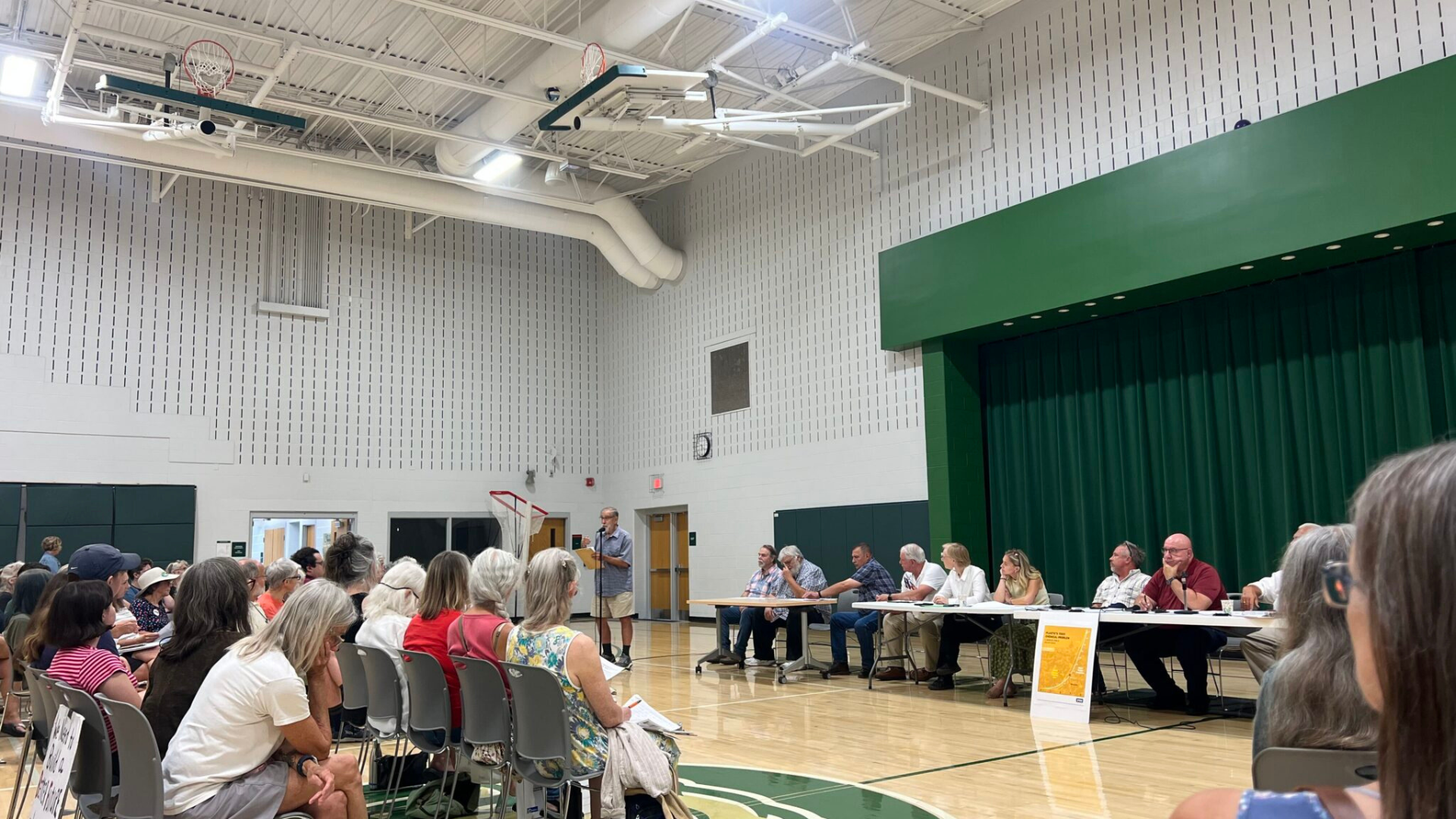
The Athens County commissioners held a public hearing on the matter Aug. 4 at The Plains Intermediate School. Around 150 people gathered in the school’s gym, taking turns speaking about environmental concerns, health impacts, and possible economic benefits.
Many attendees held signs and pictures; two people were dressed in hazmat suits. All rows of seats were taken, and the bleachers in the back of the gym began filling up as the meeting progressed.
Mimi Morrison voiced a sentiment that was echoed by others throughout the two-and-a-half-hour hearing: “I love Appalachia. It’s my home. I continue and will continue to stand firm against coming into this land and using it for garbage.”
Janalee Stock, a member of Athens ReThink Plastics, showed a picture of small pre-production plastic pellets washed up on Raccoon Creek near Beaver, Pennsylvania. The Styropek USA plant had been routinely releasing the pellets into the creek. The plant was closed in 2025, and the company settled a lawsuit brought by local environmental groups.
CCC Plastics would produce plastic pellet products known as masterbatch resins.
“This is a big problem,” Stock said.
Following public comment, Athens County Port Authority board members answered questions about the next steps for the plant.
“My mind’s not totally made up on any of this, I’m not totally sure that this is exactly the right fit, but I know it’s an opportunity,” said Athens County Port Authority board member Ted Linscott. “If we don’t take this opportunity, it’s going to go someplace else.”
The port authority board will ultimately have to vote to approve the company’s lease. A date for the vote has not been set. Currently, the port authority and CCC Plastics are negotiating an agreement for the company to avoid liability for possible preexisting issues at the site.
Economic impact
Mollie Fitzgerald, executive director of the Athens County Economic Development Council, said in a June 29 interview the plant would create 25 full-time jobs with an average annual salary of $70,000.
The Athens County Port Authority, which is able to “own land, set fees, and levy taxes,” has been working to attract businesses to its 60,000-square-foot spec building since it was completed in 2025, Fitzgerald said. The building can be expanded to 120,000 square feet through construction, but the lease would have to be renegotiated.
“We hope that they [CCC Plastics] continue to grow and create more jobs, and you have the extra space right there if they need it,” Fitzgerald said.
However, development of the property will offer a limited financial benefit to the county. The Athens County commissioners offered CCC Plastics a 60% tax abatement for 15 years — the maximum allowable duration under Ohio law — through an enterprise zone agreement. The enterprise zone agreement means that CCC Plastics would only pay 40% of the taxes on improved property value for the next 15 years.
At the public hearing, some community members noted that companies like TS Trim Industries received tax abatements, only to downsize after the abatement ended. County commissioner president Lenny Eliason said that other factors like market conditions can impact a company’s presence in the county.
“Hopefully, when you do these things, the idea is that the companies will stay,” he said.
Enterprise zone agreements require school board approval when the proposed tax exemption period exceeds 10 years, or if the exempted property value percentage is greater than 75%, or 60% for unincorporated areas. Both the Tri-County Joint Vocational School District and Nelsonville-York School Board passed resolutions approving the terms of the agreement in April.
Property taxes fund school districts in Ohio. The Ohio School Boards Association estimates that the Nelsonville-York School District would receive around $4 million in property tax revenue in this year; it estimated Tri-County Joint Vocational School District’s tax revenue at almost $8.5 million.
Tri-County Career Center Supt. Andrea Townsend said the tax abatement would “hold that [current property tax revenue for schools] in place,” as it would only be applied to improved property tax values.
However, Townsend said the plant’s opening would benefit the school in other ways.
“Obviously, our students are the direct beneficiaries of creating that type of opportunity, so we’re always happy to explore opportunities that create opportunities for our students,” she said.
Nelsonville-York School Board Superintendent Rick Edwards could not be reached by email on June 23 and Aug. 5.
Not all residents are convinced that the plant is an economic good. Sharon Casapulla recently moved from Athens to The Plains, about two miles from where the plant is proposed. She worries that the plant will make it harder to sell her home in the future, and questions the promised economic benefits.
“I don’t think that anybody has guaranteed that those jobs are going to come to people that live in The Plains,” she said. “It’s not going to improve our economy.”
Health impacts
The most frequent concern raised by residents is how the plant and its products could affect their health.
Miller said she was one of thousands of Ohio River Valley residents exposed to C8, a chemical used in manufacturing by DuPont de Nemours, Inc.’s factory in Parkersburg, West Virginia.
“Many of my neighbors and people around me in southeastern Ohio died from that C8, and I don’t want to see that happen again,” she said.
The port authority said in its response to residents’ questions that it “cannot speak to local authorities’ specific awareness of the impacts of plastics production on human health.”
Tracey Woodruff, a Stanford University professor who studies toxic chemicals’ impact on health, said plastic production can cause problems with reproductive health, respiratory issues, skin irritation, and cancer, among others. Proximity to toxic chemicals also can accelerate the development of these conditions, she said.
“You could see these more chronic health effects occurring within a shorter time frame, as opposed to a decade or something,” Woodruff said.
Woodruff has also studied how plastics manufacturing and extraction industries generally target marginalized and poorer areas. She pointed to Louisiana’s Cancer Alley, a predominantly Black area that processes a quarter of the country’s petrochemical products. The region experiences markedly higher rates of cancer and other illnesses as a result of air pollution from the high concentration of factories.
The lack of healthcare services and access to high quality food in areas like Cancer Alley makes them especially vulnerable to health risks, Woodruff said.
Woodruff said the plastic industry’s emphasis on job growth is attractive to communities that are seeking economic growth. However, economic benefits may be at least partially negated by tax incentives.
“The state or the locality will give a lot of monetary subsidies for these facilities to locate without much payoff,” she said. “So the community ends up paying twice, because that money could have been spent on helping them with their health — rather than bringing in a facility.”
Disaster worries
Residents’ concerns about the CCC Plastics plant were further inflamed when plastic materials in a Parkersburg warehouse caught fire on July 5. Two days later, smoke was still visible in the surrounding area and firefighters could not confirm that the fire had been fully extinguished.
Miller and other citizens had already raised questions over email on June 28 about CCC Plastics’s plans in the event of a similar emergency and how citizens will be notified.
CCC Plastics will provide fire local departments with an “emergency preparedness binder,” according to the Athens County Port Authority.
In a fact sheet distributed at the commissioners’ Aug. 4 meeting, the Athens County Port Authority emphasized that a lease with CCC Plastics would require annual inventory reports about the quantities and types of materials being used at the plant in order to avoid a disaster like that in Parkersburg.
Valerie Young, an associate professor of chemical engineering, spoke in favor of the plant at the meeting, pointing to the company’s safety record and compliance with environmental standards set by the EPA and other entities. For her, the benefits of 25 full-time jobs in the county outweigh the possible consequences.
However, she wants the Athens County Port Authority to ensure that the lease is “carefully worded.” Changes in the quantity and types of chemicals used at the plant could create hazards, she said.
“This is the scope of your business, this is the volume you’re doing, these are the types of things you’re using,” Young said. “Setting thresholds so that it’s possible for the business to grow and adjust to market forces to a certain extent, but if there’s a big change, you have the option to tell them they need to stop.”
Athens County Emergency Management Agency Director Teresa Fouts-Imler said that communication between the county emergency management agency and the Athens County Port Authority was in its “beginning stages.”
CCC Plastics will send the agency a report outlining potential risks with chemicals and other hazardous materials, Fouts-Imler said. Meanwhile, the emergency management agency is conducting research and briefing area fire departments about emergency responses if the plant is built.
“We’re all about planning, preparing, mitigating any type of risk,” she said. “So if it is a go, then that’s what we will work toward to make a successful response with the county departments.”
Questions and answers
Questions about the plant appeared on social media in early June. Fitzgerald presented a list of answers to residents’ questions at the county commissioners’ June 30 meeting. The 27 questions addressed on the sheet range from those related to industrial byproducts and processes to questions on water usage and worker protections.
“I think it’s really commendable for groups to come forward and ask important questions about the companies that are coming to their community, I really appreciate that,” Fitzgerald told the Independent on June 29. “I’m also excited by the jobs that this will bring, and the indirect and induced economic benefits of that as well.”
The port authority’s answers at the June 30 county commissioners meeting were “not totally satisfactory,” said resident Milena Miller.
“Nobody in this whole economic development band that’s looking at this company from Canada has been looking at the health and welfare of the community or the sustainability of these products,” Miller said.
Around 50 county residents attended the port authority’s board meeting on July 15, but only 10 minutes of public comment were allowed. Attendees raised environmental and health concerns, as well as criticisms of the negotiation’s transparency.
On July 23, the Athens County Port Authority published a response to community concerns, detailing the safety of CCC Plastics’s practices and the economic rationale for the plant.

However, some residents are not satisfied with what they’ve heard. Both residents and local environmental groups want more transparency from officials about the details of the negotiations.
“We are not learning from either the [Athens County] Port Authority or the [Athens County] Economic Development Council that they have answers to any of these questions,” said Nancy Pierce. She is a member of Athens ReThinks Plastics, a local environmental advocacy group that works to reduce production and use of plastic products in the county, especially single-use plastics.
Some community members have asked for more clarity on how CCC Plastics’s materials will be transported, what the products will be used for, and what resources the plant will use. Fitzgerald said CCC Plastics would be open to taking questions from residents — but only after a lease has been signed.
In a written statement, CCC Plastics emphasized their 100+ year history and focus on industry standards, including Operation Clean Sweep, a program that aims for zero plastic pellet loss.
“Environmental, Health and Safety performance is central to how CCC Plastics operates, and an Athens County facility would be held to those same standards and would meet or exceed all applicable federal, state, and local environmental requirements from day one,” CCC Plastics wrote.
Before it signs a lease, CCC Plastics wants a guarantee that it will not be held responsible for any pre-existing pollutants and chemicals from the power plant that was previously housed on the site. Fitzgerald said the site is being assessed to finalize that guarantee through a formal agreement, called a covenant not to sue.
The covenant not to sue must obtained from the Ohio Environmental Protection Agency before the port authority will officially vote whether to lease space to the company.
The Athens County Port Authority’s next board meeting will be 1 p.m. Wednesday, Aug. 19, Ohio University Innovation Center, room 103, 340 W. State St., Athens.
