
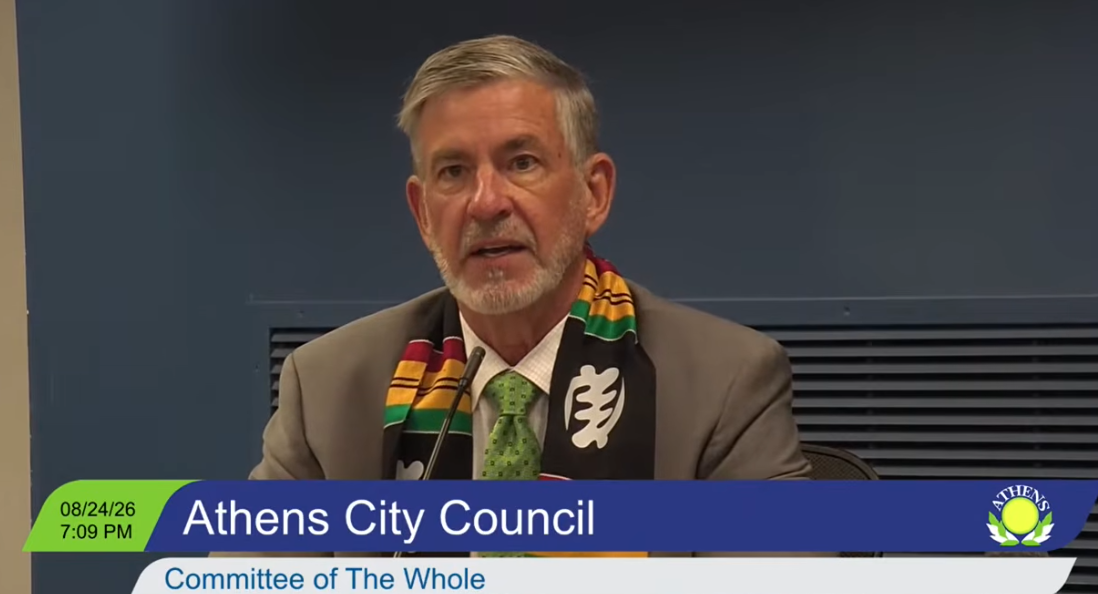
ATHENS, Ohio — During a special meeting Monday night, Athens City Council members got an earful about a proposal to double the fine for expired parking meters.
The idea of raising the fine from $15 to $30 was introduced during a Committee of the Whole meeting Aug. 10. Ordinance 82-26 had its first reading Aug. 17.
Alan Swank, 4th Ward, said his discussions with business owners indicated that enforcement of the two-hour limit around Uptown was inconsistent.
He also expressed concern that the increased fine would keep people from patronizing Uptown businesses. Imagine four people who go to Casa for breakfast, he said. They each pay for two hours of parking, but their conversation runs a little longer than that.
“They all four get a ticket and they say to one another, ‘Man, that was a great breakfast ’til we got to our car’ and one of the people says, ‘You know what, I’m tired of this. We’re going to start going to GiGi’s for breakfast.’”
Jessica Thomas, At-Large, said the simple solution is to park in the city garage.
“You can stay as long as you want and it has 286 spaces,” she said.
Swank said that would be fine if the parking garage design wasn’t “a nightmare.” Among other issues, “the turning radius is incorrect,” he said.
“Unless you have a small car or are Mario and can navigate these curves, it’s not designed correctly,” Swank said.
At the Aug. 17 meeting, the council also discussed a graduated fine system that would penalize some more than others. Megan Almeida, 1st Ward, asked how the city was going to define “repeat offenders.”
“The one thing that keeps surfacing in my mind is our workers Uptown,” Almeida said. Depending on the business, workers might have to clock out of work, move their car, and then clock back in. “It just seems very unfair,” she said.
She also noted safety concerns for women who work in bars and have to walk back to the parking garage late at night.
Council member Beth Clodfelter, At-Large, noted that Capt. Ralph Harvey of the Athens Police Department, who heads up parking enforcement, had emailed council members to share his opposition to increasing the fines. Paul Isherwood, At-Large, said Harvey objected to the graduated fines only. Clodfelter countered that the message also addressed regular fee increases.
Business owners speak
The purpose of doubling the fine was to deter violations –– Patterson said that businesses wanted spaces freed up so new customers could find parking. However, on Monday night, audience members said doubling the penalty is what will harm business.
Ric Wasserman, who owns the Pigskin Bar and Grill, said he had seen no data from the city documenting whether repeat parking meter violators are a problem, or to what extent they might be.
Wasserman appreciated the sentiment of helping businesses, he said, “but it doesn’t seem like any outreach was done to local businesses before this was proposed to council,” he said.
Wasserman said he had talked with “12 or 15 businesses,” and not one was in favor of the increase. “Locals refer to parking Uptown as a tax on going Uptown,” he said. “We should be welcoming to people Uptown when we want them to shop small.”
If the concern is about repeat or long-term offenders, Wasserman said, the city can already issue multiple tickets for cars past the meter limit.
“If someone parks for seven hours, they could get as many as five tickets,” he said. “That’s 75 bucks. That’s a pretty good deterrent.”
Monica Bennett, who owns Raphael’s Aveda Salon at 42 N. Court St., said that helping clients navigate Athens’ parking challenges makes the stress of running a small business even more stressful.
“We want to take care of what we need to take care of, but I can’t stand there and worry about my customers to that kind of extent and still try to keep everything going,” she said.
Leslie Schaller, one of the original workers at Casa Nueva, 6 W. State St., said she supported the city’s decision to limit meters Uptown to two hours.
“But we recognize that sometimes it’s just not feasible to consistently enforce,” Schaller said. “I think there are … some opportunities to think about how to address the challenges of those frequent offenders without encouraging the dialogue some of us have constantly with our customers where they feel they have to abandon Uptown.”
Business owner Keith Chapman said doubling the fine to $30 “is not where we are” as a community, calling it “meanness.”
Ohio University student Grant Hampson, who is studying urban planning, said the only good thing in the proposed ordinance is extending the time to pay the fine from five days to 14 days.
Having listened to the comments, Mayor Steve Patterson suggested striking the language about the fines, while leaving the 14-day payment period. Swank made that motion; Almeida seconded.
Patterson said he would have the city planner look into the flow of parking Uptown.
Council voted to amend the ordinance, which sent it back to first reading.
Question of procedure
When the special meeting was called to order, Swank asked why the agenda included readings of ordinances other than what the special meeting was supposed to address — specifically, appropriations for sewer work and interfund transfers.
“A special session is called for a specific purpose, not to lump every truck driving down Richland Avenue to piggyback on that,” Swank said.
Since Swank had raised a point of order, President Micah McCarey asked if there were any motions to amend the agenda. Council member Michael Wood, 3rd Ward, moved to strike everything from the agenda other than the emergency ordinances. Council member John Staser, 2nd Ward, seconded.
In the subsequent discussion, Clodfelter said that while she understood the point about the agenda, a number of residents were in the room to speak on the items that would be struck.
Isherwood noted that the meeting agenda — including the non-emergency ordinances — had been public since Aug. 20. Wood responded that state sunshine laws require that the agenda be amended in open meeting.
“We can’t discuss the agenda ahead of time on email,” he said. “We’re not allowed to do that. So, this is kind of our one shot.”
Isherwood replied that while the council members can’t discuss the agenda ahead of time, “you can email the clerk. You can email the council president. You can raise objections at that point.”
Swank disagreed, saying items appear on regular meeting agendas after a decision whether to add them is made during committee meetings.
“If someone were to call after it’s been placed on the agenda, you would be canceling out the vote or the affirmation of the members of that committee. And we can’t do that,” Swank said.
Swank noted that council agreed in January at his suggestion to update council rules to specify the order of business for meetings, including approving the agenda.
Swank then proposed amending Wood’s motion to allow discussion of Ordinance 82-26.
McCarey then turned to City Auditor Josh Thomas for any administrative concerns about skipping the other ordinances. Thomas said he did indeed have concerns.
Ordinances 68-26 and 69-26 involved financing of the roundabout at the intersection of State Route 682 and West Union Street.
“We’re going to need to get moving on this to get that money from the state,” Thomas said. “They’re not going to wait forever on us to do this.”
Ordinance 74-26 amends appropriations for the public safety training facility to add $40,000 from Safety Services Fund 206. “We need to get this done so that we can just put that project to rest,” Thomas said.
Other ordinances could be tabled instead of removing them from the agenda, Thomas said.
“There are a few things on here that don’t really need to be discussed this evening,” he said. “But these first three were in third reading — I’d like to see those just get done this evening.”
Asked if he still wanted to amend the motion, Swank said no, although he said that some of the reasoning — specifically, the lack of July meetings — didn’t hold up for him.
“The July recess thing is a false dichotomy,” Swank said. “We have this every single year. Pretending like it’s a new thing is a weird item.”
Wood then withdrew his motion and the council moved forward with the agenda as published.
In other action during Monday’s special meeting:
- Council tabled Ordinance 81-26 to give the city more time to analyze proposed sewer fee increases of 4% for residential, commercial and industrial customers.
- Council suspended the rules and adopted Ordinance 83-26 to make storm water and sewer repairs, including $40,000 for a storm tunnel failure on Kern Street; $75,000 to replace a failing influent pump at the wastewater treatment plant; and $75,000 to replace a failing clarifier at the plant. The projects will be paid from the sewer fund.
- Upon third readings, two ordinances were adopted for the city to enter into an agreement with the Ohio Department of Transportation for a State Infrastructure Bank loan of $499,000 for a SR 682 Major Rehabilitation Project, through ordinances 68-26 and 69-26. The loan will be paid back from the Small Cities ODOT fund. The project involves repairing a section of SR 682 from the Richland Avenue roundabout eastward onto U.S. 50/33. Federal funds will pay more than 90% of the $7.1 million project.
- Upon third reading, the council adopted Ordinance 74-26 to appropriate an additional $31,000 in order to repave an emergency medical services lot and TS Tech access road damaged during construction of the public safety training facility on Kenny Drive. The project total now stands at $5.1 million, funded from multiple sources including the safety services fund.
Due to Labor Day, Athens City Council’s next regular meeting is Tuesday, Sept. 8, at Athens City Hall, Council Chambers, third floor, 8 E. Washington St. Meetings are also streamed online. Regular sessions are on the first and third Mondays of the month; committee meetings are on the second and fourth Mondays.

