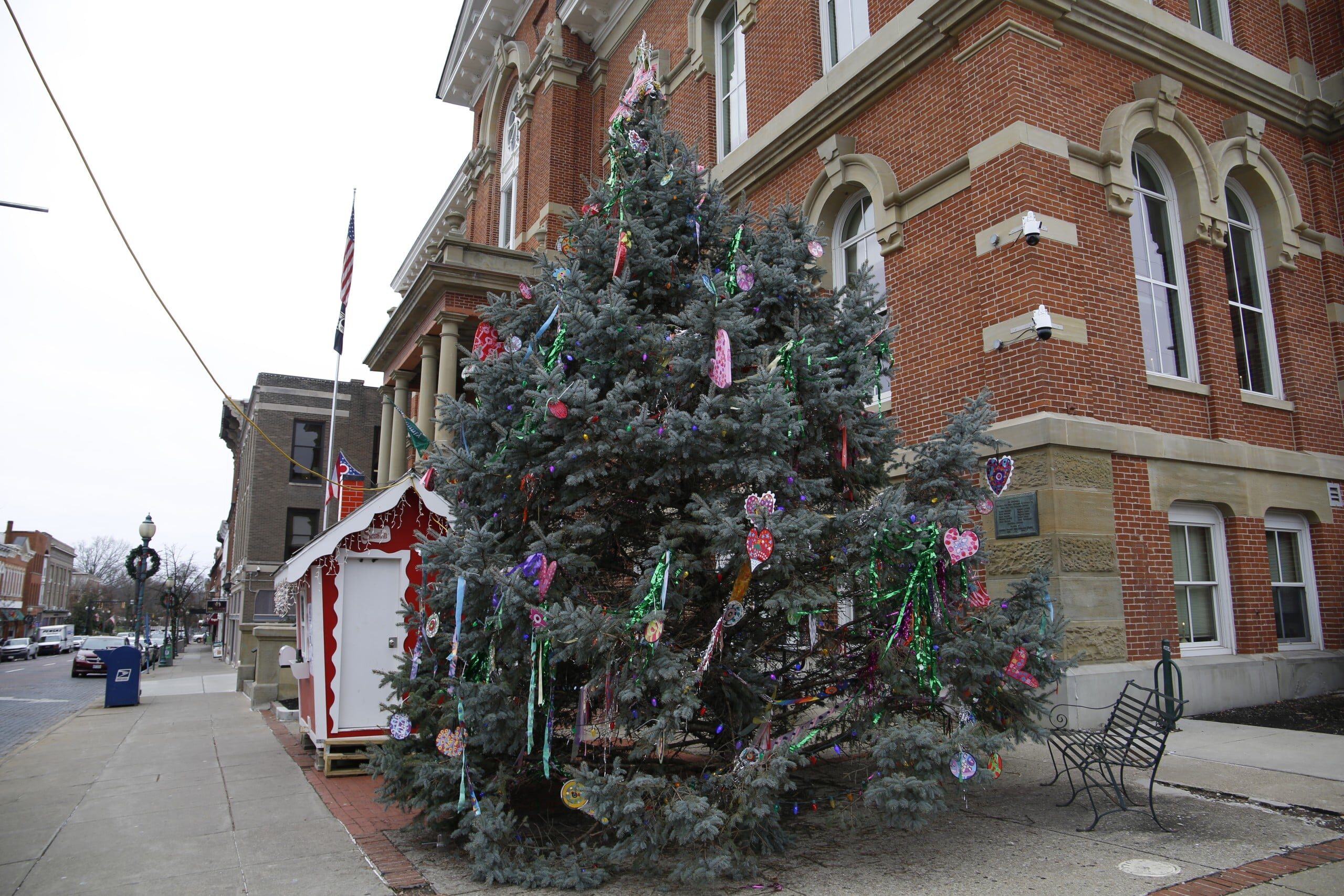
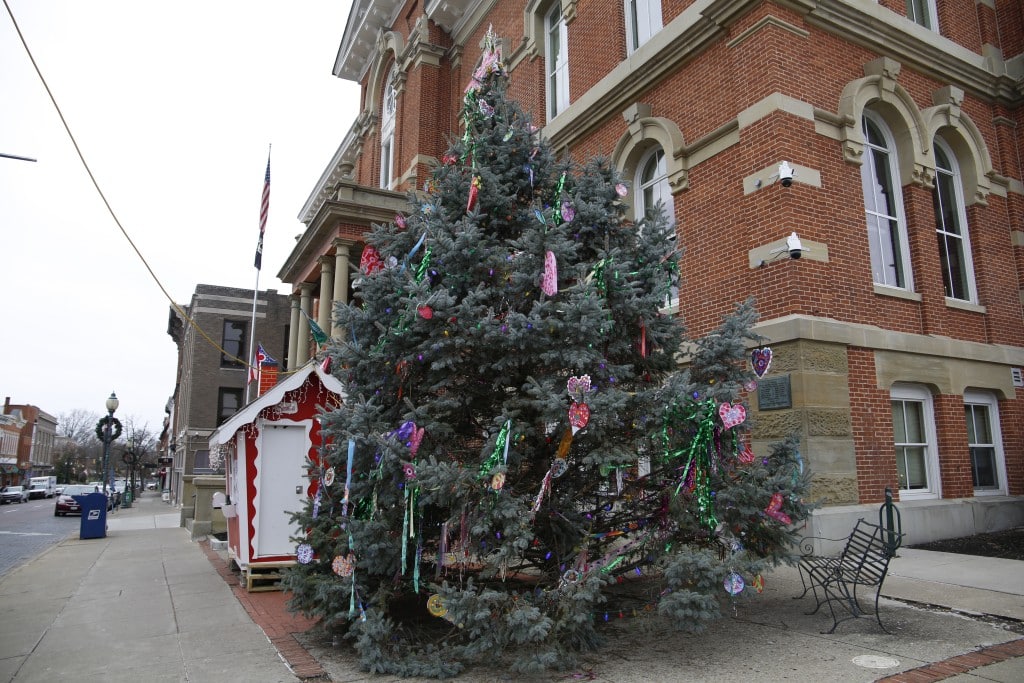
ATHENS, Ohio — For the Athens Shade Tree Commission, this year’s Uptown Athens Christmas tree has sparked anything but joy.
The Colorado blue spruce that now sits at the corner of Washington and Court streets used to tower over the parking lot of the Athens City Pool. Katherine Ann Jordan, director of the city of Athens Arts, Parks and Recreation Department, said the tree was already slated for removal because it was old, not a native species and was too close to deciduous trees that needed more room.
Some city residents noticed the tree’s removal and contacted the Independent to ask what happened — and if the Athens Shade Tree Commission had been consulted.
It was not, Jordan said.
“Since it’s in the city park, no,” Jordan said. “We work with the Shade Tree Commission pretty well. They’ve helped us out with a lot of tree plantings in our parks over the past several years. But this wasn’t something we were required to consult with them on.”
The Shade Tree Commission is an official city body whose members are appointed by the mayor and approved by city council to promote and regulate green spaces and tree health within the city.
Shade Tree Commission Chair Chris Fahl disagreed with Jordan’s assertion that the body didn’t need to be included in the discussion about the spruce tree.
“We were, after the fact, told that it was part of old landscaping and that there was something wrong with it,” Fahl said. “But, that does not preclude having the Shade Tree Commission as part of the discussion.”
Fahl said this isn’t the first time the Shade Tree Commission has been left out of city decisions that affect the urban forest. For instance, she said, the Shade Tree Commission gave no input on the newly opened Chipotle or its parking lot on East State Street. City code mandates planting a certain number of trees per square foot on developed land.
Shade Tree Commission member and arborist Gene Deubler echoed Fahl’s annoyance with the city.
“Most of our frustrations stem from not being involved in a lot of these conversations,” Duebler said. “It’s an ongoing issue with other developments in town. I speak for myself, but I know others share these frustrations, feeling that as the body designated to manage the city’s tree canopy, we should have more input in these conversations.”
The commission has had enough, Fahl said.
“There are problems with when the Shade Tree Commission is required to be consulted,” Fahl said. “That is being rewritten right now. In the new year we will be bringing forward to the city council some changes so that sort of stuff doesn’t happen.”
These changes won’t be radical, Fahl said.
“Some cities have a lot stricter codes when it comes to anything with trees. There are cities that require people who want to cut down a tree on their own property over a certain size get a permit,” Fahl said. “Thats not going to happen here.”
Instead, the focus is on clarifying the Shade Tree Commission’s enforcement and oversight responsibilities, she said.
Part of the problem is a lack of communication between city employees and the commission, said Tristan Kinnison, an arborist and member of the Shade Tree Commission.
“One thing we have been working on is opening the communication channels between the Shade Tree Commission and folks on the ground,” Kinnison said. “We only meet once a month and they work everyday. The drought this last year really put in a big effect that there should be a little bit more hand holding on the day to day stuff.”
The city could mitigate droughts and other effects of climate change by planting more trees, said Glenn Matlack, a professor of environmental and plant biology at Ohio University, who is also Fahl’s husband.
“It’s not just comfort, it’s human health,” Matlack said. “The temperatures that we are getting in midsummer here are high enough, hot enough, to cause serious health problems for the citizens of Athens. The best, the easiest and the cheapest way to fight that is to put in trees.”
Matlack added that urban trees also help save taxpayers money by expanding the life of pavement. This is done by preventing the cracking of pavement, which is primarily a result of the expansion and contraction of pavement as it gets warmer and cooler each day.
“If this happens 10,000 times then you begin to get cracks in the pavement,” Matlack said.
However, trees provide shade to cool pavement during the day and their roots provide heat at night, decreasing the overall temperature change and extending the life of pavement.
Trees also reduce the amount of rainwater that hits the sidewalk, Matlack said. Wet pavement more easily expands and contracts with temperature, making it more prone to cracking. Matlack said that tree canopies catch roughly the first millimeter of rainwater. This results in the pavement receiving less rain and drying out faster.
Whither the Christmas tree?
For years, the city bought its community Christmas tree from the Russell Baird Tree Farm, said Athens Deputy Service-Safety Director Andrew Chiki. After Russell Baird died in 2012, the family allowed the city to continue to purchase trees from the farm for several more years.
When trees from Baird’s were no longer available, the city purchased a tree elsewhere in 2022.
But, “It was an ordeal to find a place that could supply a tree of the size we were looking for,” Chiki said. So in 2023, the city opted to cut down its own tree from property by the community center.
“Last year as we were evaluating trees on city property that needed to be taken down, [we decided] that rather than cutting those trees down … it was better to utilize certain trees as a holiday tree,” Chiki said. “That’s kind of the intent — instead of just cutting down trees, we would do what we could to utilize them rather than dispose of them.”
The city plans to remove three other blue spruces in that area for use as Christmas trees in the future if they live long and look good, Chiki said.
In the future, community Christmas trees could come from trees the city could plant along the Hocking River — effectively functioning as the city’s own tree farm.
Eastern white pine “does well in those soils,” Chiki said. “We could have a better management plan for when we take those trees and have intentionality behind the removal of those trees while continuing our efforts in the riparian area.”
But there is scientific debate over the range of the eastern white pine and if it isn’t truly native it would add another nonnative plant to the riparian. The city’s Hocking River Riparian Area Project is intended to remove nonnative species.
“We’re kind of on the edge of a lot of different native ranges for species of pine,” Deubler said. “This is definitely its native range and habitat, but those ranges are also shifting with climate. A lot of southern species are becoming more climate adapted to this region and could become a more dominant species. That’s something I think we need to take into consideration when we think about what and where to plant.”
Matlack, however, contends that the eastern white pine’s range is much further north.
“They are native up in the extreme northeast corner” of Ohio, Matlack said. “We have them down here because they were put in in the ’40s, ’50s and ’60s in plantations to reclaim degraded agricultural land.”
Matlack disputed Chiki’s claim that the trees would do well along the river on land that is frequently flooded.
“White pines do not naturally grow on flood plains,” Matlack said. “Of course, we’re not within the natural range of white pines — but even within the range they do not normally grow on flood plains.”
Kinnison said it depends on the specific area chosen for planting.
“Typically not, but I would have to see the kind of microclimate it is destined for,” Kinnison said. “Typically you would see Eastern White Pines in a more dry environment but they are pretty adaptable.”
Chiki said the city is willing to consider alternative tree species.
“For us it’s the best tree species for what we are able to do,” Chiki said. “If there is a different pine species that is native to Southeast Ohio, we would be very open to taking that into consideration.”
Regardless of the type of conifer the city goes with, the situation reflects one of Fahl’s gripes with the city’s underutilization of the Shade Tree Commission.
“We have two arborists on the Shade Tree Commission,” Fahl said. “There is no reason why … they don’t come to us and borrow our arborists.”
Editors Note: This story was updated to include that Glenn Matlack and Chris Fahl are married to each other