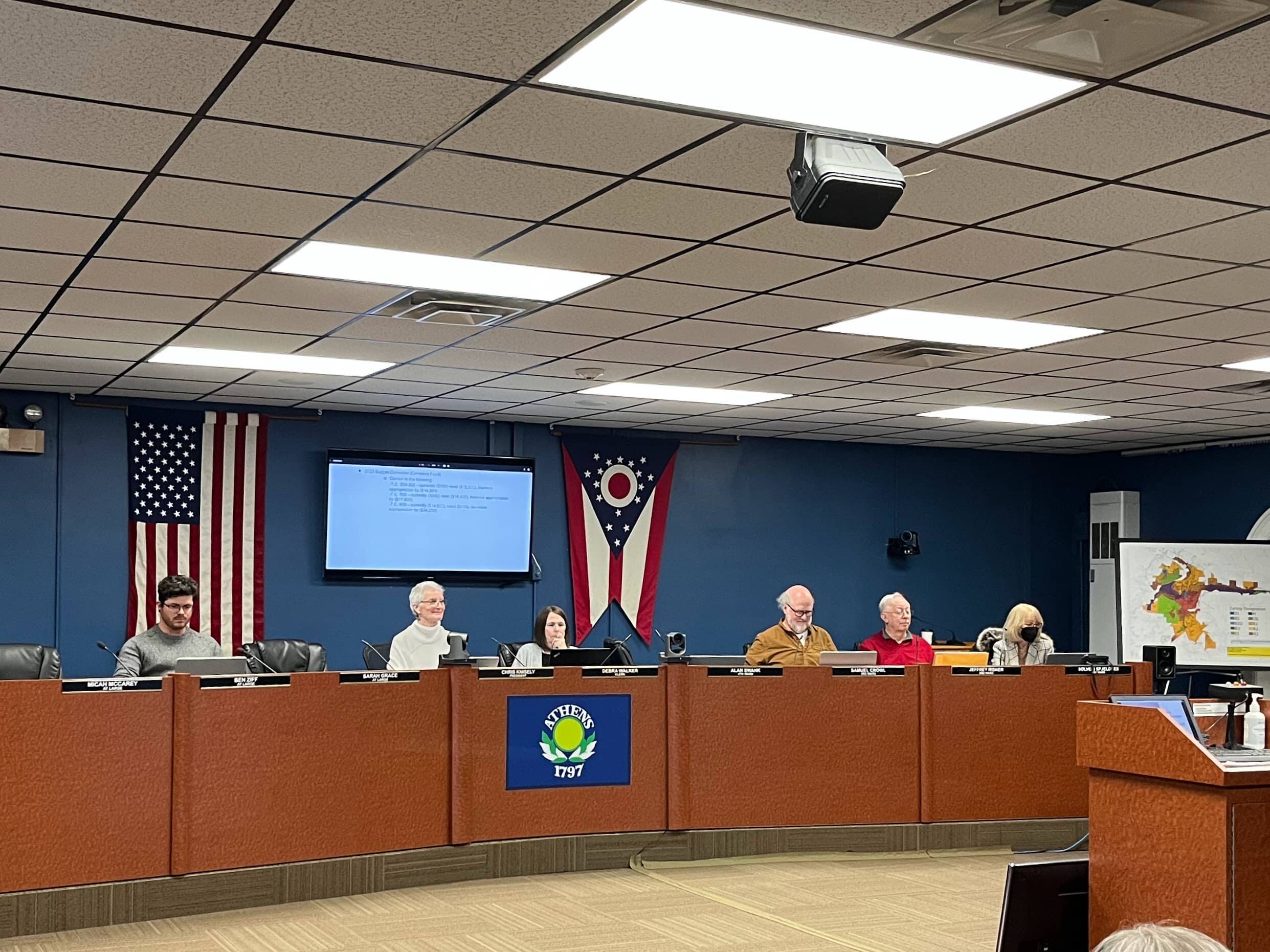
ATHENS, Ohio — Athens sidewalks need some serious attention: That’s the gist of the report that the Athens Ad Hoc Pedestrian Accessibility Committee presented to Athens City Council’s Transportation Committee on Jan. 23.
After a year of research — including conducting focus groups and collecting 784 survey responses — the committee made 50 suggestions, including establishing standards to assess sidewalk conditions, working with neighborhoods to make sidewalk plans and ensuring all repairs are made in compliance with the Americans with Disabilities Act.
The committee comprised Mayor Steve Patterson; city council member Solveig Spjeldnes; local sustainability advocate Rob Delach; Ohio University student Neil Ryan; Dianne Bouvier, previously OU’s associate director for accessibility; and accessibility activist Stephanie Hunter, who asked to join the committee as an unofficial member.
Most of the city’s sidewalks and crosswalks are currently unusable by people with disabilities, the committee found. Nine of the 38 miles of sidewalks in the city are out of compliance with the ADA, Hunter said—and more than 42% of the city’s sidewalk corners also present accessibility problems. Noncompliance with ADA standards could exclude the city from eligibility for future federal funding, she said.
In a short film the committee showed, Carolyn Lewis—treasurer of the Athens City Commission on Disabilities—talked about the difficulty of using the crosswalk at Court and Union streets in a wheelchair. She can get only halfway across the crosswalk when the walk signal reaches zero, Lewis said, leaving her in the street as cars regain the right of way. The bricks of the crosswalk have large gaps between them and the sloped curb cuts that connect the sidewalk to the crosswalk are steep, leaving her worried about sliding back into the street.
“This is the number-one priority for the city to take care of, because it’s very dangerous,” Lewis said in the film. “It’s not safe. It’s the centerpiece of Ohio University. Though this is the priority, this is just the beginning.”
The city is trying to address the problems with the Union and Court street crosswalks, the committee acknowledged. Committee chair Dianne Bouvier proposed that the crosswalk be resurfaced with paved concrete that looks like bricks.
“That will allow us not to have the heaving, not to have the separations and make the whole crosswalk much more accessible,” Bouvier said.
Improving sidewalks requires funding but, the committee argued, it’s a worthy investment for Athens because of their longevity and purpose. Sidewalks can last for as long as 25 to 80 years, according to the U.S. Department of Transportation.
“Anything we build today will still be in good repair by the time my small children are pushing strollers of their own,” Hunter said.
Athens Code of Ordinances requires homeowners and landlords to keep the sidewalks in front of their properties repaired. The committee suggested future sidewalk repairs could be funded using a city-resident cost sharing program, a tax levy, money from the Athens Street Fund and grants.
After the committee members completed their presentation of recommendations and priorities, six attendees of the council meeting voiced support of funding sidewalk improvements.
“I’m 100% willing to support this initiative through something like a tax levy or a cost sharing program,” resident Natalie Whitman said. “I think that initiatives like this that promote the livability in our city need community contributions of ideas, of time and of money, because change doesn’t happen magically.”
The Ad Hoc Pedestrian Accessibility Committee is collecting feedback on its plan and presentation from councilmembers until Feb. 1. After that, it will make edits and collaborate with OU’s Voinovich School of Leadership and Public Service to complete the Pedestrian Accessibility Plan.
The recommendations, according to a draft of the executive summary of the Pedestrian Accessibility Plan:
- Conduct city-wide concrete grinding: Grinding, also known as milling or precision concrete cutting, uses machinery to remove the top layers of a sidewalk to even out the surface. The process is less expensive than replacing the sidewalk completely, and has been done on Court Street before, committee member Dianne Bouvier said.
- Eliminate parking spaces at all city intersections: Daylighting is the removal of parked cars at street corners that limit pedestrian’s sight. The committee said this would maximize visibility and safety for drivers and pedestrians at intersections.
- Develop 10-year Pedestrian Accessibility Plans for neighborhoods: Creating neighborhood plans would enable neighborhoods to address their specific needs and desires — for example, adding a sidewalk on a street that does not have one — and outline steps on how to achieve that. Ohio University MBA students could be involved in facilitating the creation of neighborhood plans, Bouvier said.
- Train snowplow drivers not to leave piles of snow at intersections: It is important for crosswalks, sidewalks and curb cuts to be clear of snow for usability and visibility, according to the U.S. Department of Transportation.
- Create a permanent Athens Pedestrian Accessibility and Bicycle Committee: The permanent committee could help implement recommendations and continue work into the future, committee member Rob Delach said.
- Improve and enhance the city’s complete streets performance metrics: Complete streets support transportation networks that assume that pedestrian, bicycle and transit facilities are needed as well as streets. In Athens, complete street practices include sidewalk leveling, increasing the minimum width of new sidewalks in the new subdivisions, expansion of total miles of sidewalk, ADA curb improvements, lighting improvements, and audible crosswalk signalization, according to the Athens 2040 Comprehensive Plan.
- Establish dedicated funding for sidewalk remediation and replacement: During the presentation, committee member Solveig Spjeldnes said the committee considered a city-resident cost sharing program, a tax levy, money from the Athens Street Fund and grants as options for future funding.
- Establish a “Sidewalk Program” to assess, prioritize, and remediate infrastructure: “Other cities have tried to improve their sidewalk condition. They’ve had the same problems, same challenges we face here in Athens. It’s not a new problem,” Delach said. Some municipalities have had success in improving sidewalks with the formal creation of a sidewalk program.
- Adopt and communicate city sidewalk, curb ramp, and crosswalk standards: This recommendation involves adopting the ODOT Multimodal Design Guide for Pedestrian Facilities, establishing clearly defined criteria to determine when sidewalks must be repaired or replaced and communicating design standards for replacing and building new sidewalks.
- Implement the prioritized sidewalk and accessibility project list: The Ad Hoc Pedestrian Accessibility Committee presented a prioritized sidewalk and accessibility project list in its 178-page Pedestrian Accessibility Plan.