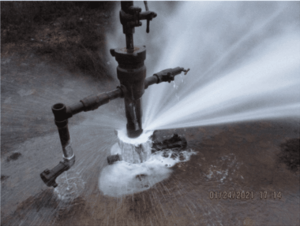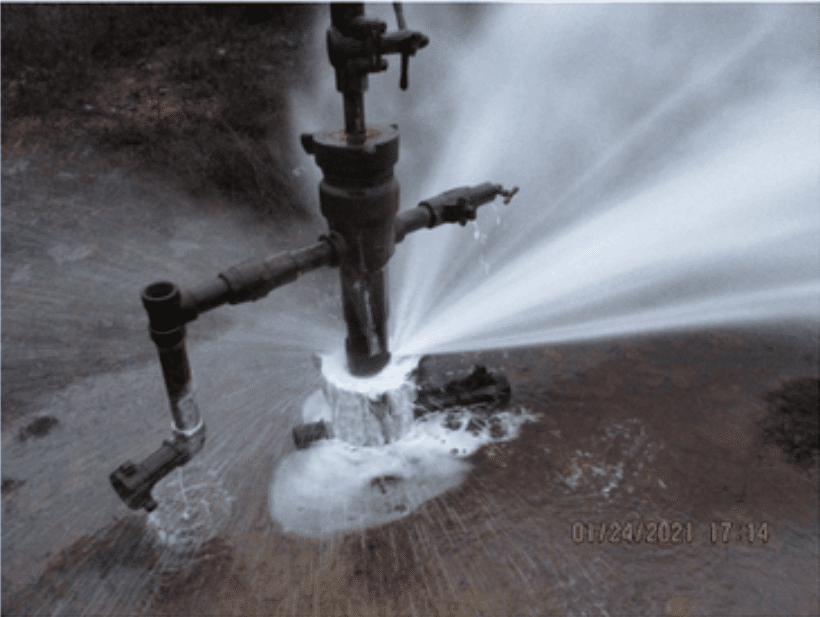
NOBLE COUNTY, Ohio — A fracking waste injection company is fighting to reopen two suspended Noble County wells that the Ohio Department of Natural Resources linked to a 2021 environmental disaster.
The wells were initially suspended by order of the chief of the Ohio Department of Natural Resources Division of Oil and Gas Resources Management in January 2023. The division found the wells were responsible for a 2021 incident in which toxic waste injected into the ground by DeepRock Disposal Solutions burst to the surface via an oil and gas production well two miles away. The incident contaminated Noble County land and waterways, killed hundreds of animals, and cost the state nearly $1.3 million to clean up.
The division’s order also identified four other instances in which it claims the company’s waste migrated uncontrolled beneath the surface. The division claimed that between 2010 and 2023, the company’s waste rose to the surface via production wells as far as 5.4 miles to the southwest of DeepRock’s injection wells, and 1.5 miles to the northeast.
All five of the instances cited by the division occurred along the same “linear trend,” a miles-long line running southwest to northeast.
In the 2023 incident, “spraying brine caused imminent health, safety, and environmental risk,” the suspension order said.
After the division suspended DeepRock’s wells in 2023, DeepRock and the division held “extensive discussions” to address the problems with the wells. According to the chief’s most recent order, those discussions failed to address the division’s concerns.
In April, DeepRock argued at a hearing before the division that the suspension order should be vacated. The company presented evidence that it said demonstrated its wells were not responsible for the five incidents.
But the division was not convinced. The chief of the division issued a new order on July 31, continuing the suspension of DeepRock’s two wells.
On Aug. 28, DeepRock filed an appeal with the Ohio Oil and Gas Commission to challenge the July 31 order. An arm of the ODNR, the commission hears challenges to orders by the division chief.
Under Ohio Administrative Code, DeepRock has 120 days from the July 31 suspension order to submit a plan that would correct the problems the division identified with its wells. If the company does not develop a plan by then, it will have to plug the two wells permanently.
DeepRock’s attorney declined to comment on pending litigation. The ODNR Division of Oil and Gas did not fulfill a Sept. 15 request to comment for this story by press time.
Bev Reed, Appalachian organizer for Buckeye Environmental Network, a nonprofit that has been actively campaigning against new injection wells in the region, told the Independent, “Companies are aggressively seeking to inject more and more toxic radioactive waste fluids into southeastern Ohio. To date there has never been a comprehensive geological analysis of the region to even determine if the geology here can handle the waste.”
Reed also called on ODNR to investigate well water impacts in Noble County.
“Residents have no assurances that our drinking water is safe from these injection wells,” Reed said.
DeepRock’s wells are just the latest to be affected by findings of brine migration by the ODNR Division of Oil and Gas Resources Management. The division recently requested that operators of four Washington County fracking waste injection wells cease operations.
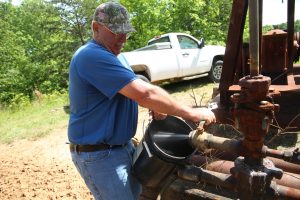
In an emailed response to questions related to the recently suspended Washington County injection wells, Press Secretary at Ohio Department of Natural Resources Whitney Higaki said, “The Division has signed a contract with a third-party consultant to conduct private water well sampling and analysis.”
“The Division will determine what, if any, further investigation is necessary based on the outcome of the private water well assessment and other available information,” Higaki said.
Higaki did not specify the parameters of that analysis, and did not respond to a clarifying question by press time.
While suspending wells in the region, the division has permitted drilling of new injection wells, including new DeepRock wells permitted under outdated regulations. In October 2025, the division permitted DeepRock to drill a new well near the Noble County wells the division suspended. The well has not yet been drilled, according to ODNR records.
The case before the Oil and Gas Commission
In its appeal, DeepRock cited expert reports showing that “materials could not have migrated the required distances” and that the chemical composition of fluids which rose to the surface in the five incidents cited by the division chief “did not match DeepRock’s injectate.”
The division’s 2026 order preempted these arguments. The division said DeepRock’s arguments about how far the waste it injects could spread relied on an assumption that waste would migrate out in all directions. Instead, the waste appeared to migrate along a linear trend from the southwest to the northeast.
Additionally, the division said the company’s arguments on chemical composition were not valid because fluids “received for injection” at the wells “are constantly changing and highly variable.”
Injected fluids could also interact with or push preexisting underground water, the division said, meaning the fluid that rises to the surface may have a much different chemical composition than that injected into the ground.
DeepRock argues in its appeal that the division did not present a scientific basis for disregarding the evidence presented by the company.
“Plainly, the chief answered science with speculation,” DeepRock argues.
DeepRock’s arguments mirror those leveled by K&H Partners after the division suspended its Athens County wells in 2023. Before the Oil and Gas Commission, K&H argued the division lacked evidence to suspend its wells and based the suspension order on speculation.
The division rebutted that the injection well operator was responsible for proving its wells were not leaking toxic fluid underground. The commission upheld the division’s suspension order.
But the commission is composed differently today. Under Ohio law, the commission includes five members appointed by the state governor, featuring representatives from major petroleum, independent petroleum producers, and the public, alongside experts in oil and gas law and geology. Currently, the seats designated for an expert in oil and gas law and a public representative are vacant.
Reed said the state’s process for handling complaints via the Oil and Gas Commission is “questionable,” and that it is “not fair to have two out of the three with industry backgrounds. That shouldn’t be the case. We need a fair process.”
The K&H case was also heard by only three members, but the vacant seats at that time included the spots for a geology expert and major petroleum representative. The latter seat had just been vacated by former DeepRock CEO Brian Chavez following his appointment to the Ohio Senate. Chavez maintains ties to DeepRock.

In addition to arguing over its culpability before the Ohio Oil and Gas Commission, DeepRock also faced a lawsuit in the Franklin County Court of Common Pleas related to the cleanup costs from the 2021 incident. While that initial lawsuit was dismissed Aug. 5, the attorney representing the plaintiff in the case, Kevin Maloney, told the Independent that the case would be refiled, and that the dismissal was due to scheduling concerns.