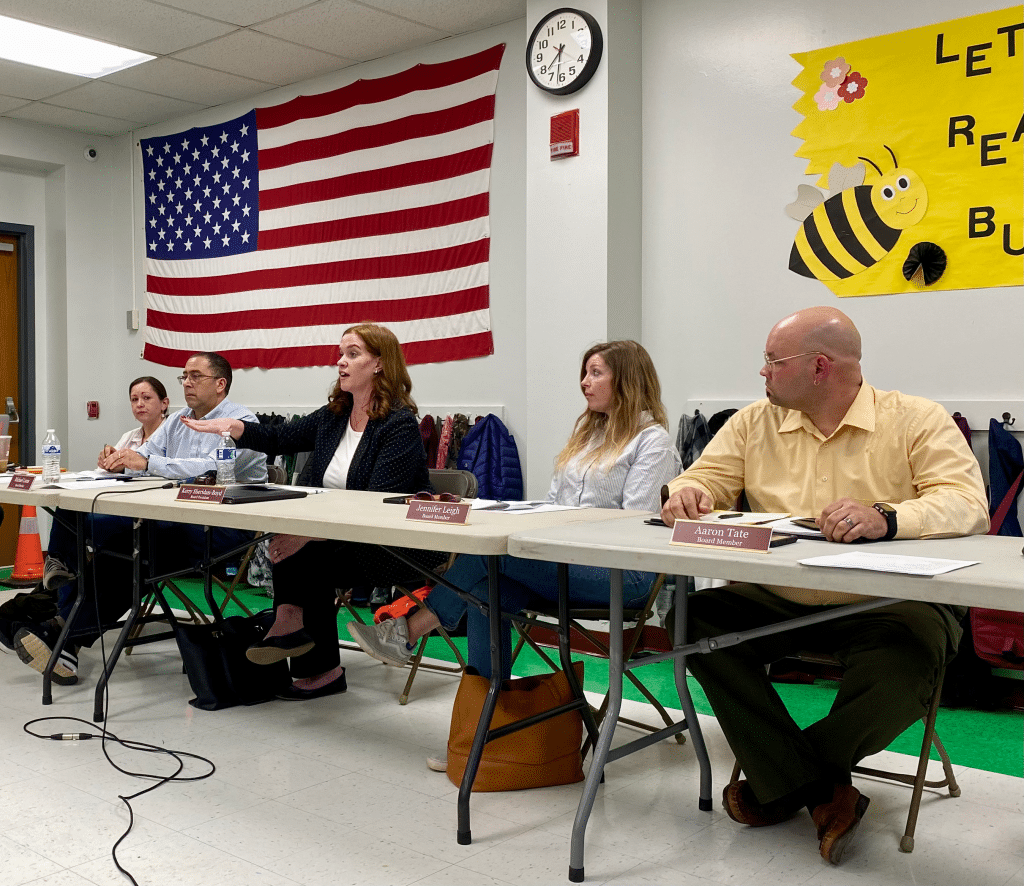
AMESVILLE, Ohio — The Federal Hocking Local Schools Board of Education voted Tuesday night to eliminate six teaching positions effective with the 2025–26 school year.
The reduction in force proposal from Superintendent Jason Spencer, introduced at the board’s Feb. 19 meeting, calls for cuts at every school in the district:
- A second grade position at Amesville Elementary;
- One fifth grade position at Coolville Elementary; and
- One position each in English, math, science and social studies at Federal Hocking Middle School.
The proposal also eliminated a fourth-grade position at Amesville Elementary but added a fourth/fifth grade position.
In a reduction of force, the district eliminates specific positions. The teachers whose positions are eliminated can remain employed by “bumping” less experienced teachers as long as their teaching licenses are for the same grades and subjects.
Spencer said at the meeting that he thinks that only two teachers will actually lose their jobs, but that number is not certain.
Nick Warmke, co-president of the Federal Hocking Teachers Association, said the next step is for Spencer to work with the union to figure out how the RIF will play out.
“I don’t want to talk about those numbers in those positions, because that is a very complicated process, and I legitimately do not know everybody’s license or how long they’ve been with the district,” he told the Independent after Tuesday’s meeting.
Speaking during the public comment period at the meeting, parent Gem Stone said reduction in force is just a euphemism: “Call a spade a spade,” she said. “It’s not a reduction — it’s firing teachers.”
Spencer has said the RIF is necessary to address a budget deficit that will begin this year and continue to grow.
According to a five-year forecast that district Treasurer Bruce Steenrod distributed at a March 11 meeting of the board’s finance committee, Federal Hocking will spend nearly $366,000 more this fiscal year than it takes in.
The forecast predicts that the district’s costs will increase by nearly 11% by the end of the 2029 fiscal year — but that its revenues will rise by only 2% over the same period. Making up the difference will eat into the district’s cash balance, reducing it by nearly half.

However, Stone pointed out that the effects of the spending gap won’t become critical for some time.
“It is clear that the cash balance will reduce year by year, however, it will not be until the end of June 2028 that there will truly be a fiscal emergency,” Stone told the board. “I am here to ask you to give us a chance to help fill that gap.”
Stone was one of nine community members who spoke during the 30-minute comment period. Each was allotted 3 minutes; board president Kerry Sheridan-Boyd set a timer for each speaker.
As at the March 11 finance committee meeting, community members pleaded with the board to hold off on a RIF and try to increase revenue instead — including trying to pass a levy.

Parent Hannah John Connery said her research on Ohio’s school levy procedures showed that pursuing a levy is entirely up to the board of education — and that the district had multiple opportunities to put a levy on the ballot in the next 18 months.
“We have three times that we could try to get a levy through,” she said. “I encourage you to do so.”
Former superintendent George Wood sympathized with the board’s plight.
”These things have been coming for a while,” he said. “We lost 20% of our students and 85% of our budget is salaries in benefits, so of course you want to look at that first.”
However, he said, the board should proceed cautiously and deliberately.
“You don’t have to do anything for quite a while,” he said. “People deserve not a one-year cut — they deserve a three- to four-year plan. It shouldn’t just be what we can reduce, but what we can bring in.”
Some speakers referred to the district’s high number of students who live in the district but are not enrolled in Federal Hocking schools. According to figures Spencer shared at the meeting, 358 children — about 30% of all children who live in the district — are enrolled in other districts, take classes online or are homeschooled.

If the board voted to cut teaching positions, parent Jim Meeks said, “I know of at least five or six kids that will be leaving this school district,” he told the board. “There’s got to be another issue than getting rid of teachers. I mean, this is not the right way to go.”
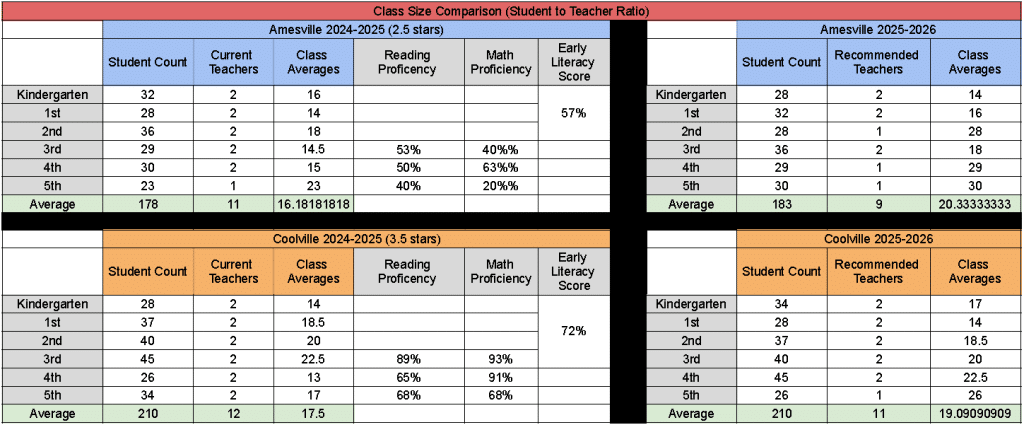
Spencer has noted that Federal Hocking has smaller class sizes compared to other nearby school districts, and that even with the larger class sizes that would result from reducing the teaching staff, the district would still have average classes below the state threshold of 25.
Data Spencer shared at previous meetings show average class sizes of 16.2 students at Amesville Elementary and 17.5 students at Coolville Elementary. Eliminating positions at those schools would bring those averages up to 20.3 students and 19.1 students, respectively.
But for some parents, smaller class sizes set Federal Hocking apart and make the district more attractive.
“To me and my family, what makes [Federal Hocking] great are the small class sizes. That’s why we’re here,” parent Pete Shooner told the board. “What [you’re] proposing cuts out what makes Fed Hock unique and special.”
Parent Jen Zingler, whose family lives in the Athens City School District, said the smaller class sizes were what led them to enroll their children in Federal Hocking.
“We actually enrolled into this district because of the small class sizes, and we stayed because of the culture within Amesville Elementary,” she said.
She noted that she attended an elementary school “with 30+ kids in a class.”
“It was awful — disciplinary issues all the time, a lot of bullying,” she said. “I would hate to see choices that would precipitate a negative feedback cycle where you’re losing teachers, you’re losing students.”
Spencer’s comparisons of class sizes include the schools’ state report card ratings, which are generally higher than Federal Hocking’s. At the March 11 finance committee meeting, Federal Hocking High School teacher Robin Hawk said she worries that larger class sizes make it harder for teachers to help struggling students close their learning gaps.
“It becomes almost impossible to do that in a tenth grade classroom with 30 kids,” she said.
At Tuesday night’s board meeting, high school guidance counselor Emma Wright said that it’s not just struggling students who will suffer.
“Fewer staff means fewer opportunities for students, fewer AP classes, fewer College Credit Plus options, fewer extracurriculars — and ultimately, fewer reasons for families to choose our district,” she said.
During the board’s discussion of the motion, board members asked about class configurations, support for teachers with higher class sizes, and the projected cost savings of implementing a RIF. Some members of the audience reiterated concerns about the long-term impact of the move.
When Sheridan-Boyd called on Steenrod to conduct the vote, however, members of the audience began to call out.
“This is a meeting of the board. There was a public speaking time, and this is our time to have our board meeting,” Sheridan-Boyd told the audience.
“Your position is to represent this community, not the superintendent,” one audience member said. “We don’t feel heard by you.”
“We have listened. We have heard all of you. We have discussed this,” Sheridan-Boyd replied. As the crowd began to rumble, Sheridan-Boyd rapped her gavel several times. “OK, no, we are not going to do this,” she said.
“We have not heard directly from you guys why you’re not willing to accept a levy,” the audience member said.
Sheridan-Boyd replied, “We have never, never said—” before the audience member interrupted to ask, “Then why are you agreeing to make these cuts? We want to hear it.”
“You want to lose a lot of students? Do you want to lose more?” another audience member called.
“Ok, enough, this is a board meeting,” Sheridan-Boyd said.
“I want an answer,” the audience member said.
“We do not have to answer,” Sheridan-Boyd said. “This is a board meeting. The public participation part was at the beginning.”
Steenrod then called the vote. Leigh promptly said “no” when called on, but Brumfield visibly struggled with a decision before giving her “no” vote. Sheridan-Boyd, Mike Lucas and Aaron Tate all voted in favor of the RIF.
As the board moved on to discussing the 2025–26 academic calendar, a member of the audience indicated that the vote could have consequences for the board as well.
“We will not be voting for you,” she called, generating applause around the room.
Brumfield’s, Tate’s and Sheridan-Boyd’s terms all end Dec. 31, 2025. Lucas was appointed to replace former member Dan Torrence, whose term was to end in 2027; by state law, that seat’s term also will end this year. Candidates for the Nov. 4 general election must file with the board of elections by 4 p.m. on Aug. 6.
The Federal Hocking Board of Education meets on the third Tuesday of the month at 6 p.m. The next regular meeting is scheduled for April 15 in the cafeteria of Coolville Elementary School, 26461 Main St, Coolville.
This story was updated at 3 p.m. March 21, 2025, to correct the number and composition of positions being eliminated and to add Mike Lucas to the list of board members whose seats are up for election in November.