

WASHINGTON COUNTY, Ohio — A new report from regional environmental groups claims that the Ohio Department of Natural Resources failed to properly investigate, enforce regulations and record data on oil and gas wells.
The report, authored by the FracTracker Alliance and the Buckeye Environmental Network, looked at ODNR incident reports over a 10-year period, 2015–2025.
“This was something that we decided to do after roughly 15 years of community advocacy, pointing out that there were more accidents than what the Ohio Oil and Gas Association was telling the public and what ODNR was telling the public,” said Gwen Klenke, FracTracker’s Midwest program coordinator and the report’s author, in an Oct. 21 presentation.
Much of the report focuses on issues with ODNR’s incident reporting data.
“There’s no clear definition of what an incident is,” Klenke said, but that “generally, we can say this is something like a spill, a leak, a truck carrying brine rolled, basically any sort of accident that relates to some sort of pollution event going on.”
The report found that the yearly “incident” rate has increased over time, with 103 incidents in 2015 and 268 incidents in 2025.
2015’s low incident rate appears to be an outlier. Since 2016, there has been an average of 243 incidents each year, with an overall trend of a 5% increase in incidents each year.
Much of the report focuses on the limits of ODNR’s incident reporting system. Issues identified by the report include:
- The incident classification system that measures the severity of reported incidents. The severity ranking may reflect initial perception of an incident, rather than its ultimate impact, the report claims. It points to a 2016 incident in Columbiana County, where a tank exploded and released nearly 2.5 thousands gallons of oil and over 200 gallons of waste water. The incident was classified as “minor.”
- Key details about an incident being “buried” in the narrative section of reports. The narrative section sometimes includes information that contradicts data in other fields.
- A lack of clarity in some records regarding how incidents were ultimately addressed and how long incidents were considered active.
The report includes numerous suggestions to improve incident tracking. These include making incident data more accessible; improving accessibility of state databases related to oil and gas; and clarifying terms used, perhaps by including a data dictionary.
The report says clearer and more accessible incident data would give the public a better understanding of threats from the industry.
The report also suggests hiring more inspectors and escalating enforcement against repeat offenders.
Incidents in Southeast Ohio
The majority of incidents took place in East and Southeast Ohio.
In Southeast Ohio, Athens, Hocking and Washington counties recorded 221 incidents 2015–2025. That means that roughly 9% of all oil and gas well incidents happened in these three counties.

The issues identified by the report pervade the regional data.
In a 2024 Athens County incident in Amesville, a hunter discovered a gas release on his property and reported it. The description of the incident offers no detail on what was done to address the report.
The duration the report was listed as ‘open’ is zero (meaning it was closed the same day). Its status is listed as “closed with referral,” though it’s not clear to whom the incident was referred. The authorized agency is listed as “undetermined.”
The same issues apply to reports on fracking waste injection wells, which are also included in the dataset analyzed by the environmental groups.
In a 2021 incident from a Washington County injection well owned by DeepRock Disposal Solutions, the narrative description states that contaminated soil was removed. However, the report does not identify what caused soil to become contaminated or what was done to address the incident, classified as minor.
3,800 wells per inspector
The report states that the state has only 25 oil and gas well inspectors to oversee the roughly 96,000 active oil and gas wells in the state, or an average of 3,840 wells each. However, the workload varies by assignment: The report found that one inspector is responsible for a 26-county area containing 24,000 wells.
“These inspectors are not able to reasonably see every well that they’re in charge of,” Klenke said. “The burden is just too high on them for them to be able to proactively catch degrading
infrastructure that might lead to an incident.”
The report also found that it would take 664 eight-hour work days for the 25 state inspectors to review every active oil and gas well in the state. That math doesn’t account for inactive and orphaned oil and gas wells, for which state inspectors are also responsible.
The report also found that only four inspectors statewide are responsible for reviewing the over 230 fracking waste injection wells, also known as Class II wells. As a result, each inspector for Class II wells covers large geographic areas, with one covering 2,000 square miles in Holmes, Tuscarawas, Perry, and Washington counties.
“The oversight doesn’t really match the scale of these incidents and [it] can’t with how overburdened these inspectors are,” Klenke said.
Because of the mismatch between numbers of inspectors and wells, wells can go years without receiving a visit. The well in Columbiana County where a tank exploded in 2016 hadn’t been inspected in 12 years before the explosion, according to Ohio’s Oil and Gas Database.
The well was subsequently inspected in 2017 and 2019. The well was sold to another company in 2020 and was most recently inspected in 2024. The report calls the gap in inspections after the well was sold “notable given the well’s incident history.”
The report also links issues with the Kris-Mar No. 1 oil and gas well in Washington County to a lack of inspections. Oil and gas production wells near Kris-Mar No. 1 were flooded by wastewater in 2019 and 2020, per reports submitted to ODNR.
ODNR’s inspectors visited the Kris-Mar No. 1 well in 2021 and assessed a violation to the well for not having proper signage. In 2022, well owner Cross River Energy Inc. was cited once again for not correcting the issue.
“Before 2021, the well hadn’t been inspected since 2012, nine years prior,” said Bev Reed, Appalachian organizer with the Buckeye Environmental Network.
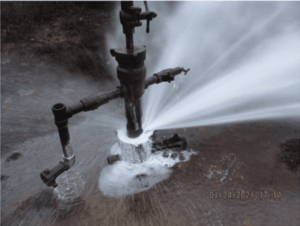
A 2023 inspection of the same well discovered that the well was leaking and had contaminated the surrounding area. However, “The incident lists the estimated quantity released as zero,” Reed said. “The well was flowing for days after the leak was found, so there’s no way to measure the amount released. However, stating that it was zero is inaccurate.”
After the leak was discovered, inspectors visited the Kris-Mar No. 1 well over 20 times between May 2023 and October 2025. ODNR still considers the well to be the site of an ongoing incident.
“No plan has been submitted,” Reed said. “No action [has been] taken to bring this well into compliance. This should have been cleaned up immediately. The contaminated soil is still sitting [there] to this day, as far as we understand it.”
The report recommends more meaningful corrective action in response to violations.
Ohio law authorizes penalties in response to violations, but ODNR would need to act through the state attorney general’s office. The report notes that in 2015, the U.S. Environmental Protection Agency found Ohio could improve regulation of injection wells by “escalating enforcement” against repeat offenders.
However, the report states, “To date, we are not aware of any instances of ODNR using the attorney general’s office to issue fines for companies violating Ohio’s injection well laws. This approach to enforcement may have allowed companies to avoid meaningful consequences for repeated violations.”
Meanwhile, if more inspectors were hired, wells could be “inspected with the regularity required to avoid oil and gas pollution events, leaks, and spills” in the first place, the report says.
The Independent contacted the Ohio Department of Natural Resources on Wednesday, Oct. 21, for comment on the report and did not receive a response prior to publication.

