ATHENS, Ohio — A little over 20 people — mostly Ohio University students — attended a low-key Ohio House District 95 candidate forum held by Ohio University Student Senate on Oct. 8 in Bentley Hall.

Don Jones (R-Freeport) faces off against challenger Micah McCarey, a Democrat from Athens.
Jones has held the office since 2019. He said he was a teacher for 23 years before serving in the Ohio House.
McCarey said he is a three-time graduate of Ohio University and has served as an at-large member of Athens City Council since 2021. He is also the director of the OU Pride Center.
Questions have been paraphrased for clarity.
Would you support or oppose a statewide school boundary program?
Jones and McCarey both said they were publicly educated.
McCarey said he believes “vouchers should only be used for public funding public schools, and that they are inappropriately used for private and religious schools. So I would be opposed to voucher use in that context, but really supportive of anything we can do to really alleviate some of the achievement gaps that result from students not being able to access the same quality school systems, largely due to funding being based on property taxes, and there being so much economic disparities across the region.”
Jones said “ As a parent, you want what’s best for your child. Sometimes it’s a small charter school, sometimes it’s a whole system, sometimes it is a parochial school, sometimes it is a public school.”
Jones agreed with McCarey on the point that schools around the state are not equally funded, nor held to the same standards.
“We’re funding schools that aren’t played by the same rules that our public schools are, and that’s that’s a problem,” Jones said. “That’s something I’m committed to try to work on in my last term, if elected.”
Some believe that individual teachers’ classroom curriculum should be relatively unconstrained, while others point to a need for centralized curriculum standards. What is your position on this issue?
Both candidates agreed that schools should equip students with critical thinking skills, as opposed to rhetoric.
Jones said, “Being a teacher, you want to have as much freedom in the classroom as you can have, because it’s something that’s important, but you also need to make sure that we do have standards that we follow.” He expressed support for curriculum development on a local level. “That’s beauty of our local school boards,” he said.
Jones said that as an educator, his job “was to help the students become productive members of society.” He added that “our curriculum has to be something that is unbiased. It needs to be something that is factual, not opinionated. We can’t change history. Whether we like history, we don’t like history, we can’t change it, but we need to teach it and realize that there are two sides to every story.”
In contrast to Jones, McCarey said he believes standardized curriculum “is appropriately resting with our state school boards and educators … who are making the recommendations on what the content is being taught in schools.” He seconded Jones’ point on local school boards, in that they “do indeed have responsibility to evaluate the various curriculums available to them, look at the strengths and weaknesses that they see, seek input from the educators in the school system, as well as PTOs.”
McCarey said he believes in listening “to the testimony of students who’ve experienced that curriculum directly and the teachers who are able to talk about the challenges of potentially implementing it,” referencing curriculum based around standardized testing.
McCarey also voiced support for funding for arts in schools, and acknowledged Jones’ statement on history: “I absolutely believe in the importance of our schools for teaching knowledge from history in honest and accurate ways, and the history that has more than two sides.”
How can we facilitate the transition to cleaner energy, while also protecting the economic livelihood of the folks that work in threatened industries?
McCarey said it’s important to him that Athens is “a community that’s modeling the way” in the transition to sustainable energy.
“I believe that Ohio is in a place where we can embrace increasingly efficient technologies that can help us counter the negative impacts of oil and natural gas excavation,” McCarey said. He added that he believes it is important to monitor “the safety of our drinking water and putting in place any environmental protections that can increase the quality of technology in our water treatment facilities.”
“I want to acknowledge that our local economies are largely dependent on natural resources for energy, and that the reality is we are seeing right in our own community the benefits of switching to renewable sources, and I hope we continue to inspire and share that work in the region,” McCarey said.
Jones said that energy is “a very, very very important topic to all of us in this room,” pointing to cell phones, laptops and other “gadgets.”
“And you know what? They’re all driven by energy,” Jones said. “If we want to continue the things that we enjoy, we have to understand we’re going to have to generate more electricity than what we have right now.”
Jones continued, “We’re going to have to either build a lot more solar farms … We’re gonna have a lot more windmills up, and windmills are not sustainable in southeastern Ohio, because the wind currents are simply not here … Storing electricity is becoming a real issue because we’re gonna have to start building batteries. We’re gonna have to build storage facilities.”
Jones pointed to natural gas as a “clean-burning fossil fuel that most people don’t want to recognize,” and the large reserves of it located in Appalachian Ohio. “We’re not utilizing [it]. That’s a problem for me, because I would rather have the lights on than to not.”
How can the General Assembly help farmers combat the effects of climate change?
Jones, not only a teacher but also a farmer, acknowledged the historic drought currently affecting his district.
“It’s frustrating because we’ve never been in a situation like this before,” Jones said.

Jones said “there’s a lot of factors to deal with” regarding climate change. He said he supports small-scale solar projects, “but I think we also have to look at the fact that there’s a lot of things that are beyond our control.”
Jones continued, “Look at our look at our world. We have hurricanes like we’ve never had before. We have floods like we’ve never had before and I don’t know that anybody can pinpoint one specific thing that’s caused that. I think we also have to remember that we’re not in control of everything that happens in our world.”
McCarey acknowledged Indigenous “history and culture, and how one of the ways that we demonstrate that respect is through our sustainability efforts and our efforts to honor the land and protect our Earth and think about it, not just as something for us to extract from or immediate needs, but to think about it for generations to come.”
McCarey said he believes “climate change is real.” He said he learned from serving on Athens City Council that establishing community-to-community partnerships can “help us learn from one community to another, different ways that we can combat climate change and lower our carbon footprint.”
Further, McCarey said he supports regional efforts to lower carbon footprints. He said he would approach the issue by helping communities develop sustainability plans “with a specific goal of lowering their carbon footprint.”
“I believe in partnering to share,” McCarey said.
McCarey also voiced support for programs for waste mitigation, composting and recycling.
How can the government best balance the Constitutional rights of individuals when it comes to access to firearms? As a leader, how do you make those tough decisions?
McCarey said he believes gun violence is “one of the top issues and concerns that I’m hearing from young people today, and it’s one of the most difficult to talk about in District 95 because there’s such varying beliefs on our strategies for addressing gun violence.”
McCarey and Jones both said they believe gun violence is tied deeply to mental health.
“Mental health resources are important for so many reasons, and having communities equipped with the partnerships where they know how to alert appropriate mental health professionals and safety authorities to potential threat — to begin first individuals connected to the resources that can help evaluate and fully reconcile any danger that they may be to themselves or to the community,” McCarey said.
McCarey voiced support for gun licensing and training as well.
“And in general, we want to recognize that this is a Second Amendment issue for some people and it’s a school safety issue for others,” McCarey said.
Jones said, “There’s a lot of questions about, ‘How does this happen? Why does it happen?’ I think we can answer those questions … but we’re talking about people that have different motives for different reasons.”
Jones said he has a concealed carry permit himself, which he obtained through a class. He also touched on teachers carrying guns as a potential deterrent for school shootings: “There are some districts … that do permit their staff to carry; sometimes just the fear of knowing that someone else may have a gun is enough to deter somebody from doing that. But it’s not always the case.”
Jones noted that schools may also lack funding for adequate mental health resources.
“My wife’s a fifth-grade teacher. We have these conversations about when school shootings happen … We need to have that conversation and continue having these conversations about, how do we make our schools safer?”
What action do you support taking to strengthen the job market in Ohio?
McCarey said he believes “in supporting small businesses and entrepreneurship.” He said he’s found small businesses are a common “backbone” of communities in the 95th District.
“That means that one of the goals I have as a House of Representatives member is to increase availability of grants for small businesses, whether they be grants that are used to improve ADA accessibility for a building, or where they support minority-owned businesses.”
Jones pointed to broadband internet expansion as a way to support small businesses and workers in the district.
Members of the State House set policy governing the use of public funds. Currently, the state of Ohio owns over two $60 million in Israeli Treasury funds. With the current situation, these investments are controversial. How would each of you like to see Ohio economic policy evolve on this front?
McCarey said that as an elected representative, he views his role as “not to inflict my will and my judgment and my values alone on folks, but to really think of myself as a representative.”
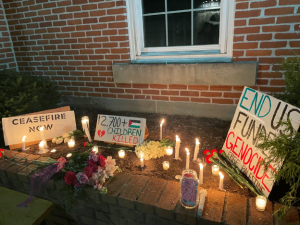
He gave the example of listening to members of the public in Athens when the council passed a ceasefire resolution for Israel’s siege on Gaza.
“That’s legislation that I supported after listening really carefully, along with the rest of my fellow council members for weeks about why it is that people felt that this is something that city council needed to be involved in,” McCarey said.
Jones seconded McCarey’s point about listening to constituents, but said he was not knowledgeable about the subject. He said that “as a legislative body, we have said that we are not to do business with any of the countries that are on the terrorist list because we don’t want to do business with bad people. We don’t want to do business with countries that are not our friends.”
Jones continued, “And you’re going to find that I’m an America First guy. We have to take care of our folks here at home first and foremost.” He added that as a state rep, “We have no control over what happens in those countries or those other states, because we are state legislators. We’re not federal. We’re not U.S. representatives. We’re not U.S. senators. We are state representatives.”
In a May press release, Ohio Treasurer Robert Sprague said that state has purchased a total of $357.5 million in Israel Bonds since he took office.
Legally speaking, the issue of abortion access is not as debated, given last year’s passage of Issue One. What do you feel are the next steps in shaping policies surrounding abortion healthcare?
McCarey said he believes “that access to quality healthcare is an essential right for individuals.”
“I want Ohio to be a place where, as I said before, [where] people feel like they can make decisions based on their personal experience and the expertise of their positions, not with legislators getting to get into the way out of that relationship,” McCarey said.
Jones said that, “As a constitutional right, whether I agree with it or not, is my personal feelings.” He cited concerns in instances where parents do not have access to their children’s medical information. He compared abortions to tattoos.
“We have to make sure that these people are making very well-thought out decisions with their parents, with their healthcare providers that’s going to benefit them when they get older,” Jones said.
Jones voted for House Bill 68, which restricted minors from accessing gender-affirming care.

What best qualifies you to represent the 95th House District?
Citing his professional background, McCarey said he wants to “help people communicate more effectively … in ways that represent a diverse range of views and that are in alignment with our values and goals.”
McCarey noted that “sometimes those values seem to be really far apart, but I believe in helping people figure out exactly what we can agree on, oftentimes that comes down to agreeing that people deserve to be able to live healthy lives with dignity, and providing frameworks for people to create rules that align with that.”
McCarey also said he has a passion for an experience in “bringing people together.”
“I really want people to know that I am going to be here for them,” McCarey said. “I’m going to be not just at your county fair, but I’m going to be wanting to get to know the local business owners and those challenges that you face, the things that you tried to get from the state that you haven’t and figure out how I can help you do those things. I am a candidate who’s going to be here for everyone.”
Jones expressed gratitude for the past six years representing the 95th District.
“I think my record speaks for itself,” Jones said. “This job is classified as a part-time job. I can tell you that it’s not a part-time job. If you do the job, you do it very well. It’s a full-time job.”
Election information
Election Day is Nov. 5. Early voting is currently underway. Find more information from the Athens County Board of Elections.