ATHENS, Ohio — Ohio University sought to exclude employees from the proposed bargaining unit in a prospective faculty union in a filing earlier this month with the State Employee Relations Board.
“We’re pleased that the university is moving towards an election, but are concerned about the attempts to exclude faculty,” OU faculty member and American Association of University Professors President John O’Keefe said in a statement.
In its May 9 filing, obtained by the Independent through a records request, OU specifically moved to exclude all faculty in the College of Health Sciences and Professions, with the exception of faculty in the Department of Social Work.
Sarah Webb, a CHSP faculty member in the Department of Social Work, said the exclusion of her CHSP colleagues from the bargaining unit could have significant consequences for the college.
“Especially if you’re leaving out CHSP — all of those folks could probably find better jobs in the direct service sector that pay better,” Webb said. “You really risk losing a lot of quality faculty members, team members and folks who I think all want the best for Ohio University and for our students. And when you leave that number of folks out, the risk is you are not delivering the same quality of education that you would be otherwise.”
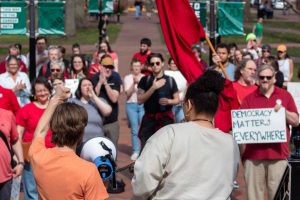
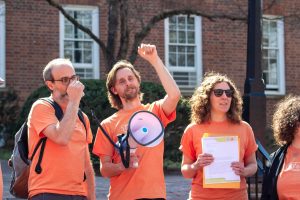
United Academics of Ohio University organizers previously told the Independent that nearly 70% of faculty members across OU campuses signed cards to file for the election. Faculty concerns include pay, staffing cuts, workloads and a lack of faculty input in decisions that affect them.
OU also moved to exclude faculty in the Heritage College of Osteopathic Medicine, along with some other faculty groups, but said it was unclear if UAOU initially intended to include those faculty in its proposed bargaining unit or not. (Faculty organizer Julie White declined to address a question about HCOM, and a national organizer with the American Federation of Teachers who previously spoke with the Independent didn’t respond to repeated requests for comment for this story.)
Regardless, the bargaining unit OU proposed is about 70 members smaller than that proposed by labor organizers.
UAOU initially proposed a bargaining unit that would represent about 850 non-supervisory faculty members across OU’s six campuses through an association of the AAUP and American Federation of Teachers, according to records obtained from the SERB.
O’Keefe said in his statement that UAOU would still prefer its initially proposed bargaining unit.
“We very much agree that all faculty, clinical or non-clinical, add value to the university, and are the core of what the university provides to students and the community — we all deserve representation,” O’Keefe said.
White emphasized OU’s exclusion of CHSP faculty, which she said came as a big surprise to organizers.
“We think that some of those jobs are clearly enough like jobs around the rest of the university that they should be included with us,” White said.
Webb said, “The exclusion of CHSP specifically was very disheartening, because if you read through the response, it makes me think — I’m like, ‘Oh, these people really don’t understand what we do in terms of our teaching and how we interact with students.’”
The university argued that the bargaining unit should exclude “faculty from clinical academic groups that do not share a community of interest, similar wages, hours, and other working conditions, and operate distinctly from the rest of the general academic community at the University.” Having these dissimilar groups in a shared bargaining unit could create problems in contract negotiations, OU said.
OU proposed keeping social work faculty in the bargaining unit because “the Department of Social Work does not have any clinical faculty or a clinical curriculum,” according to OU’s filing.
But Webb disputed that reasoning, saying that her job looks very similar to those of excluded faculty members.
“Our Master of Social Work program is actually a clinical social work program, and many of us have to maintain clinical licenses, just like many of the folks that they excluded in CHSP,” Webb said.
She added, “One thing that I’ve loved about being involved with this group for the last two years is the feeling and commitment to solidarity that we have. …We are actively working with our national leaders and ourselves as a group to try to figure out a way to include as many people as possible because we value and respect our CHSP colleagues.”
UAOU has until June 10 to file a response to the university’s proposal.
“Our national organization is providing legal representation and those lawyers are reviewing the response (OU’s),” O’Keefe said in his statement. “That said, our goal is to represent as many faculty as possible, and we’ve been reaching out to faculty in CHSP and HCOM. Even if SERB rules against a broad and inclusive definition, we have already been talking to potentially excluded faculty about our options, and what they’d like to see.”
Mona Reed, executive director of the SERB, said what happens next will depend on whether the university and UAOU can agree on their proposed bargaining unit.
“If the parties, union and OU, agree on who is in the bargaining unit, the parties will decide on a time of the election; however, if the parties do not agree on who is in the bargaining unit, then SERB will decide who is in the bargaining unit before an election is held,” Reed explained.