
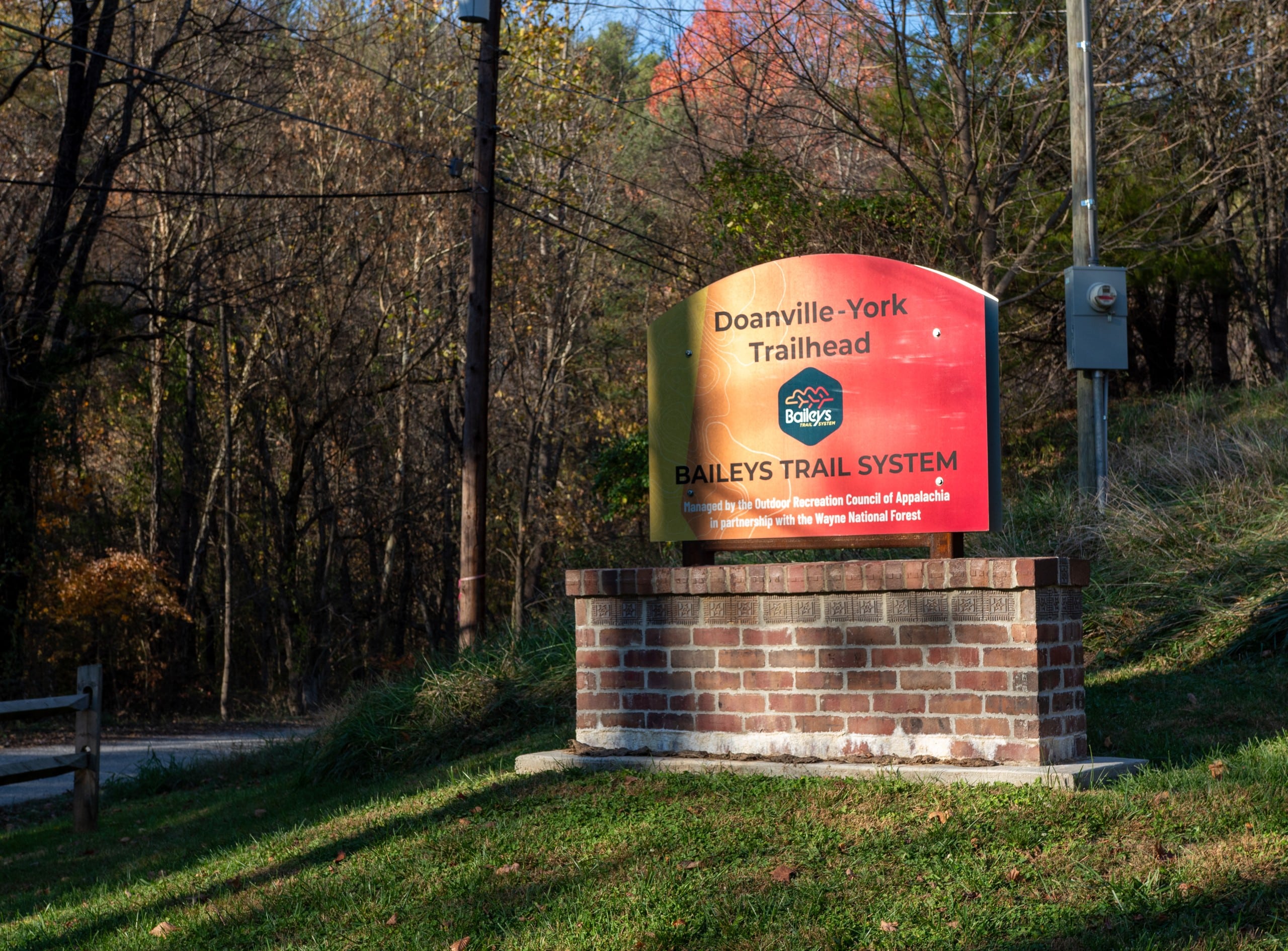
COLUMBUS, Ohio — A house bill awaiting Ohio Gov. Mike DeWine’s signature would strip at least three quarters of a million dollars in funding from the entity that manages the Baileys Trail System, the Outdoor Recreation Council of Appalachia.
The funding cuts to ORCA could leave the Baileys Trail System without an entity to maintain it. Long-touted as a major driver for economic development in Southeast Ohio, the 88-mile mountain biking trail system cost $9.1 million to build, according to ORCA director Jessie Powers.
House Bill 479 would strip ORCA of $750,000 earmarked for the organization in fiscal year 2027, which begins July 1 of this year. The bill could also impact funding awarded to ORCA in 2026 that hasn’t yet been spent, Melaney Carter, director of the Ohio Legislative Budget Office, told the Independent.
ORCA Director Jessie Powers said the cut to ORCA’s state funding could ultimately cause ORCA to collapse, compromising not only its work to maintain the Baileys Trail System but also planned initiatives to advance outdoor recreation opportunities elsewhere.
The change to HB 479 that would remove ORCA’s funding was one of many approved by the Ohio Senate Finance Committee June 9. The bill was approved in its final form by the Ohio House and Senate the next day.
ORCA has advocated for DeWine to issue line-items vetos on the provisions in the bill impacting ORCA, Powers said.
The governor’s office did not respond to the Independent’s requests for comment via emails sent June 15 and June 16 prior to publication.
The funding cut to ORCA is part of $1.5 million awarded last summer, which was to be split over two years. Powers said ORCA planned to leverage the second year of funding as a match needed to secure $2.6 million in federal grants through the Appalachian Regional Commission. That funding would support ORCA’s partnerships, operations and growth, she said.
“These dollars were our bridge dollars to leverage federal investment that would fund our organization for five years and help us establish earned revenue opportunities that would make ORCA self-sustaining and able to deliver on mission and vision long term for the region and the state,” Powers said.
Without the state funding, Powers said future federal funding could be in jeopardy, and she is not sure whether ORCA will be able to continue to pay staff members through the end of the year.
If ORCA goes under, Powers said there will be no organization able to provide the “constant maintenance” needed to maintain the Baileys Trail System.
Powers said ORCA’s collapse would undercut the investment in building the Baileys Trail System, which opened its complete 88 miles of trails just this spring. Multiple infrastructure projects at local trailheads remain under development, including a trailhead in Buchtel and a welcome center in Chauncey.
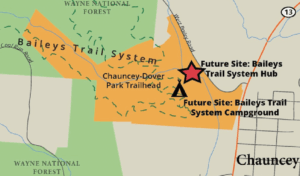

“Why build this if we’re not going to ensure that someone’s able to maintain it?” Powers said.
ORCA board member Jay Kline, a Buchtel Village Council member who has previously described the Baileys Trail System as potentially the “biggest thing here in this area since they discovered coal,” declined to comment for this story.
Tim Warren, ORCA’s board chair, did not return the Independent’s June 15 phone call about the budget prior to publication.
ORCA funding cut unique in HB 479
The bill’s full text was about nine pages long and focused on nursing and radiology before it was revised by the Ohio Senate Finance Committee. It ballooned in size and scope within the Senate Finance Committee, with the bill at 107 pages as of its final passage in early June.
The change to ORCA’s funding award was among several miscellaneous adjustments to existing appropriations made by the bill.
However, ORCA’s situation was unique: No other projects overseen by the Ohio Department of Development would be cut by the bill.
In addition to cancelling $750,000 that was set to be awarded to ORCA in fiscal year 2027, the bill also earmarks a new $1.3 million in FY 2027 for Marietta College. Funding would be channeled through the same Appalachia Assistance line-item that supports ORCA.
The bill specifies that before funds are awarded to Marietta College, the Ohio Department of Development must certify “canceled encumbrances from existing General Revenue Fund appropriations in the Department of Development budget equal to at least $550,000.”
Carter, the director of the state’s Legislative Budget Office, told the Independent, “This would be not this fiscal ‘27 earmark, but anything that’s been appropriated by the Department of Development from the [General Revenue Fund]. I mean, it’s millions of dollars, so I don’t know where they would cancel that.”
“[ORCA] did receive an earmark of $750,000 in fiscal year ‘26 which hasn’t completely been spent, so it’s possible that they’re planning on canceling that –– what’s left from that encumbrance –– but I don’t know, there’s no way for me to tell,” Carter said.
Powers told the Independent that she has not yet received word of what the exact dollar value hit will be to ORCA. She said ORCA’s point of contact regarding its state funding has been the Governor’s Office of Appalachia.
John Carey, director of the Governor’s Office of Appalachia, declined via email and phone call to comment for this story. Ohio Department of Development Chief Communications Officer Mason Waldvogel also declined via email to comment for this story.
In other instances within the miscellaneous changes to appropriations in HB 479, when funds were allocated to support new projects, there were not corresponding cuts, according to an Ohio Legislative Service Commission analysis of the bill.
Powers said she was unaware legislators were considering any change to ORCA’s funding until the change had already been approved by the legislature.
“I really didn’t know that the funding could be revoked, nor that any of our legislators had any concern about this. We’ve heard none,” Powers said.
Ohio 94th House District Rep. Kevin Ritter (R-Marietta) declined via text message to comment on this story, without explanation.
Ohio District 30 Sen. Brian Chavez (R-Marietta) did not respond by press time to a request for comment emailed to his office on June 15.
Chavez and Ritter both represent Athens County and sit on the finance committees for their respective chambers.
Cut follows falling out with Athens mayor, lobbying firm
The lobbying firm that secured the $1.5 million in state funding for ORCA last summer, Sunday Creek Horizons, declined to continue contracting with ORCA on March 31. Later that same day, Athens Mayor Steve Patterson resigned from the ORCA board. With Patterson’s departure, he unilaterally revoked the City of Athens’ membership in the council of governments, effective June 28.
Sunday Creek Horizons President and former Democratic Congressman Zack Space directed the Independent’s inquiry on the removal of ORCA’s funding to the firm’s Co-Founder and Senior Vice President Will Drabold.
Drabold told the Independent that the firm’s withdrawal from ORCA was unrelated to Patterson stepping down.
A post by the progressive Columbus blog The Rooster, focused on Ohio statehouse politics, claimed Sunday Creek Horizons was involved in the funding cut to ORCA. The post noted that Marietta College is among the firm’s clients.
Drabold said the firm was not involved in stripping ORCA of funding and that The Rooster’s post was inaccurate.
When the Independent told D.J. Byrnes, who writes The Rooster, that Drabold denied the firm’s alleged involvement in stripping ORCA of funding, Byrnes laughed. In a phone interview, Byrnes said he had spoken with legislators on the finance committees of the Ohio House and Ohio Senate who confirmed Sunday Creek Horizons’ involvement.
The Independent asked Byrnes for connections to his sources, but could not connect with those sources by press time to verify Byrnes’ claims.
The Independent also requested records from Chavez’s and Ritter’s offices for Sunday Creek Horizons’ communications with the two legislators, but those requests were not fulfilled by press time.
Drabold noted that while Sunday Creek Horizons provides consulting services to Marietta College, the firm is not registered as a lobbyist for the college. Drabold was aware Marietta College was working to secure funding for the program that received funding in HB 479, “but we did not lobby anybody to that effect,” he said.
ORCA “is completely off my radar,” he said, noting that “a lot of back and forth” preceded the end of ORCA’s contract with Sunday Creek Horizons and that the firm hasn’t done work for ORCA in months.
“Why that money moved is — I just, I don’t have insight into that,” Drabold said.
Drabold added that the Baileys Trail System “is obviously a premier asset, and we are proud of the money that we’ve been involved in getting to it over the years. So I want to see it succeed.”
Patterson also did not respond to the Independent’s requests to comment for this story, via phone calls on June 15 and June 16. He has publicly described his departure from the ORCA board as stemming from strategic differences over ORCA’s use of the state funding it was awarded.
Before Patterson resigned from the ORCA board, he spoke to Carey, the Governor’s Office of Appalachia Director, about his concerns over the organization’s use of the $1.5 million in state funding awarded through the biennium budget, according to a recording of ORCA’s March board meeting obtained by the Independent through a records request.
The Governor’s Office of Appalachia was ORCA’s main point of contact for its use of state funding.
Patterson said at the March meeting that he spoke with Carey regarding his desire to see ORCA use its state funding “to make something that is actually tangible,” rather than using funding to support ORCA’s general operations.
Patterson had told ORCA’s director and other board members in a Feb. 25 email that he would speak with Carey about his concerns with ORCA’s use of state funding
In the email, he said the budget ORCA had prepared for the Governor’s Office of Appalachia regarding ORCA’s use of state funding had not received approval from the ORCA board.
ORCA’s legal counsel Sky Pettey disagreed with Patterson’s interpretation of events.
In a Feb. 26 email to Pettey, Powers said, “Sounding this sort of alarm [to the Governor’s Office of Appalachia] … would likely harm ORCA’s reputation and presumably mine and/or staffs’ too. Are there any considerations or protections for staff in this sort of scenario?”
Pettey said in a Feb. 26 email reply that while Patterson could have whatever communications he wished to have with Carey, “I wouldn’t want to create the impression with the [Governor’s Office of Appalachia] that ORCA’s application was not authorized, as I don’t think that would be accurate, and it could result in negative consequences.”
Pettey did not respond to a June 11 phone call request for comment.
In the coming weeks, the Independent will release a deeper dive into the events that precipitated Patterson’s departure from ORCA, and the role of Sunday Creek Horizons.
