
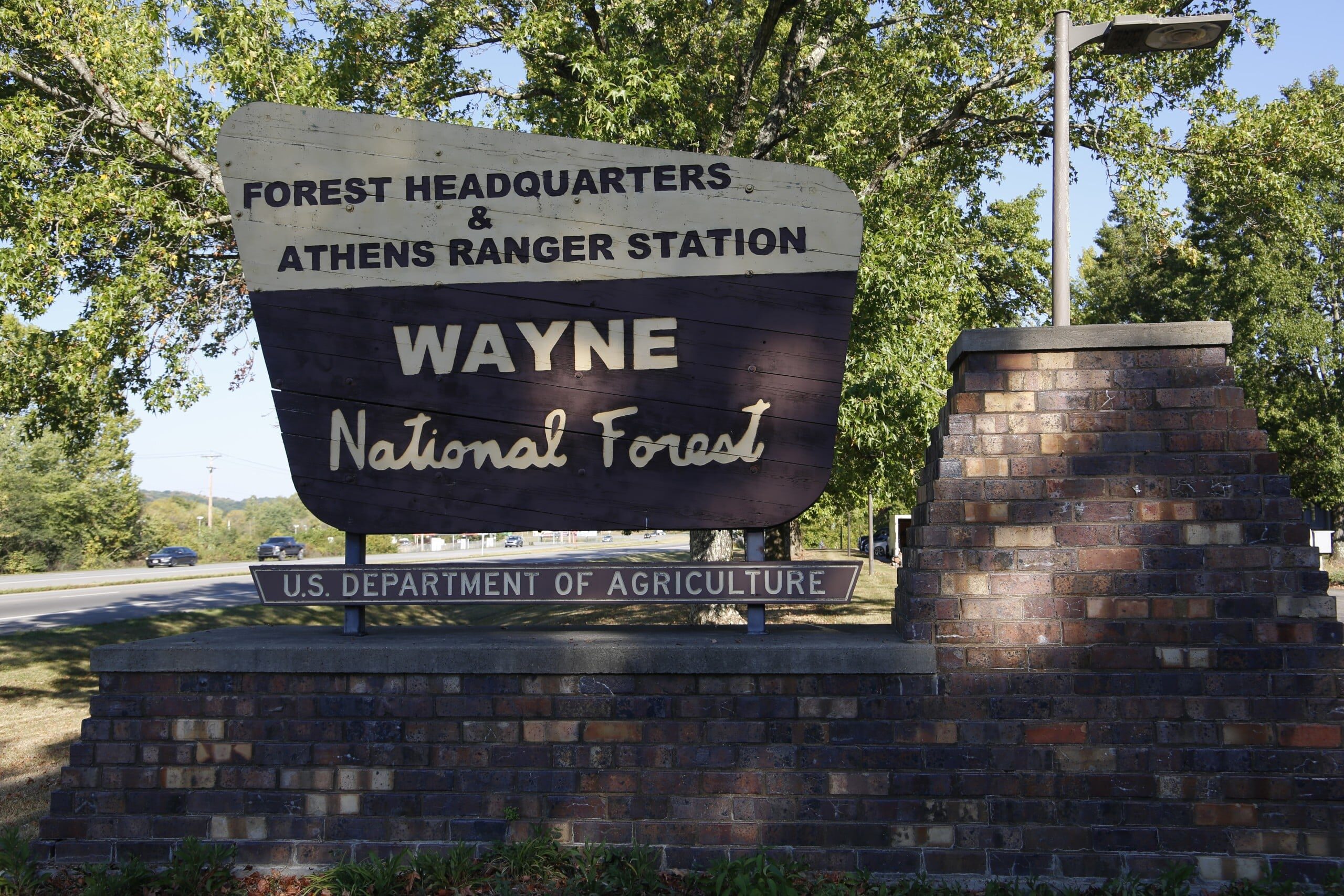
MONROE COUNTY, Ohio — A group of environmental organizations filed documents in federal court July 21, arguing that federal agencies violated a 2021 court order by approving fracking permits for the Wayne National Forest’s Marietta Unit earlier this year.
“The Wayne itself is one of the last few places in Ohio that hasn’t really been fracked or subject to fracking, and so the stakes are very high,” said Wendy Park, senior attorney with the Center for Biological Diversity, which is among the plaintiffs challenging fracking permits in court.
Additional plaintiffs in the case include Heartwood, the Ohio Environmental Council and the Sierra Club. Defendants include the U.S. Forest Service and Bureau of Land Management.
On May 18, the Bureau of Land Management approved three new applications for permits to drill fracking wells on Wayne National Forest land. The three wells will be drilled on the same parcel in southwestern Monroe County, with horizontal drilling proceeding through a portion of Washington County toward the Ohio River, according to a project map.
Fracking involves horizontal drilling beneath the earth and the injection of millions of gallons of water at high pressures to create fissures in rock, allowing gas to be extracted. This method is substantially more resource intensive than conventional drilling and creates toxic byproducts, which are injected deep underground.
On several occasions in southeast Ohio, those toxic byproducts have migrated underground well outside permitted areas, impacting oil and gas production and prompting concerns for drinking water impacts.

The BLM approval, included as an exhibit in the July 21 court filing, states that the agency considered the three applications to drill after the 2025 completion of a court-ordered supplemental environmental assessment. The assessment analyzed potential impacts of fracking on the Wayne National Forest.
As the court-ordered assessment progressed, the BLM held off granting new permits to drill on 65 previously issued oil and gas leases in the national forest. However, with the environmental assessment complete, the BLM granted the three applications for permits to drill in May.
The plaintiffs had challenged the environmental assessment in a motion on Dec. 3, 2025. The motion argues that the new environmental assessment failed to address problems the court had previously identified with the prior environmental assessment from 2016.
Specifically, the motion argued the new environmental assessment failed to adequately assess air quality impacts from fracking, as well as “impacts of fracking water withdrawals on the Little Muskingum River and local waterways.”
The Dec. 3, 2025, motion did not take issue with the environmental assessment’s consideration of fracking impacts on the Indiana bat, which the court in 2020 said was a failure of the 2016 assessment.
The federal agency defendants responded to the December 2025 motion by arguing that the court lacks jurisdiction to consider the motion, that the defendants satisfied the 2021 order by completing a new environmental analysis, and that the supplemental environmental analysis fully addressed issues the court had identified.
The December 2025 motion was fully briefed, meaning both sides submitted all arguments, by Jan. 16.
The court has yet to issue a decision on the December 2025 motion.
In their July 21 filing, the plaintiffs made the court aware that the BLM had granted the three new permits to drill. The plaintiffs said BLM’s actions violated the court’s 2021 injunction, which ordered that no applications for permits to drill be granted until a revised environmental assessment was completed “in accordance with the Court’s previous Opinion and Order.”
The plaintiffs argue that the revised environmental assessment from 2025 was deficient and did not meet the standards set by the court. Because of that, the plaintiffs argue the 2021 injunction remains in effect and new permits to drill should not have been granted.
The July 21 filing also claims the approved applications for permits to drill failed to adequately evaluate site-specific drilling impacts.
Park told the Independent that the July 21 filing was intended to “let [the court] know that there’s this … violation of the court’s order, the court’s injunction, and potentially new wells being drilled very soon.”
“Ohio has some of the least public lands in the nation, and it’s a really important resource for all Ohioans, and it should remain a safe haven for people and wildlife,” Park told the Independent. “We’re hoping that the court does rule on this motion to enforce soon and put an end to these fracking activities before it’s too late.”
Park added that she is not certain whether the newly permitted wells have yet been drilled.
Wayne National Forest media representatives deferred the Independent’s Aug. 4 request for comment to the BLM, passing the Independent’s request along Aug. 5. The Independent also emailed and attempted to call the BLM media contact directly Aug. 6 but did not immediately hear back.
Park said that in addition to fighting the new permits to drill in court, the Center for Biological Diversity has also filed an administrative appeal with the BLM.
‘Inadequate’ environmental assessment underpins planned lease sale
The BLM also is proceeding with a new lease sale planned for September. The sale will offer leases on 41 oil and gas parcels, totaling 2,840 acres in Monroe and Washington counties.
The BLM is currently accepting protest letters from the public until Aug. 17. The protest letters must meet specific requirements outlined by the BLM.
Park told the Independent that the Center for Biological Diversity plans to protest the lease sale.
“It’s a really important opportunity for the public to have their voice heard and point out any flaws in the environmental analysis, any particular resources that the BLM and the Forest Service should consider before they go forward with a lease sale,” Park said.
While the pending motion from December 2025 does not directly challenge the lease sale — because the 2021 injunction did not bar issuing new leases — “our concern is that the new environmental analysis that they’re relying on for approving new leases is still inadequate,” Park said.
“Potentially, if the court rules on that motion to enforce soon and agrees with us, then BLM would be prevented from relying on that environmental analysis to proceed with the upcoming lease sale,” Park added. “But we don’t know what the court’s going to do yet, so we can’t really count on that. We’re still planning on protesting.”
The lease sale is scheduled for Sept. 15. All documentation related to the planned sale is available on a BLM webpage.
