

COLUMBUS, Ohio — Ohio Gov. Mike DeWine issued an eleventh-hour line-item veto on a house bill provision that would have stripped the Outdoor Recreation Council of Appalachia of $750,000 in state funding.
DeWine waited until last night to announce the veto. The funding cut would have automatically gone into effect hours later without his action.
A representative of the Ohio Legislative Service Commission told the Independent in an interview before DeWine’s announcement that the bill would have automatically become law on June 25.
“This funding termination would disrupt economic development related to the Baileys Trail System that is already in progress,” DeWine said in a press release. “In my time as Governor, I have worked to foster the economic development of Ohio’s outdoor recreation sector, and this item would unnecessarily harm this development in the Appalachian region of Ohio. Therefore, the veto of this item is in the public interest.”
The cut to ORCA’s funding was targeted through changes to Ohio House Bill 479 made the day before the bill’s final passage by the state legislature. ORCA’s situation was unique within the bill: No other projects overseen by the Ohio Department of Development were cut by the bill.
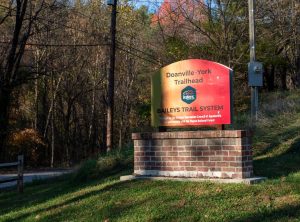
ORCA Director Jessie Powers warned after learning of the proposed funding cut that the cut could essentially collapse the organization that manages the Baileys Trail System.
Without ORCA around, Powers previously told the Independent there would not be an entity to manage and maintain the Baileys Trail System, compromising the more than $9 million investment that allowed ORCA to create the 88-mile mountain biking trail system.
At an ORCA board meeting on Tuesday, June 23, Powers said ORCA had been focused on “getting messaging out around the recent budget amendment that was approved by the state legislature and finding out what options we may have available to us.”
She said ORCA had submitted letters to the governor’s office requesting a line-item veto, and that ORCA had encouraged stakeholders to do so, too. An email from ORCA and a social media post encouraged members of the public to contact the governor’s office.
ORCA’s partner, the Cincinnati Off-Road Alliance, encouraged their audience to request the line-item veto via social media and on its website. The organization said on its website that ORCA is “building a much larger outdoor recreation corridor, the kind of region that draws people out of Cincinnati to hit the trails.”
“Whatever way you like to get outside, this is the future of it in Southern Ohio, and ORCA is the organization stepping up to make it last,” the Cincinnati Off-Road Alliance webpage stated.
Powers said at the June 23 ORCA board meeting, “We’ve explained how this … funding is really a linchpin in our plans for long-term development and transitioning to a self-sustaining organization, as well as bringing in $2.6 million in federal cash investment” via Appalachian Regional Commission grants that were already submitted. A public records request for those grant applications had not been fulfilled by press time.
ORCA board member Jay Kline, a Buchtel Village Council member, said at the Juen 23 meeting that while he was at the Nelsonville Music Festival in his Baileys Trail System shirt, about a dozen people approached him to say they had contacted the governor’s office.
“I would say that you guys did all you could do,” Kline told Powers at the meeting.
According to ORCA’s grant agreement with the state, obtained via a public records request, ORCA plans to use the bulk of its state funding for operational and programming expenses. Roughly a third of the funding would go toward other services
Deliverables attached to the funding include maintenance and marketing of the Baileys Trail System and associated enterprises; the development of the Baileys Trail System Visitor Hub and the Baileys Buchtel-Snow Fork trailhead; applying as a partner for Appalachian Regional Commission funding “to support growth of Ohio’s outdoor recreation and tourism sectors;” and initiating and completing strategic organizational planning.
Powers emphasized the use of state funding to match Appalachian Regional Commission dollars in a previous interview with the Independent. She said the federal grants would “fund our organization for five years and help us establish earned revenue opportunities that would make ORCA self-sustaining and able to deliver on mission and vision long-term for the region and the state.”
At the June 23 board meeting, the ORCA board authorized Powers to offer a strategic partnerships director position to a current fellow at the organization, on the condition that state funding come through as anticipated.
ORCA Board Chair Tim Warren told the Independent he appreciated DeWine’s confidence that “we used the money responsibly, and we needed the money, and we had something going that we keep wanting to keep going.”
In addition to the proposed cut to ORCA in fiscal year 2027, HB 479 earmarked a new $1.3 million in fiscal year 2027 for Marietta College. Funding was to be channeled through the same Appalachia Assistance line-item that supports ORCA. The bill required that the Ohio Department of Development cancel $550,000 in “encumbrances from existing General Revenue Fund appropriations” before directing funding to Marietta College.
A representative of the Ohio Legislative Service Commission previously told the Independent it was unclear whether that line-item in the bill could ultimately strip additional funding from ORCA.
According to the disapproved language, DeWine vetoed the entirety of the section impacting the Appalachia Assistance line-item, including the funding allocated to Marietta College. However, in his veto message, DeWine said, “I am instructing the Ohio Department of Development to distribute the additional $550,000.00 in the Appalachia Assistance appropriation item to Marietta College.”
The total new funds earmarked to Marietta College via HB 479 were equal to $1.3 million, however, not just $550,000. A representative from the governor’s office did not respond to the Independent’s emailed request for clarification.
The proposed cut to ORCA via HB 479 came less than three months after Athens Mayor Steve Patterson withdrew the city of Athens from ORCA. Patterson’s withdrawal came the same day that lobbying firm Sunday Creek Horizons, which secured the threatened state investment in ORCA, declined a new contract with ORCA.
Warren told the Independent he felt the organization had been “stabbed in the back” by the funding cut proposed in HB 479. He declined to specify who he held responsible but added, “People that we thought was our friends and was with us, I don’t think they was with us.”
A representative of Sunday Creek Horizons previously denied any involvement in the decision to cut ORCA’s funding via HB 479.
Patterson told the Independent he did not speak with legislators regarding possible funding cuts.
For this story, the Independent reached out to on June 25 and did not hear back from Ohio District 30 Sen. Brian Chavez (R-Marietta), contacted by email, or Powers, contacted by phone call and text message.
The Independent will update this story as requests for comment are returned.
Ohio 94th House District Rep. Kevin Ritter (R-Marietta) declined via text message to comment on this story due to a situation in his family. Ritter said he would comment in the future.
A representative of the Governor’s Office of Appalachia declined to comment for this story.
Note: This article was updated around 2 p.m. Thursday, June 25 to include additional information. The story was updated again around 3:15 p.m. the same day to add comment from Tim Warren and Steve Patterson
